
 MeshLine
AI-Assisted Organic Growth without Hiring a Content Team
Scale with ai-assisted organic growth without hiring a content team—templates, tight briefs, editorial QA, internal links, and predictable refreshes drive.
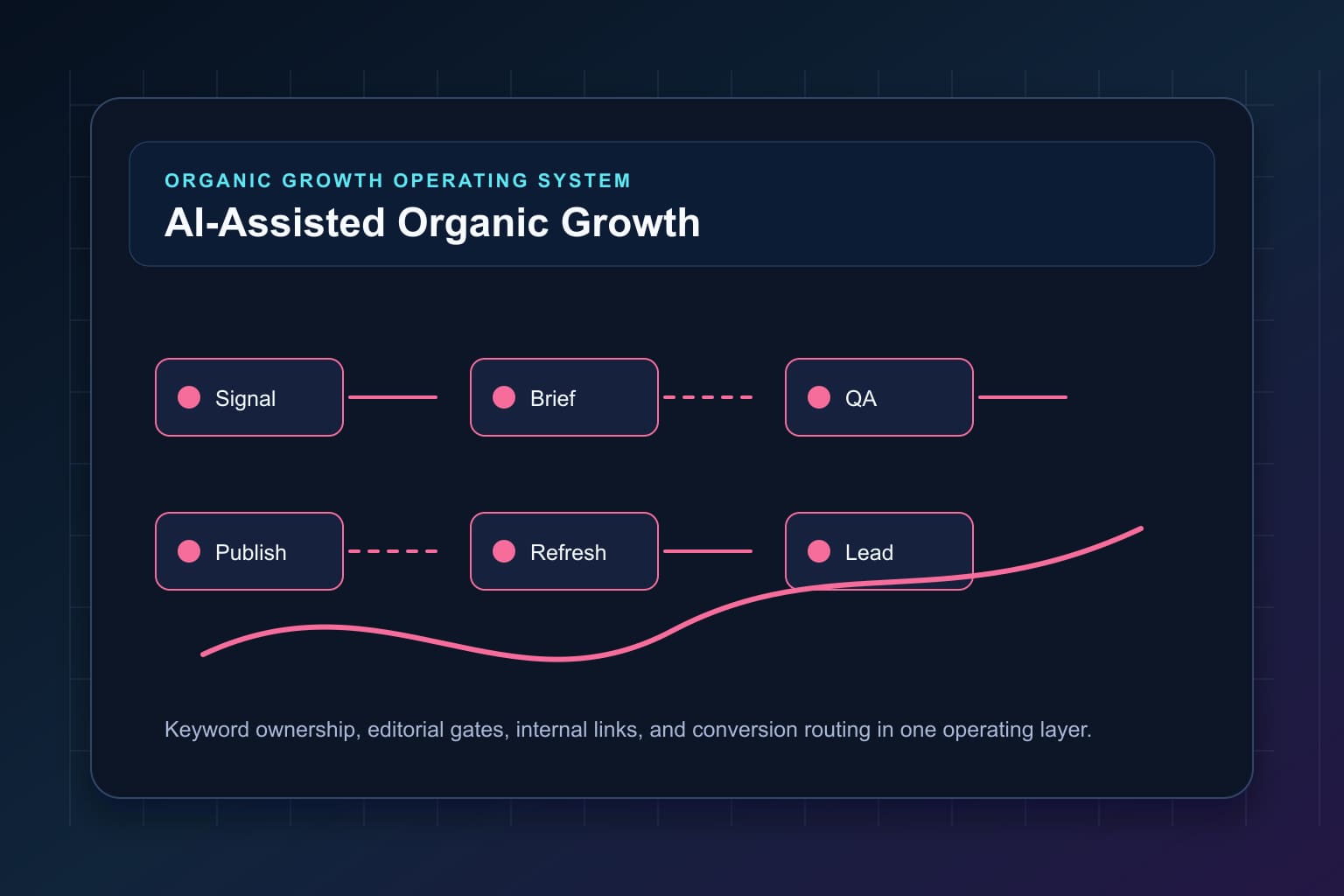
AI lets you generate drafts at scale, but volume is only useful when each page has a clear role, real examples, and somebody who knows when to push back. If you want ai-assisted organic growth without hiring a content team, the trade isn't "AI vs humans"—it's where you micro-invest human time to convert fast drafts into memorable pages that actually rank and convert.
The trap of speed: why output ≠ impact
Teams I work with spin up hundreds of AI drafts and end up with thin, repetitive pages that cannibalize each other. The cause isn't the model; it's missing constraints and examples. A 90-second draft is only valuable if the brief includes a target persona, one differentiating claim, and a concrete example or case study to ground the prose. Otherwise you get generic paragraphs and a headline that could be about any competitor.
Practical tradeoff: accept fewer pages that do different things. Ten distinct, well-targeted pages will beat thirty near-duplicates every time. That means spend your human minutes on positioning, examples, and distribution planning instead of rewriting every opening paragraph.
Templates and briefs that preserve editorial judgment
Create lightweight templates that force the right inputs. Each template should include: audience (job title, level, intent), one unique selling idea, two examples (numbers, quotes, or scenarios), and the preferred URL intent (compare, how-to, landing). Use those fields to seed the AI prompt so drafts come out with relevant detail.

Example template fields:
- Audience: Head of Product at a seed-stage startup, evaluating analytics tools.
- Unique idea: Our SDK sends event topology instead of raw events — reduces instrumentation time by 40%.
- Example: A 6-week integration for a two-engineer mobile team at Acme Health.
When you enforce these inputs, you preserve editorial judgment in a compact, repeatable way. That’s the difference between a thousand undifferentiated pages and a scalable library of useful assets.
Lightweight QA: what to check (and skip)
Quality doesn't require hours—just a checklist aimed at the next human reader. A two-minute pass should confirm:
- The page speaks to the named audience and their goals.
- The unique idea appears up front and is repeated in at least one section with an example.
- Headings reflect user intent and contain the target keyword naturally.
- Internal links point to one logical home page (avoid pointing to many competing pages).
Skip micro-editing every sentence. Let the AI handle copy smoothing. Humans add judgment where it matters: claims, examples, framing, and link decisions.
Prioritization: where to spend human time
Not every page is equal. Use simple signals to prioritize human review and promotion: search volume + conversion potential + content gap severity. For early-stage products, prioritize pages that answer direct purchase intent or reduce onboarding friction (e.g., integrations, pricing comparisons, case studies).
Example prioritization ladder:
- Conversion intent pages (pricing, features tied to purchase signals) — full human review.
- High-volume informational pages with differentiation potential — targeted human edits and a link plan.
- Long-tail or low-value pages — publish-as-is with an automated refresh schedule.
This lets you get result-driving pages polished while still publishing volume where it helps discovery.
Internal linking and ownership, practically
Internal linking is a force multiplier but it needs ownership. Assign an owner per topic cluster who decides the hub page and which supporting pages link to it. The owner doesn't need to be a full-time editor; it can be a product or growth lead who signs off on the hub structure and a handful of high-priority links.
A simple rule: each cluster has one canonical page that earns the most internal link equity. All supporting AI-generated pages should link to that canonical page with an explanatory anchor (not just keyword stuffing). That reduces cannibalization and makes promotion decisions straightforward.
If you want tools to automate internal linking and monitor cluster health, see the Organic Marketing Engine to reduce manual bookkeeping and keep link maps consistent across hundreds of pages. (/products/organic-marketing-engine)
Measurable refreshes and experiment windows
Published AI content shouldn't be "set and forget." Set explicit experiment windows: measure a page for 6–8 weeks before deciding to refresh, rewrite, or decommission. Track traffic, click-through rate, and a single engagement metric tied to your goal (demo requests, signups, leads).
If a page underperforms but shows intent signals, schedule a targeted refresh: tighten the brief, add one real example, and improve internal links. Maintain a simple cadence—quarterly for high-value clusters, semi-annually for long-tail pages.
Automation vs bespoke: how to split work
You can automate draft generation, meta tags, and basic schema, while humans focus on the high-leverage pieces: case studies, comparisons, and frameworks. If you want external help wiring that together without hiring more headcount, consider a partner that handles orchestration and execution. Meshline offers marketing automation services that plug into existing teams and set up the right mix of AI and human review without adding full-time hires. (/services/marketing-automation-services-for-organic-growth-teams)
Putting it together: an example two-week sprint
Week 1: Populate templates for 6 prioritized pages, include audience, one unique idea, and examples. Auto-generate drafts and push them to staging.
Week 2: Human review for top 2 pages (claims, examples, links), light QA on remaining 4, schedule internal links, and publish. Start a 6-week performance window and tag pages for refresh cadence.
Repeat with learnings: swap out prompts, refine templates, and codify what makes a 'good' example for your product.
Meshline’s viewpoint (practical and lean)
AI should reduce the time to experiment, not replace judgment. The right model plus a few quality controls gives you speed and signal: fewer, stronger pages that grow steadily. If your goal is ai-assisted organic growth without hiring a content team, design for where humans add the most leverage—positioning, examples, and link strategy—and automate everything else.
If you’d like to see a demo of how these pieces fit together in practice, book a Meshline demo and we’ll show a repeatable workflow that scales with your current team. (/contact)
For more operational reads and case studies on scaling organic systems, visit the Meshline blog or consult the glossary for terms we use here. (/blog) (/glossary)
Keep Building the System
For AI-Assisted Organic Growth without Hiring a Content Team, if this is the workflow your team is trying to clean up, the next useful move is to connect the article's ideas to the operating layer behind it. Start with Organic Marketing Engine, Marketing Automation Services, Meshline blog, then use the demo path when you are ready to map the handoffs around your own growth system.
Practical operating checks
In AI-Assisted Organic Growth without Hiring a Content Team, use this section to turn the workflow automation idea into a visible operating decision. The goal is to make the next handoff obvious before volume increases.
Monday morning diagnostic
For AI-Assisted Organic Growth without Hiring a Content Team, start by checking the last five examples where the workflow stalled. Write down the trigger, the source system, the owner, the next action, and the moment the customer or lead received a response. If one of those fields is missing, the workflow is relying on memory.
First workflow to tighten
For AI-Assisted Organic Growth without Hiring a Content Team, step 1 is to choose one handoff and make it measurable. For example, define what should happen when a qualified lead arrives, when a content brief is approved, when a CRM record changes, or when a reconciliation exception appears. The smaller the first rule, the easier it is to prove.
Checklist before you scale
- For AI-Assisted Organic Growth without Hiring a Content Team, Confirm the page or workflow has one owner.
- For AI-Assisted Organic Growth without Hiring a Content Team, Confirm the source system and destination system agree on the key fields.
- For AI-Assisted Organic Growth without Hiring a Content Team, Add one quality check that catches bad data before it reaches a reader, lead, or customer.
- For AI-Assisted Organic Growth without Hiring a Content Team, Add one relevant Meshline resource link that helps the reader take the next step.
- For AI-Assisted Organic Growth without Hiring a Content Team, Review the result after seven days and improve the rule before adding more volume.
Related Meshline resources
Use AI-Assisted Organic Growth without Hiring a Content Team with Organic Marketing Engine, Revenue Intel Module, Meshline glossary, and Book a Meshline demo when you want the workflow to connect back to pipeline instead of stopping at planning.