
 MeshLine
AI SEO Workflow: From Search Intent to Reviewed Article
Move from search intent to a focused SEO brief, an AI-assisted draft, and a reviewed article with evidence checks and clear editorial ownership.
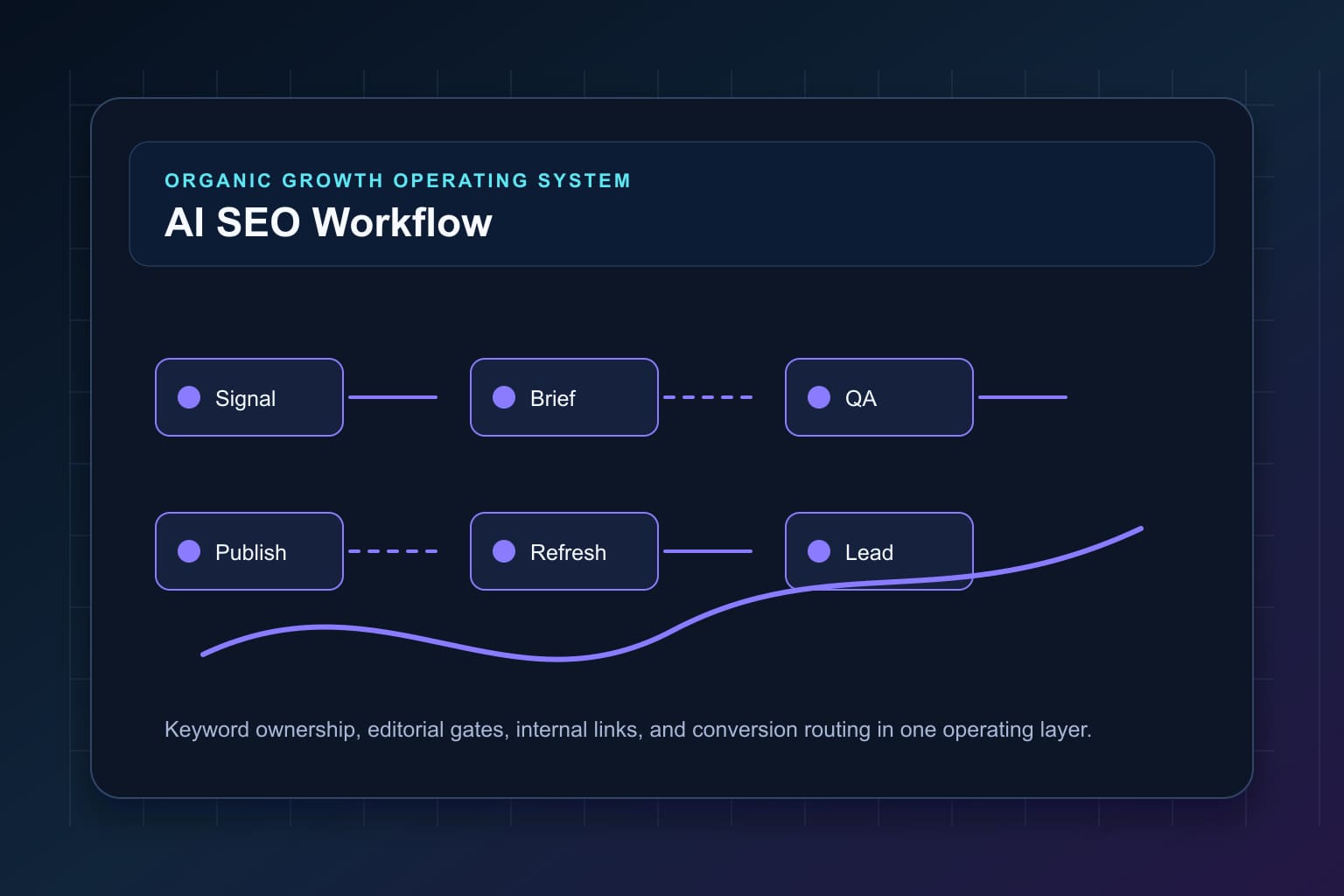
AI lets teams produce first drafts at scale, but speed without structure produces shallow pages. The real advantage is repeatability: a clear, repeatable AI SEO workflow from what the searcher is trying to solve to reviewed article that encodes positioning, examples, and editorial judgment so each page earns traffic and converts visitors.
Start from the user intent, not the keyword
Begin with the question a real searcher is asking. Is the query transactional, investigational, or navigational? Translate that into the page’s job — educate, compare, or convert. Example: for the query "best onboarding software for startups" the intent is comparison+evaluation. The page job is to shortlist tools, highlight tradeoffs for early-stage teams, and push to a lightweight demo request or checklist download.
A brief that lists intent, target audience, and one clear micro-conversion (email capture, demo, trial) will keep AI output focused. Anchor the brief with two short examples of what you want to see: a 40-word product positioning statement and a 3-point comparison table header. Those concrete anchors prevent generic intros and boost usable output.
Craft prompts that contain examples and constraints
Prompts that say "write a good intro" produce generic intros. Instead, give constraints and examples. For the onboarding example, tell the model: "Write a 70–90 word intro aimed at founders at Series A who care about speed and low cost. Use the phrase 'time-to-value' once; include a one-line hook that compares setup time to cost."

Include structural instructions: headings to include (TL;DR, When to choose, Pros/Cons, Pricing signals), a required H2 for 'When to choose this', and a short bulleted comparison. That keeps the draft aligned with what the searcher is trying to solve and helps reviewers scan for gaps.
Produce a scaffolded draft, not a polished page
Ask AI to output a scaffold: title, meta, outline, 3 variant intros, a 600–900 word draft split into labeled sections, and a 4-row comparison table. Scaffolds are easier for humans to edit than polished longform. They show where examples, quotes, or data points are needed and make review faster.
Tradeoff: scaffolds require one more step but save reviewer time because reviewers edit chunks instead of rewriting. If you automate scaffolding across dozens of pages, you get consistent structure and predictable review effort.
Human review checklist (practical, short, and actionable)
Create a one-page checklist reviewers can run in 3–7 minutes:
- Intent match: does the intro answer the user's question in one line?
- Positioning: is the product or company position stated and differentiated?
- Examples & specifics: are there at least two concrete examples, metrics, or use cases?
- Conversion hook: is a clear micro-conversion present within first 300 words?
- Accuracy: any claims needing citations or quotes?
- Internal links: three contextual links to relevant pillar pages or product pages.
Make reviewers highlight missing examples and add a 'must-add' comment rather than rewrite large sections. Small, specific edits maintain the original voice while ensuring the AI output is useful.
Use structured internal links and product signals
Linking is not just SEO hygiene — it signals product depth and intent. For product-led content, include contextual links to your core tools like the Organic Marketing Engine when you reference processes that the product automates. When describing automation of content workflows, reference relevant services like our Marketing Automation Services for teams that need implementation help. And keep a short list of canonical resources readers will find useful, such as the Meshline blog and Meshline glossary.
Concrete rule: every decision-stage page should link to a single primary product page and one supporting resource. That keeps funnel paths simple and measurable.
Measure results and set refresh triggers
Track three KPIs per page: organic sessions from targeted queries, engagement (time on page or scroll depth), and conversion rate on the micro-conversion. If sessions trend down for a page that previously ranked, refresh the page within 4–8 weeks — fix examples, update product signals, and add a fresh case study. If engagement is low but traffic is steady, test new hooks or move the micro-conversion higher in the page.
Operational tip: keep a lightweight list of pages that require regular content refreshes tied to product changes or seasonal demand. Automate reminders where possible and batch edits by page type.
Example workflow in practice (30–90 minute cadence per article)
1) 10–20 minutes: brief creation — intent, audience, conversion, two example snippets.
2) 5–10 minutes: prompt and scaffold generation with AI.
3) 15–40 minutes: reviewer runs checklist, inserts examples, tightens positioning.
4) 5–10 minutes: QA — links, meta, and publish.
This cadence keeps each article lean and reviewable without creating review bottlenecks.
Decision-stage next step
If you want to turn this into repeatable infrastructure for your team, we can show you templates and automations that enforce these checks while keeping throughput high — book a quick demo to see a working example and the publish pipeline in action: Book a Meshline demo.
AI reduces time-to-first-draft. The multiplier comes from adding human taste: precise briefs, example-driven prompts, and a tight, checklist-based review. That combination produces pages that searchers value and teams can scale without adding headcount.
Practical operating checks
In AI SEO Workflow: From Search Intent to Reviewed Article, use this section to turn the workflow automation idea into a visible operating decision. The goal is to make the next handoff obvious before volume increases.
Monday morning diagnostic
For AI SEO Workflow: From Search Intent to Reviewed Article, start by checking the last five examples where the workflow stalled. Write down the trigger, the source system, the owner, the next action, and the moment the customer or lead received a response. If one of those fields is missing, the workflow is relying on memory.
First workflow to tighten
For AI SEO Workflow: From Search Intent to Reviewed Article, step 1 is to choose one handoff and make it measurable. For example, define what should happen when a qualified lead arrives, when a content brief is approved, when a CRM record changes, or when a reconciliation exception appears. The smaller the first rule, the easier it is to prove.
Checklist before you scale
- For AI SEO Workflow: From Search Intent to Reviewed Article, Confirm the page or workflow has one owner.
- For AI SEO Workflow: From Search Intent to Reviewed Article, Confirm the source system and destination system agree on the key fields.
- For AI SEO Workflow: From Search Intent to Reviewed Article, Add one quality check that catches bad data before it reaches a reader, lead, or customer.
- For AI SEO Workflow: From Search Intent to Reviewed Article, Add one relevant Meshline resource link that helps the reader take the next step.
- For AI SEO Workflow: From Search Intent to Reviewed Article, Review the result after seven days and improve the rule before adding more volume.
Useful references
- For AI SEO Workflow: From Search Intent to Reviewed Article, Google Search Central documentation
- For AI SEO Workflow: From Search Intent to Reviewed Article, Google Search Console Help
- For AI SEO Workflow: From Search Intent to Reviewed Article, Google Analytics Help