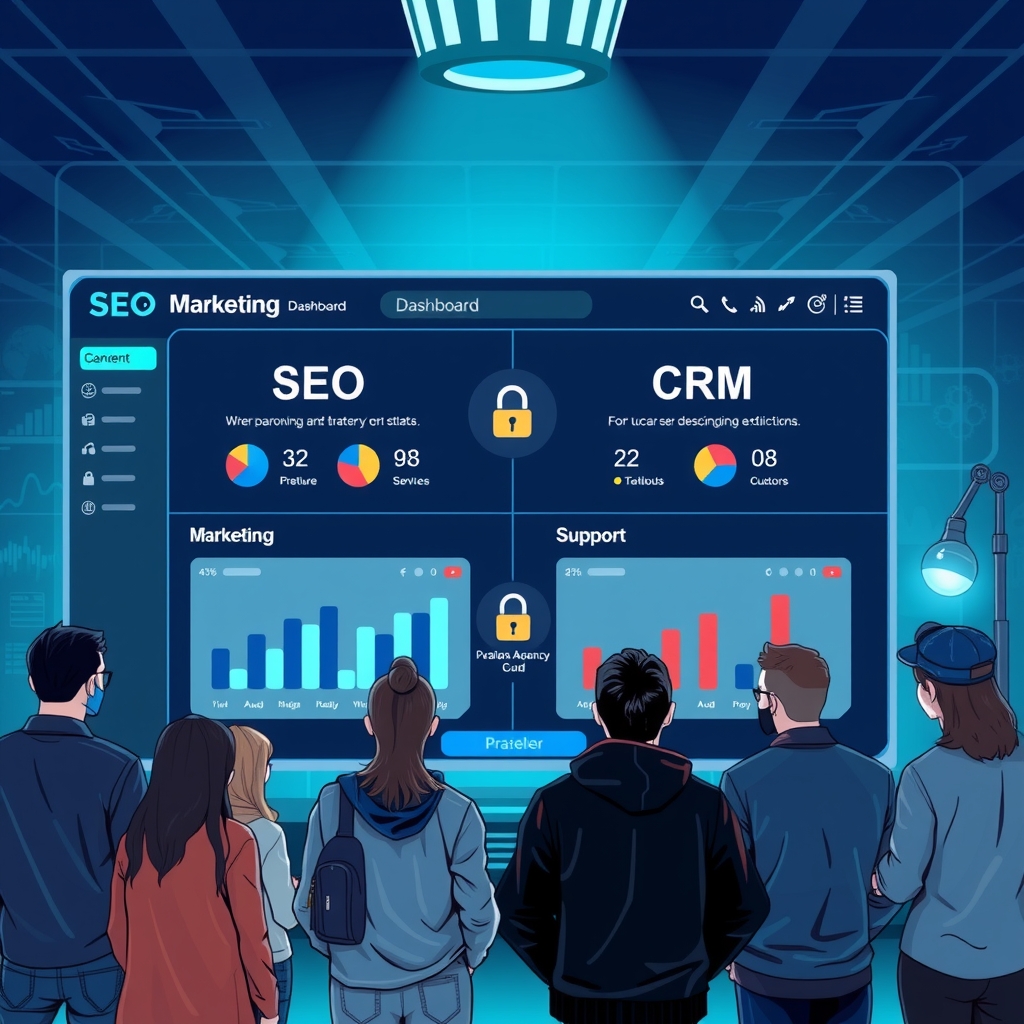
Agency leaders are tired of the “vendor jungle”: separate contracts for SEO, paid‑media platforms, a CRM, and a help‑desk solution. The constant hand‑offs create data silos, slow decision‑making, and hidden costs that erode profit margins. What if a single autonomous platform could execute the same tasks—plus more—while keeping security and governance front‑and‑center? Meshline’s Autonomous Operations Engine does exactly that, turning a patchwork stack into a unified, AI‑driven workflow hub.
What “Autonomous Operations” Means for an Agency
In the context of digital growth, autonomous operations refer to AI‑orchestrated processes that run end‑to‑end without manual intervention, yet remain transparent and auditable. Meshline builds its engine on the NIST Cybersecurity Framework, which defines five core functions—Identify, Protect, Detect, Respond, Recover. By mapping every workflow to these functions, Meshline ensures that automation is not a black box but a risk‑aware, controllable system.
The Four Pillars Meshline Replaces
Each pillar of a typical agency stack is covered by a dedicated autonomous module that aligns with industry‑standard best practices.
1. SEO – Guided by Google’s Recommendations
Google’s SEO Starter Guide stresses a clear site architecture, consistent metadata, and ongoing content optimization. Meshline’s SEO engine automatically:
- Analyzes new content for target keywords and semantic relevance.
- Generates structured data (JSON‑LD) and meta tags that match Google’s guidelines.
- Schedules internal linking updates to preserve site hierarchy.
- Monitors ranking signals and triggers corrective actions when performance dips.
2. Marketing – AI‑Powered Campaign Execution
Modern marketing demands rapid iteration. Meshline pulls audience insights, allocates budget, and optimizes pacing across channels—all in real time. The platform can:
- Ingest UTM parameters from paid‑social ads.
- Auto‑segment audiences based on behavior and intent.
- Launch split‑tests and reallocate spend to the highest‑ROI creatives.
3. CRM – A HubSpot‑Style Unified Data Layer
HubSpot defines a CRM as “a central place to store contact data, track interactions, and automate nurturing sequences” (HubSpot CRM product page). Meshline does not replace HubSpot; it sits on top, creating a relational data model that:
- Synchronizes contact records via native APIs.
- Enriches leads with AI‑derived intent scores.
- Triggers multi‑step nurture workflows without manual list uploads.
4. Support – Zendesk‑Inspired Ticket Routing
Effective support hinges on “timely, personalized responses” (Zendesk blog). Meshline’s support module:
- Analyzes ticket sentiment and context using natural‑language processing.
- Matches queries to a knowledge‑base for instant resolution.
- Escalates only the truly complex cases to human agents, preserving service quality while reducing volume.
Step‑by‑Step Flow: From Creation to Conversion
The following narrative shows how a creator’s new video moves through Meshline’s autonomous pipeline, delivering SEO‑ready metadata, a marketing boost, a qualified lead, and a support safety net—all without the creator leaving the studio.
- Upload & Parse – The creator drops a video file into the publishing platform. Meshline’s ingestion service extracts the title, description, and transcript.
- SEO Generation – Using the Google guide as a rule set, the engine auto‑creates an optimized
<title>,<meta description>, and JSON‑LD schema. These are pushed back to the CMS via API. - Marketing Activation – The system tags the video with relevant keywords, generates UTM‑enabled social snippets, and schedules a paid‑social burst. Real‑time performance data feeds back into the budget optimizer.
- CRM Enrichment – Viewers who click the UTM links are captured as leads. Meshline enriches each lead with an intent score and adds it to the HubSpot‑style contact hub, automatically enrolling them in a nurture track that offers a related ebook.
- Support Readiness – If a viewer submits a help request (e.g., “Why is the video not playing on mobile?”), Meshline assesses sentiment, pulls the relevant knowledge article, and either resolves the ticket instantly or routes it to a support specialist with full context.
- Security Checkpoint – Before any workflow executes, Meshline runs a compliance audit against the NIST “Identify” and “Protect” functions, confirming that data handling meets the agency’s risk policies.
Concrete Workflows & Trade‑offs
Below is a side‑by‑side comparison of the traditional manual approach versus Meshline’s autonomous flow for each pillar. The table highlights time savings, error reduction, and the primary trade‑off agencies must manage.
| Process | Manual Stack | Meshline Autonomous | Key Trade‑off |
|---|---|---|---|
| SEO metadata creation | Content team drafts tags; SEO specialist reviews (2‑3 hrs per asset) | AI generates tags instantly; human audit optional (minutes) | Potential over‑reliance on AI; mitigated by periodic audits. |
| Paid‑media budgeting | Spreadsheet modeling; manual bid adjustments (daily) | Real‑time budget optimizer reallocates spend (seconds) | Loss of manual control; mitigated by guardrails and spend caps. |
| Lead import to CRM | Export CSV, clean data, import (30‑60 min per campaign) | API sync with AI enrichment (instant) | Data mapping errors; mitigated by schema validation. |
| Support ticket triage | Agent reads, categorizes, assigns (average 5 min/ticket) | NLP routes or resolves automatically (sub‑minute) | Complex queries may be mis‑routed; mitigated by escalation thresholds. |
Implementation Roadmap: From Assessment to Full Rollout
Deploying an autonomous platform is a strategic project, not a quick plug‑in. Follow these six phases to ensure a smooth transition.
Phase 1 – Business Assessment
- Map existing tools (SEO, ad platforms, CRM, help desk) and data flows.
- Identify high‑impact bottlenecks (e.g., duplicate data entry, delayed reporting).
- Define success metrics: reduction in manual hours, increase in qualified leads, ticket resolution time.
Phase 2 – Data Architecture Design
- Create a unified relational model that aligns with Meshline’s data layer.
- Document field mappings for each source system (e.g., HubSpot contact ID ↔ Meshline lead ID).
- Set up a secure data lake for raw event logs to support AI training.
Phase 3 – API Integration & Connector Build
- Leverage native Meshline connectors for Google Search Console, Facebook Ads, HubSpot CRM, and Zendesk.
- Configure OAuth scopes and webhook endpoints.
- Run end‑to‑end tests to verify data fidelity.
Phase 4 – AI Model Calibration
- Train the SEO engine on existing high‑performing pages using Google’s best‑practice signals.
- Fine‑tune the lead‑scoring model with historical conversion data.
- Validate support NLU intents against a sample of past tickets.
Phase 5 – Governance & Security Hardening
- Map each workflow to the NIST Framework functions: Identify assets, Protect data (encryption, RBAC), Detect anomalies, Respond with automated alerts, Recover with audit logs.
- Enable role‑based access controls so only authorized operators can modify AI thresholds.
- Schedule quarterly risk assessments and compliance reports.
Phase 6 – Pilot, Iterate, Scale
- Run a pilot with a single creator or client segment for 30 days.
- Collect quantitative metrics (time saved, error rate) and qualitative feedback.
- Iterate on AI rules and governance policies before agency‑wide rollout.
Real‑World Example: Indie Podcast Network Grows 45 % in Six Months
SoundWave Studios, an indie podcast network with three shows, adopted Meshline in Q1 2024. Their prior stack consisted of:
- Manual SEO spreadsheet for episode titles.
- Separate Facebook Ads manager.
- HubSpot CRM with manual lead imports.
- Zendesk for listener support.
After implementing Meshline’s autonomous pipeline:
- Episode metadata was generated in under 30 seconds, cutting prep time from 2 hours to 5 minutes.
- AI‑driven ad pacing increased click‑through rates by 18 % while staying within a $5,000 monthly budget.
- Lead enrichment added an average intent score of 0.73, improving email open rates from 22 % to 34 %.
- Support tickets resolved instantly 62 % of the time; the remaining tickets saw a 40 % reduction in handling time.
- Overall operational headcount required for growth tasks dropped from five full‑time equivalents to two, freeing resources for content creation.
Crucially, each automated decision was logged against the NIST “Detect” and “Respond” functions, giving the agency a clear audit trail for compliance audits.
Anticipated Objections & Evidence‑Based Rebuttals
| Objection | Evidence‑Based Rebuttal |
|---|---|
| Automation will make my SEO feel generic. | Meshline follows Google’s structured‑data guidelines, ensuring each page retains the nuanced signals that search algorithms reward (Google SEO Starter Guide). |
| Our CRM is already tied to HubSpot; switching is risky. | Meshline layers a unified data model on top of existing HubSpot APIs, preserving all contact history while adding autonomous enrichment—no data loss, just added capability. |
| Support bots can’t handle complex queries. | The system first triages using Zendesk’s proven skill‑set framework; only truly complex tickets are handed to human agents, preserving quality while reducing volume (Zendesk blog). |
| I’m not comfortable giving a platform control over security. | Meshline’s architecture is mapped to the NIST Framework, providing transparent risk assessments and audit trails for every automated decision (NIST Cybersecurity Framework). |
Operator Checklist: Ready to Deploy Autonomous Operations?
Use this concise checklist to verify that your agency is prepared for a Meshline rollout.
- Stakeholder Alignment
- Executive sponsor signed off on budget and risk policy.
- Team leads (SEO, Paid Media, CRM, Support) have defined success metrics.
- Data Mapping Completed
- All source fields mapped to Meshline’s unified schema.
- Data validation scripts run without errors.
- API Connections Tested
- OAuth tokens refreshed and stored securely.
- Webhook callbacks confirmed for real‑time events.
- AI Models Tuned
- SEO tag generator benchmarked against 10 high‑performing pages.
- Lead‑scoring model reviewed for bias.
- Support NLU intents verified with a sample set of tickets.
- Governance Controls Enabled
- RBAC roles assigned (Operator, Auditor, Admin).
- Spend caps and escalation thresholds configured.
- Audit logging turned on for all workflow executions.
- Pilot Launched
- 30‑day pilot with defined KPIs.
- Feedback loop established for continuous improvement.
- Full Rollout Plan Approved
- Training schedule for all operators.
- Documentation repository populated with SOPs.
- Support escalation matrix updated.
Bottom Line: One Platform, Unlimited Growth
By consolidating SEO, marketing, CRM, and support into a single autonomous engine, agencies eliminate the coordination overhead that eats profit and stifles creativity. Meshline’s AI respects the best‑practice standards set by Google, HubSpot, Zendesk, and NIST, delivering a secure, data‑unified environment where creators stay in the studio and agencies run a lean, scalable operation.
Ready to see Meshline in action? Request a live demo of the autonomous dashboard and discover how your agency can replace fragmented vendors with a single, risk‑aware platform that drives growth without adding headcount.