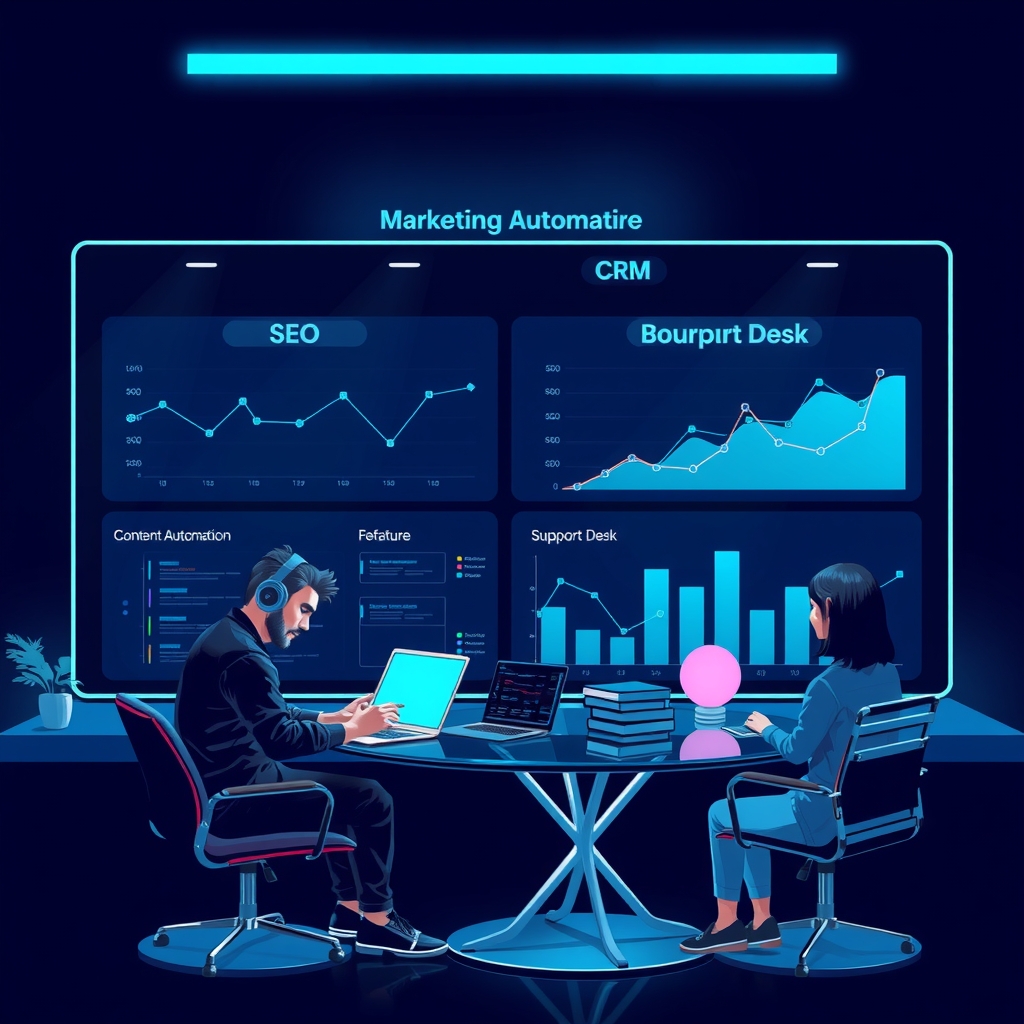
When a creator says, “I’m spending more time chasing invoices than recording,” the problem is rarely a lack of talent—it’s a fragmented tech stack. Boutique agencies feel the same pressure: multiple vendor contracts, overlapping reports, and data silos that turn every client update into a relay race. Meshline’s autonomous operations platform was built to end that relay, consolidating SEO, marketing, CRM, and support into a single, intelligent hub that works *for* the creator and *with* the agency.
The Hidden Cost of Vendor Juggling
Most agencies start with a best‑of‑breed mindset: a specialist SEO firm, a separate email‑marketing tool, a third‑party CRM, and an outsourced help‑desk. On paper that looks optimal, but in practice it creates three core losses:
- Time drain: Account managers spend hours each week syncing data, reconciling invoices, and chasing status reports.
- Data fragmentation: Campaign metrics live in analytics platforms, contact histories sit in a CRM, and support tickets are stored in a ticketing system, making holistic insight a guessing game.
- Security exposure: Each integration point is a potential breach, and compliance audits become a nightmare of disparate policies.
These inefficiencies directly eat into the creative bandwidth that creators need to produce content, and they erode the profitability that agency operators strive to protect.
Why Autonomy Matters Across the Stack
Autonomous operations do more than automate—they enforce the industry‑standard best practices that underpin every successful digital business.
SEO Foundations Remain Critical
Google’s SEO Starter Guide outlines timeless principles: keyword relevance, logical site architecture, and structured data. An autonomous SEO engine can apply those rules at scale, ensuring every new page or podcast episode is optimised without manual checklist work.
Centralised CRM Drives Pipeline Visibility
HubSpot’s CRM demonstrates that a single source of truth for contacts reduces manual entry and improves sales forecasting. Meshline’s CRM module mirrors that capability, automatically enriching leads from marketing campaigns and syncing interaction history from support tickets.
Consistent Customer‑Service Skills
By routing every support request through a unified inbox, Meshline equips agents with the same knowledge base and response templates, preserving the human empathy that creators value.
Security Built on the NIST Framework
Any autonomous workflow must be secure by design. Meshline aligns its data‑handling processes with the NIST Cybersecurity Framework, covering identify, protect, detect, respond, and recover stages for every module. This reduces the attack surface that typically grows with multiple SaaS integrations.
Meshline’s Unified Autonomous Hub
Meshline consolidates four traditionally separate functions into one platform. Each module runs on an AI‑driven rule engine that can be customised per client, per campaign, or per content type.
| Module | Core Capability | Autonomous Action | Benefit for Creators & Agencies |
|---|---|---|---|
| SEO Engine | Keyword research, on‑page optimisation, schema markup | Auto‑generates SEO‑rich titles, meta descriptions, and structured data for every new asset | Eliminates manual optimisation, guarantees search‑engine compliance |
| Marketing Automation | Email campaigns, social scheduling, paid‑media sync | Triggers newsletters, posts, and ad‑budget adjustments based on content calendar events | Reduces campaign lag, aligns promotion with publishing cadence |
| CRM | Lead capture, contact enrichment, pipeline tracking | Ingests form submissions, tags leads with content‑interest signals, updates deal stages automatically | Provides a 360° view of audience interaction without duplicate entry |
| Support Desk | Ticket routing, knowledge‑base access, SLA monitoring | Routes listener or customer queries to the appropriate agent, attaches relevant CRM context, escalates per SLA rules | Preserves empathy while handling volume, improves first‑contact resolution |
Concrete Workflow: The Creator‑First Podcast
Consider a weekly video‑podcast host who releases an episode every Tuesday. Her pre‑launch checklist traditionally looked like this:
- Export audio and upload to a hosting platform.
- Manually write SEO‑rich show notes and submit to a freelance writer.
- Copy‑paste episode link into an email‑marketing tool.
- Log sponsor outreach in a spreadsheet.
- Monitor listener emails and social messages for support queries.
With Meshline, the workflow collapses into three autonomous steps:
- Upload: The creator drops the raw episode file into Meshline’s Media Hub. The platform instantly extracts a transcript, identifies high‑value keywords, and generates SEO‑optimised show notes.
- Publish & Promote: Meshline schedules the episode on all podcast platforms, auto‑creates a newsletter blast, and pushes teaser posts to social accounts—all timed to the same release window.
- Engage & Support: Listener questions that land in email or social are automatically turned into tickets, enriched with episode context, and routed to the creator’s virtual assistant. Sponsor outreach is logged in the CRM, with follow‑up reminders set automatically.
The result? The creator spends her week recording, editing, and brainstorming new topics—no longer juggling admin tasks. Her audience receives timely, SEO‑friendly content, and sponsors see a transparent pipeline of engagement.
Agency‑Level Consolidation: A Boutique Digital Shop
Now look at a boutique agency handling a diverse client roster across e‑commerce, SaaS, and lifestyle brands. Their legacy stack involved multiple SEO firms, separate email‑marketing platforms, a distinct CRM, and an outsourced help‑desk. The operational overhead was staggering: many active contracts, weekly status calls, and a quarterly audit that required stitching together multiple dashboards.
The agency migrated to Meshline using the following high‑level steps:
- Discovery & Mapping: Catalog every vendor contract, data flow, and reporting cadence.
- Rule‑Engine Design: Define client‑specific SEO roadmaps (keyword clusters, schema templates), marketing triggers (launch dates, budget caps), CRM enrichment rules (lead source tagging), and support SLA parameters.
- Data Migration: Export existing contact lists, historical tickets, and SEO audit data; import into Meshline via secure CSV pipelines, applying NIST‑aligned encryption at rest.
- Parallel Run: Operate Meshline alongside legacy tools for a short period, validating data parity and performance benchmarks.
- Cut‑over & De‑commission: Cancel redundant contracts, consolidate billing, and train staff on the unified dashboard.
E‑Commerce Brand Scaling Example
An online retailer rapidly adding new product lines needs consistent SEO metadata, seamless lead capture, and responsive post‑purchase support. Meshline’s rule‑engine auto‑applies SEO tags to every new product page, enriches incoming leads in the CRM, and triggers support tickets for order issues. The brand experiences faster time‑to‑market for new SKUs and a support team that handles inquiries with full context, improving customer satisfaction without additional manual effort.
Trade‑offs: What You Gain and What You Lose
Consolidation is powerful, but it is not a zero‑cost decision. Understanding the trade‑offs helps agencies set realistic expectations.
What You Gain
- Operational simplicity: One contract, one invoice, one dashboard.
- Data coherence: Real‑time cross‑module insights (e.g., SEO traffic linked to CRM lead source).
- Scalable security: Uniform compliance posture across all functions.
- Creative bandwidth: Creators reclaim hours previously lost to admin.
What You Potentially Lose
- Specialised nuance: A boutique SEO firm may offer deep technical audits that a generic engine cannot replicate out‑of‑the‑box.
- Vendor‑specific integrations: Some legacy tools have proprietary APIs that may not map directly to Meshline’s rule engine.
- Initial learning curve: Teams must adapt to a new UI and workflow paradigm, which can temporarily dip productivity.
The key is to evaluate whether the efficiency gains outweigh the loss of hyper‑specialised features—a calculation most agencies find favourable after an initial adjustment period.
Implementation Blueprint: From Pilot to Full Roll‑out
Meshline recommends a phased approach to minimise disruption.
- Pilot Selection: Choose a low‑risk client or a single content vertical (e.g., a podcast series) to test the autonomous workflow.
- Configure Core Rules: Set up SEO templates, email cadence, lead‑scoring criteria, and support SLA thresholds.
- Integrate Existing Data: Use Meshline’s secure import wizard to bring in historical SEO reports, CRM contacts, and ticket archives.
- Run Parallel Monitoring: Compare Meshline’s output against legacy tools for accuracy and latency.
- Iterate & Optimise: Adjust rule parameters based on pilot feedback (e.g., tweak keyword density thresholds).
- Scale Across Clients: Replicate the refined rule set, customizing per client brand guidelines.
- De‑commission Redundant Vendors: Consolidate billing, archive contracts, and re‑allocate budget to content creation.
Throughout the rollout, Meshline’s onboarding team provides a dedicated security liaison to ensure every data‑transfer step satisfies NIST controls, and a product specialist to fine‑tune automation logic.
Addressing the Most Common Objections
| Objection | Underlying Concern | Meshline Response (Evidence‑Based) |
|---|---|---|
| “We already have best‑of‑breed tools.” | Fear of losing specialised functionality. | Meshline’s modules are built on the same standards highlighted in the Google SEO Starter Guide and HubSpot CRM, delivering core capabilities while adding orchestration. |
| “Switching will disrupt our workflow.” | Change‑management risk. | Migration follows the NIST Cybersecurity Framework steps—identify, protect, detect, respond, recover—preserving data integrity and continuity. |
| “Automation will make support feel cold.” | Concern about loss of human empathy. | Meshline routes tickets to human agents and equips them with the service‑skill playbooks championed by Zendesk, preserving personal touch while handling volume. |
| “We can’t afford another subscription.” | Budget pressure. | Consolidating multiple vendor contracts into one eliminates overlapping fees and reduces administrative overhead, freeing budget for creative initiatives. |
Operator Checklist: Ensuring a Smooth Transition
Before you hit “Go Live,” run through this quick audit:
- All client contracts have been inventoried and mapped to Meshline modules.
- SEO rule templates reflect the latest guidance from the Google SEO Starter Guide.
- CRM field mappings align with HubSpot’s recommended contact properties.
- Support ticket categories match the SLA matrix defined in your service handbook.
- Data imports are encrypted at rest and in transit per NIST guidelines.
- Staff have completed the Meshline onboarding sprint (UI basics + rule‑engine workshop).
- A parallel reporting window is scheduled to validate metric parity.
- A post‑launch de‑commission plan is documented, including vendor notice periods.
From Theory to Creative Freedom
When creators no longer have to chase invoices, draft SEO briefs, or triage support tickets, the quality of their output improves. When agencies replace a patchwork of contracts with a single accountable partner, they gain predictability, lower overhead, and a stronger data foundation for strategic decisions. Meshline’s autonomous operations platform is the bridge between those two worlds—a security‑first, standards‑aligned hub that lets creative talent focus on what they do best while giving operators the clarity they need to scale.
Take the Next Step
Ready to see how much creative time you can reclaim? Start a free pilot today, map your current vendor stack, and let Meshline’s autonomous engine do the heavy lifting. Your next episode, campaign, or product launch could be the first you run without ever leaving the creative zone.
Authoritative references for implementation
Use Google's SEO Starter Guide to ground search decisions, HubSpot's CRM overview to map the customer record, Zendesk's customer‑service guidance to define support quality, and the NIST Cybersecurity Framework to structure operational risk controls.