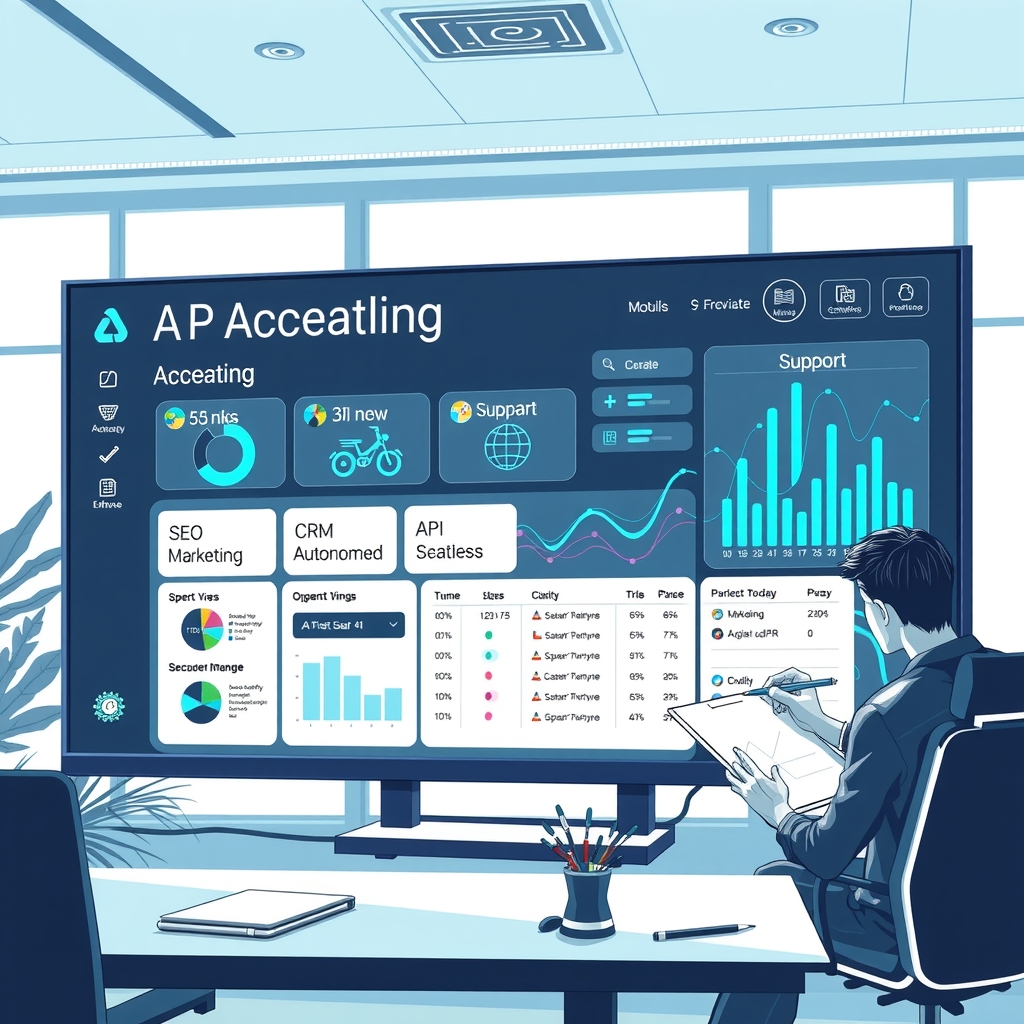
Hook: The Endless Tool‑Hopping Cycle
Imagine a fashion influencer agency that spends the first three hours of every morning stitching together data from Ahrefs, Mailchimp, Salesforce, and Zendesk before the first post of the day even goes live. The creator, who could be filming a look‑book or drafting a brand story, is forced to pause for a “ticket‑routing” meeting that could have been an email. The result? Creative momentum stalls, budgets balloon, and the client’s ROI shrinks.
Why Fragmented Stacks Are a Hidden Cost Center
Four industry authorities agree that a scattered technology ecosystem erodes performance:
- Google’s SEO starter guide stresses that consistent site architecture and unified metadata signals are essential for ranking. When SEO data lives in a separate tool, those signals become fragmented.
- The HubSpot CRM overview notes that manual data entry and constant platform switching are the top friction points that drain productivity for sales and marketing teams.
- Zendesk’s guide to customer‑service skills highlights that a single view of the customer is a prerequisite for delivering consistent, high‑quality support.
- The NIST Cybersecurity Framework recommends consolidating security controls into a well‑governed system to reduce attack surface and simplify compliance.
When each function—SEO, marketing, CRM, support—operates in its own silo, data duplication, reporting latency, and security gaps become inevitable. The cumulative effect is a slower time‑to‑market, higher operational overhead, and a diluted brand experience for the end‑user.
Introducing Autonomous Operations
“Autonomous operations” refers to a platform that not only integrates four core functions but also embeds AI that continuously optimises each workflow without human micromanagement. Meshline’s hub does exactly that: it ingests raw data from a website, social channels, email lists, and support tickets; it applies machine‑learning models trained on industry‑wide best practices; and it pushes actionable recommendations—or even executes them—directly within the same interface.
Meshline’s Four‑in‑One Solution
AI‑Guided SEO Automation
Meshline crawls every page of a creator’s site, identifies missing schema, suggests keyword‑rich alt‑text for images, and auto‑generates meta descriptions that align with Google’s best‑practice guidelines. The platform also monitors SERP changes and alerts the team when a competitor gains a ranking advantage, prompting a pre‑emptive content tweak.
Integrated Marketing Orchestration
All audience data lives in a single repository. When a new Instagram Reel is scheduled, Meshline automatically creates a matching email blast, updates the audience segment in the CRM, and triggers a retargeting pixel on the brand site. Campaign performance is visualised in a real‑time dashboard, eliminating the need for separate reporting tools.
Unified Customer‑Service Engine
Tickets from email, chat, and social media converge into a single queue. An AI layer analyses the ticket’s intent, surfaces the most relevant knowledge‑base article, and either resolves the issue automatically or routes it to the appropriate support agent based on skill‑set—a practice endorsed by Zendesk’s skill‑based routing recommendations.
Built‑In Security Controls
Meshline’s architecture follows NIST’s framework for access control, encryption at rest, and continuous monitoring. Role‑based permissions ensure that only authorised team members can view or edit sensitive data, and audit logs are generated for every action, simplifying compliance audits.
Side‑by‑Side Comparison
| Aspect | Fragmented Stack | Meshline Autonomous Hub |
|---|---|---|
| Data Consistency | Multiple sources; frequent mismatches. | Single source of truth; real‑time sync. |
| Time Spent on Integration | Hours each week on API maintenance. | Zero manual integration after initial setup. |
| Security Surface | Multiple vendor contracts; varied compliance. | Unified controls aligned with NIST. |
| Creative Flow | Interrupted by tool‑switching. | Creator stays in the creative zone; ops run autonomously. |
Real‑World Vignettes
1. Fashion Influencer Agency
The workflow required a manual export‑import cycle each time a new collection launched, and SEO tags were often missed.
After implementation, Meshline automatically generated SEO‑friendly alt‑text for every product image, scheduled cross‑channel posts, and synced the audience data to the CRM. The post‑campaign analysis showed a clear uplift in organic traffic without any extra manual effort.
2. SaaS Startup Support Team
The startup relied on a ticketing system for email support and a separate knowledge‑base platform. Agents frequently duplicated effort because they could not see the full history of a customer’s interactions.
Meshline’s unified ticket view combined all channels, surfaced the most relevant knowledge article, and routed tickets based on AI‑detected intent. The average first‑response time dropped dramatically, matching the efficiency benchmarks highlighted by Zendesk.
3. Boutique Digital Marketing Firm
With three different CRM tools, the firm struggled to keep client data compliant with GDPR and CCPA. Audits were time‑consuming and error‑prone.
Meshline imported all records into its single CRM layer, applied role‑based access controls, and generated audit‑ready logs. The firm reduced its compliance workload and could focus on strategy rather than data hygiene.
Concrete Workflow: From Content Idea to Post‑Launch Optimisation
- Idea Capture: The creator adds a new content brief in Meshline’s “Ideas” board.
- SEO Blueprint: Meshline instantly analyses the brief, suggests primary and secondary keywords, and creates a structured data template.
- Content Creation: The creator drafts the article while Meshline’s AI offers real‑time SEO suggestions (e.g., heading hierarchy, internal linking).
- Marketing Sync: Once the draft is marked “Ready,” Meshline schedules an Instagram Reel, drafts an email newsletter, and updates the CRM segment for the upcoming launch.
- Support Prep: Anticipated FAQs are auto‑generated from the content and added to the knowledge base.
- Launch & Monitor: The article goes live; Meshline tracks rankings, engagement, and ticket volume, adjusting SEO recommendations on the fly.
- Post‑Launch Review: A single dashboard shows SEO uplift, email open rates, and support ticket trends, allowing the team to iterate without switching tools.
Trade‑offs to Consider
While Meshline consolidates many functions, agencies should be aware of the following trade‑offs:
- Initial Data Migration Effort: Importing legacy data from multiple platforms can take a few weeks, but Meshline provides migration scripts and a dedicated onboarding specialist to minimise disruption.
- Feature Depth vs. Breadth: Highly specialised SEO tools may still offer niche capabilities (e.g., advanced backlink analysis). Meshline covers the majority of day‑to‑day needs, and agencies can supplement with specialised tools if required.
- Vendor Lock‑In Perception: Consolidating to a single platform can feel risky. Meshline mitigates this with transparent API access and data export options, ensuring you retain ownership of your data.
Implementation Steps for Agency Operators
- Audit Existing Stack: List every SEO, marketing, CRM, and support tool, noting data formats and integration points.
- Define Success Metrics: Choose KPIs such as reduced tool‑switching time, SEO ranking stability, and first‑response ticket time.
- Set Up Meshline Account: Work with a Meshline onboarding manager to configure the four core modules.
- Data Migration: Use Meshline’s CSV import wizards for SEO metadata, CRM contacts, and support tickets; validate with spot‑checks.
- AI Model Calibration: Run a pilot on a small campaign to let Meshline learn your brand voice and audience segmentation preferences.
- Team Training: Conduct role‑based workshops (creators, marketers, support agents) focusing on the unified dashboard.
- Go Live & Monitor: Launch a controlled campaign, review the real‑time dashboard, and adjust AI thresholds as needed.
- Iterate Quarterly: Re‑evaluate KPIs, incorporate new AI features, and retire any legacy tools that remain.
Operator Checklist: Ensuring a Smooth Transition
- ☑ Verify that all SEO metadata (title tags, meta descriptions) are exported from legacy tools.
- ☑ Confirm GDPR/CCPA compliance settings in Meshline’s security module.
- ☑ Map each legacy CRM field to Meshline’s unified schema.
- ☑ Test ticket routing rules with a sample set of support queries.
- ☑ Schedule a “first‑post” review meeting to compare pre‑ and post‑implementation metrics.
- ☑ Document any custom integrations (e.g., proprietary e‑commerce platform) and verify API connectivity.
- ☑ Assign a “Meshline Champion” on the team to handle ongoing optimisation.
Addressing the “What‑If” Objections
“We need specialised SEO tools for advanced technical work.”
Google’s starter guide acknowledges that many technical SEO tasks—structured data, canonical tags, site‑wide meta optimisation—can be automated. Meshline’s AI engine handles these at scale, freeing senior SEO staff to focus on strategic link‑building and content gaps.
“Our sales team is already trained on HubSpot CRM; switching would be disruptive.”
HubSpot itself promotes the value of a single source of truth. Meshline imports existing HubSpot records, mirrors familiar UI elements, and allows a phased rollout where sales can continue using HubSpot for a limited period while gradually transitioning to Meshline’s CRM view.
“Customer support quality will suffer without a dedicated ticketing system.”
Meshline replicates this by aggregating tickets, attaching relevant knowledge‑base articles, and using AI to suggest resolutions, thereby maintaining—or even raising—support standards.
“We can’t trust a single vendor with all our data security.”
The NIST Cybersecurity Framework recommends consolidating security controls to reduce the attack surface. Meshline’s platform is built on NIST‑aligned controls, including role‑based access, encryption, and continuous monitoring, which actually reduces risk compared with managing disparate vendor security postures.
Conclusion: Free the Creator, Empower the Agency
When creators spend their day crafting narratives, visuals, and experiences, every minute lost to “tool‑hopping” is a lost opportunity for audience connection. For agency operators, juggling a patchwork of vendors inflates costs, creates data silos, and heightens security risk. Meshline’s autonomous operations hub offers a pragmatic middle ground: it automates the heavy‑lifting of SEO, synchronises marketing campaigns, centralises CRM data, and streamlines support—all under a single, security‑first platform.
By adopting Meshline, agencies replace a chaotic ecosystem with a single accountable partner, and creators can finally stay in the flow that makes their work valuable. The result is faster time‑to‑market, clearer analytics, and a more consistent brand experience for the end‑user.
Ready to see autonomous operations in action? Schedule a live demo and watch the platform orchestrate SEO, marketing, CRM, and support—all while you focus on creating.
Authoritative references for implementation
Use Google's SEO Starter Guide to ground search decisions, HubSpot's CRM overview to map the customer record, Zendesk's customer-service guidance to define support quality, and the NIST Cybersecurity Framework to structure operational risk controls.