
 MeshLine
operational workflows Automation Guide for Founders
A decision-stage playbook for agency founders and operators: implement delivery exception automation by mapping triggers, owners, exception paths, authority references, and Meshline execution patterns. Includes sprinted implementation steps, QA checks, and a demo CTA to See the engine structure.
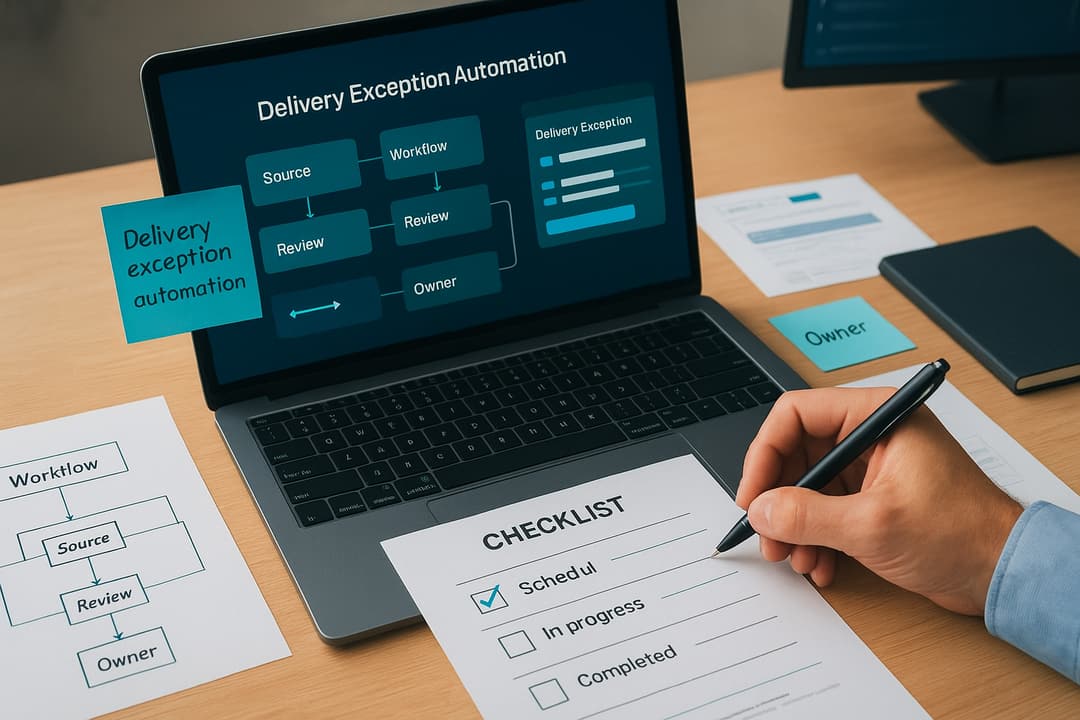
Delivery Exception Automation: Practical Workflow Guide for Agency Operators
Why this matters now (Search Console evidence and business outcome)
If your Google Search Console shows rising interest in the exact query "delivery exception automation," prioritize an execution-first page like this one. Meshline currently gets 25 impressions for the query with an average position of 6.32 — that indicates clear page-one potential but low CTR. Users searching this term want implementable workflows, not a definition. Doubling down converts impressions into demo requests and paid implementation conversations.
- Search Console signal: query = "delivery exception automation"; impressions = 25; avg position = 6.32. Use this post to close the intent gap and funnel operators toward implementation and demo-stage actions.
- Audience: agency founders, operations leads, and technical operators who must reduce MTTR, claims, and CX noise.
- Outcome: reduce manual triage, lower claims costs, and shorten resolution SLAs by routing exceptions to the right owners with automated plays.
Meshline should double down on this search signal because the current ranking page, Delivery Exception Automation Workflow Guide, already indexes for the query. This playbook strengthens that primary page by adding operational detail, sprinted steps, and a decision-stage CTA that drives a demo and implementation conversation.
What delivery exception automation means for operators
Delivery exception automation is not a single tool — it’s a repeatable operating pattern that converts ambiguous carrier statuses into deterministic remediation flows.
Triggers (what starts a flow)
Triggers are canonical events that must be standardized across carriers and internal systems. Examples:
- Carrier-provided status code: "Delivery Exception" or provider-specific exception code.
- Negative ETA delta beyond a threshold.
- Failed POD image ingestion or missing signature.
- Return-to-sender scan.
Operators must canonicalize these into an internal event model so automation behaves predictably.
Owners (who resolves it)
Owners are roles with explicit SLA windows and escalation rules. Typical owners:
- Customer Success (recipient issues)
- Carrier Liaison / Carrier Ops (carrier-at-fault)
- Trade Compliance (customs/document issues)
- Finance/Refunds (credit/chargeback decisions)
- Escalations / Director of Ops (overrides and major incidents)
Define primary and backup owners and encode escalation windows in the engine.
Exception paths (what automation does)
An exception path is a coded micro-workflow: validate evidence, attempt remediation, escalate on time-box.
Examples include:
- Auto-validate address → produce new label → schedule pickup.
- Auto-generate ETA update → schedule reattempt → notify customer.
- Auto-request customs docs → pause shipment → escalate to Trade Compliance if SLA missed.
Authority references (policy that drives decisions)
Every automation must reference a policy document: refund rules, SLA thresholds, insurance vs. carrier liability, and financial authority gates. Keep these as versioned policy artifacts accessible by the engine at runtime.
Meshline operating-layer framework (triggers, owners, paths, evidence)
This section maps the high-level concepts into the Meshline operating layer and shows what you should standardize across customers and lanes.
Canonical event model and ingestion
- Ingest all carrier tracking events into a message bus.
- Canonicalize carrier-specific codes to a small taxonomy (e.g., canonical_exception_pending, canonical_exception_resolved, canonical_pod_received).
- Record ingestion metadata (raw payload, carrier ID, event ID, timestamp) for audits.
Implement idempotency keys so duplicate carrier feeds don’t spawn duplicate cases.
Evidence bundle (immutable case record)
Every exception case must contain an evidence bundle: tracking history, POD images, attachments, owner notes, and decision receipts. The bundle is an immutable case file used for CX, finance, and compliance.
- Store PII with masking in logs and encrypted storage for attachments.
- Attach an audit trail for every automated decision (who/what/why/time).
Owner SLAs and escalation windows
Encode SLAs in the engine (owner, wait-time, next-owner) and enforce through automated escalations and notification channels (Slack, email, internal ticketing). Example:
- Customer Success owns recipient issues for the first 8 hours.
- After 8 hours, escalate to Carrier Liaison automatically.
- After 72 hours, escalate to Director of Ops.
Plays and safety gates
Design plays as composable micro-workflows with guardrails:
- Automated, low-risk plays (ETA updates, doc requests) run without human approval.
- Destructive or financial plays (refunds, cancellations) require explicit human sign-off when above thresholds.
Integrate authority references in each play so decisions reflect current policy.
Concrete use cases and runnable plays (implement this sprint)
Below are three high-impact plays you can implement quickly. Each includes triggers, checks, owners, and success metrics.
Use case: Wrong delivery address detected after label creation
- Trigger: carrier returns "Delivery Exception — Incorrect Address" or internal pre-load verification fails.
- Play steps:
- Pause shipment if still at pick/hold; mark case with priority.
- Route to Customer Success with a 4-hour SLA.
- Send SMS and email to recipient with quick-edit address flow.
- If address updated, auto-generate new label and schedule pickup; log cost centers.
- If no action in 48 hours, route to return-to-sender and flag finance for potential refund.
- Success metrics: first-pass resolution rate, time-to-redelivery, and cost-per-claim.
Use case: Out-for-delivery then "delivery exception" appears
- Trigger: last-mile scan changes from "Out for delivery" to "Delivery Exception".
- Play steps:
- Canonicalize exception reason via mapping table (e.g., weather, no driver, signature required).
- If carrier reason maps to reattempt, auto-schedule reattempt and notify customer with new ETA.
- If reason maps to recipient action, send SMS with redelivery options and capture response.
- Escalate to Carrier Liaison if no resolution in 12 hours.
- Success metrics: percentage resolved without manual intervention, customer opt-in rate for SMS actions.
Use case: International customs exception
- Trigger: carrier manifest mismatch or customs hold code.
- Play steps:
- Route to Trade Compliance; create a doc-request with a 24–72 hour SLA depending on country.
- Attach required forms to the case and notify the customer portal to upload documents.
- If documents received within SLA, resume transit; if not, cancel shipment and initiate refund/claim per policy.
- Success metrics: dwell time reduction in customs, avoided return-to-sender cases, and compliance exceptions per lane.
Implementation roadmap (four sprints)
Plan to implement delivery exception automation in measured steps so teams can validate behavior and incorporate operator feedback.
Sprint 0 — Discovery & data mapping (1–2 weeks)
- Inventory data sources: carrier APIs, OMS, ERP, returns system, payment gateway, and customer portal.
- Create a canonical event mapping spreadsheet for top carriers and lanes.
- Define owners, SLAs, and decision authority for each exception category.
Actionable asset: map your top 3 carriers and tag the top 5 exception codes to canonical categories. Link this asset to the primary implementation page: Delivery Exception Automation Workflow Guide.
Sprint 1 — Small-batch build (2–3 weeks)
- Implement event ingestion and canonicalization with idempotency.
- Build three deterministic plays: recipient-missed, carrier-delay, customs-docs.
- Create the evidence bundle pattern and basic owner routing UI.
Sprint 2 — Pilot with human-in-the-loop refinement (2–4 weeks)
- Pilot on a single high-volume lane; inject synthetic exceptions to validate routing.
- Measure MTTR, owner accuracy on first pass, and evidence completeness.
- Add safety checks for financial play gating (human sign-off thresholds).
Sprint 3 — Scale & harden (4–8 weeks)
- Expand to all carriers and international lanes; add rate limiting, backoff, and retry policies.
- Integrate claims initiation for carrier-at-fault categories and reconcile with finance.
- Build dashboards for SLA compliance, owner load, and exception trends.
For integration guidance and Meshline execution patterns, reference the engine docs: See the engine structure and the integration playbook: Integration Guides.
For operational workflows Automation Guide for Founders, ## QA, risk, ownership, and failure modes
Automation changes the failure modes — plan for them.
Ownership rules
- The Meshline case record is the single source of truth; disallow email threads as the canonical incident record.
- Owners are assigned by exception category and must update cases within a fixed window (e.g., 2 hours for live lanes).
- Financial authority gates: refunds above $X require Director sign-off; claims initiation under $Y can be auto-filed.
QA checklist (pre-deploy and periodic)
- Event fidelity: >99% of carrier exception events arrive and canonicalize correctly.
- Owner routing correctness: target 95% first-pass correct routing during pilot.
- Evidence completeness: every closed case must include a tracking history and at least one artifact (POD image or documented reason).
- SLA compliance: measure MTTR and percent resolved within SLA by owner and by lane.
Failure modes and mitigations
- Noisy feeds: dedupe by event ID + timestamp; use last-known-good logic and a short buffer to handle scan churn.
- Missing POD: fallback to carrier status + escalation; if POD missing >72 hours for high-value shipments, open claim.
- Incorrect canonical mapping: maintain a mapping audit log and daily diffs during carrier rollouts.
- Over-automation: gate destructive actions and require human-in-the-loop for refunds and cancellations above thresholds.
Testing playbook
- Triage smoke tests: inject curated events for each class and validate routing.
- Load tests: simulate seasonal peak volumes and validate owner queues and rate-limiting.
- Chaos tests: randomly drop updates and ensure SLA-based escalations still operate.
Commercial and procurement guidance (agency operators)
Decisions you’ll face and how to weigh them:
- Aggregator vs. direct-carrier: aggregators reduce integration surface area and speed time-to-value; direct-carrier integrations can preserve custom terms and richer metadata. Consider an aggregator as short-term speed, direct integration for long-term control.
- Budget for evidence storage and retention: case evidence is used in chargebacks and reconciliations — factor in storage and compliance costs.
- Autonomous agents: safe to deploy for narrow, low-risk plays (ETA updates, doc requests). Gate financial actions behind human review.
See Meshline’s solutions and automation infrastructure: Autonomous Operations Infrastructure and observability guidance: Observability for Operational Workflows.
Decision-stage next steps and CTA
Short-term (this month):
- Create canonical mapping for your top 3 carriers and tag 3 priority plays.
- Run a 2-week pilot on a single lane; measure MTTR and owner accuracy.
- Add automated customer communications for your top two exception types.
Medium-term (quarter):
- Expand to all carriers, integrate aggregator if necessary, and pilot autonomous agents on low-risk flows.
Meshline-specific next step (decision-stage CTA):
- To see the execution model and run your top exception plays in a sandbox, See the engine structure and request a demo. If you want implementation-ready runbooks, use our implementation anchor: Delivery Exception Automation Workflow Guide.
Additional Meshline references used during rollout:
- Implementation anchor: Delivery Exception Automation Workflow Guide
- Execution docs: See the engine structure
- Observability guide: Observability for Operational Workflows
- Autonomous ops solutions: Autonomous Operations Infrastructure
- Operational playbooks collection: Operational Playbooks
- Integration playbook: Integration Guides
- Commercial & pricing info: Pricing & Plans
- Case study reference: Customer Ops Case Studies
(Include these internal links on the primary page and weave this post into the site navigation to amplify the ranking signal for "delivery exception automation".)
Practical operator checklist (one-page extract)
- Week 1: Inventory carriers and list exception codes.
- Week 1: Map codes to canonical categories and assign owners.
- Week 2–3: Implement ingestion and canonicalizer with idempotency.
- Week 4: Pilot three plays: recipient-missed, carrier-delay, customs.
- Month 2: Add evidence retention and SLA dashboards.
- Month 3: Run autonomous agent pilot for non-financial actions.
If you want an exportable one-page playbook or an SLA table scoped to your top carriers, Meshline can generate a printable runbook and sandbox the top plays. See the engine docs and request a demo: See the engine structure.
For operational workflows Automation Guide for Founders, ## Implementation Evidence and Reliability Checks
Use these references to validate the operational workflows implementation model, reliability assumptions, integration controls, and incident-response expectations before rollout.
- For operational workflows Automation Guide for Founders, Google Cloud Architecture Framework
- For operational workflows Automation Guide for Founders, AWS Well-Architected Framework
- For operational workflows Automation Guide for Founders, Microsoft Azure Well-Architected Framework
- For operational workflows Automation Guide for Founders, CNCF Platform Engineering Maturity Model
- For operational workflows Automation Guide for Founders, Martin Fowler on distributed systems patterns
- For operational workflows Automation Guide for Founders, Atlassian incident management guide
- For operational workflows Automation Guide for Founders, HubSpot API documentation
- For operational workflows Automation Guide for Founders, Salesforce integration patterns
delivery exception automation Implementation Checklist
Use this delivery exception automation checklist to keep the operational workflows workflow specific enough for operators and buyers. Name the owner, source system, destination system, exception route, QA checkpoint, and reporting field before automation goes live.
For delivery exception automation, Meshline should confirm the trigger, review path, audit trail, fallback owner, and demo-ready outcome. That keeps delivery exception automation from becoming another disconnected workflow and gives teams a practical implementation path.
The operating language should stay consistent: delivery exception automation, operational workflows automation, operational workflows workflow, operational workflows operating model, operational workflows implementation, operational workflows checklist, operational workflows QA, operational workflows governance, exception routing, automation governance, operational visibility, and Meshline's operating layer. delivery exception automation workflow should appear where it clarifies search intent and buyer relevance. delivery exception automation automation should appear where it clarifies search intent and buyer relevance. delivery exception automation operations should appear where it clarifies search intent and buyer relevance.
Keyword Ownership and Supporting Links
This page supports the primary Meshline keyword family Delivery Exception Automation Workflow Guide rather than competing with it. Treat Delivery Exception Automation Workflow Guide as the canonical page for that cluster, then use this article to cover implementation details, examples, failure modes, and related long-tail intent.
- Supporting context: Delivery Exception Automation Workflow Guide