
 MeshLine
What Is a Release Freeze? Rules for Software Teams
Learn how release freezes work, when exceptions are justified, who owns rollback decisions, and what evidence teams need before reopening deployment.
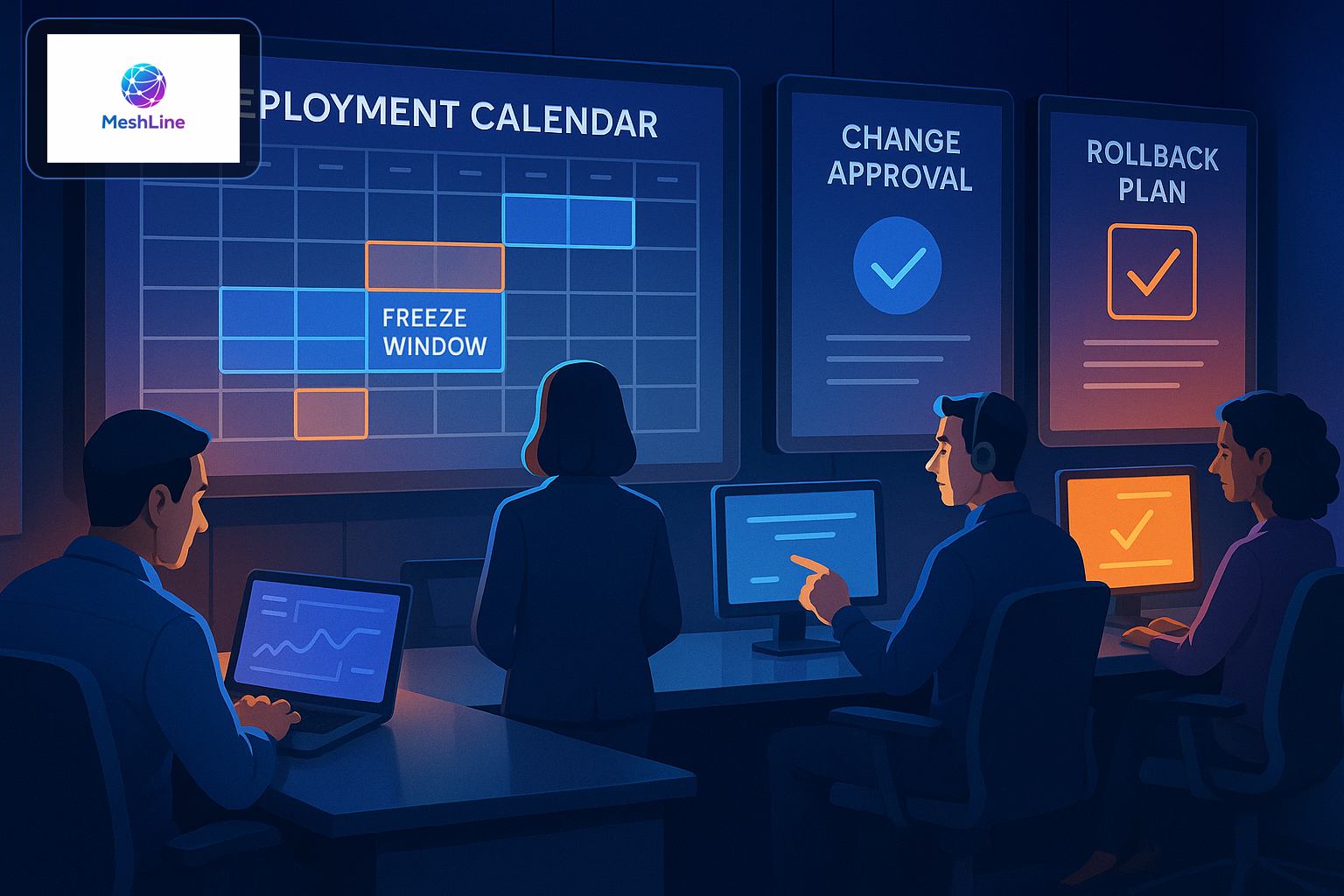
Deployment Freeze Window: Software Team Guide breaks when last-minute change requests slip around the freeze window. For operators, the painful part is the manual recovery that follows: engineers, QA, and business owners lose confidence in what is safe to ship, ownership is unclear, and the team has to rebuild context while the customer, lead, campaign, or report is already waiting.
Here is the practical Meshline angle: deployment freeze window definition is not just a term. It is a workflow control problem. Teams need to know the trigger, the owner, the exception path, the evidence, and the business outcome. When those pieces are missing, the concept becomes another vague phrase. When they are visible, the same term turns into operating infrastructure.
This guide is built for operators, founders, revenue teams, ecommerce teams, support teams, and technical teams that want execution they can inspect.It targets the related language around software deployment freeze, change freeze window, release management policy, deployment risk control, but the real goal is usefulness. explain the term, show where it applies, and turn it into a decision framework.
The category shift is important. The market is moving from isolated automation tactics toward an operating layer where business events, AI decisions, human approvals, and system actions can be governed together. Meshline's point of view is that the future belongs to teams that can make execution visible, not just faster. That is why this article treats deployment freeze window definition as infrastructure for repeatable work.
What deployment freeze window definition means in a Meshline workflow
In plain English, deployment freeze window definition describes the operating logic teams use when a software organization needs to protect peak demand, audit periods. migrations, customer launches, or reliability windows from avoidable release risk.The keyword may sound narrow, but the real issue is broader: a business event enters the system, someone or something has to decide what. happens next, and the team needs confidence that the decision is correct.
For Meshline, the useful definition has four parts. First, the trigger: a calendar window, business event, incident trend, compliance requirement, or dependency risk makes normal deployment cadence too risky. Second, the owner: engineering owns release execution, operations owns the freeze policy, and business stakeholders own approved exception criteria. Third, the exception path: security fixes, incident remediations, contractual defects, and urgent reliability patches move through an explicit approval path. Fourth, the outcome: teams reduce avoidable change risk without turning deployment freezes into vague release paralysis. If an article defines the term without those four parts, it may rank for a while, but it will not help a team actually improve the workflow.
For Deployment Freeze Window: Software Team Guide, the real problem is that many teams treat operational terms like labels instead of controls. They know the phrase. They may even have a tool that claims to handle it. But the work still depends on manual follow-up, scattered context, and undocumented judgment. That is where Meshline's operating-layer view becomes useful.
For Deployment Freeze Window: Software Team Guide, ## Why this query is worth doubling down on

Search Console showed the query "deployment freeze window definition software organization authoritative" with 33 impressions and an average position around 4.0 in the latest pull. That is enough signal to justify a stronger content asset. It means Google has started associating Meshline with this topic, but the page still needs more depth, clearer search intent coverage, and stronger internal linking to earn more visibility.
The opportunity is not only traffic. The opportunity is authority. Terms like deployment freeze window definition sit near buying and implementation conversations because they reveal operational pain. Someone searching the term usually wants to understand what it means, how to apply it, and what can break if the team gets it wrong.
For Deployment Freeze Window: Software Team Guide, that is why the content needs to answer three jobs at once. It should define the term for SEO. It should explain the workflow for operators. It should show how Meshline turns the idea into trigger-to-outcome execution instead of leaving the reader with a generic explanation.
The operating-layer framework
A strong operating-layer framework for deployment freeze window definition has six components.
For Deployment Freeze Window: Software Team Guide, first, define the entry event. Every useful workflow starts with a signal: a record changes, a customer acts, a system sends a payload, a metric crosses a threshold, or a human submits a request. Without a clear entry event, automation starts too early, too late, or not at all.
For Deployment Freeze Window: Software Team Guide, second, define the source of truth. Teams need to know which system is authoritative for the decision. The CRM may own the account. The ERP may own finance state. The storefront may own customer-facing availability. The warehouse may own physical stock. The model may produce a recommendation, but it should not silently override policy.
For Deployment Freeze Window: Software Team Guide, third, define the decision rule. A decision rule does not have to be complex. It can be a threshold, a matching rule, an owner assignment, a validation check, or a confidence band. The important part is that the rule is inspectable. If a team cannot explain why the workflow acted, the workflow is not ready to scale.
Fourth, define exception handling. security fixes, incident remediations, contractual defects, and urgent reliability patches move through an explicit approval path. This is where many automations fail. The happy path gets designed. The exception path gets left to Slack messages, inbox searches, and memory. Meshline treats the exception path as part of the workflow, not as cleanup after the workflow breaks.
Fifth, define the owner. engineering owns release execution, operations owns the freeze policy, and business stakeholders own approved exception criteria. Ownership should be visible at the point of work. If the workflow needs review, the right person should see the context, the evidence, and the recommended next action.
Sixth, define the outcome. teams reduce avoidable change risk without turning deployment freezes into vague release paralysis. A workflow is not complete because a tool fired. It is complete when the business state improved and the result can be measured.
For Deployment Freeze Window: Software Team Guide, ## Example: how this breaks without workflow ownership
Imagine a team trying to handle deployment freeze window definition manually. The trigger happens in one system. The context sits in another. The policy lives in a document. The owner is assumed but not assigned. The exception gets discussed in a thread. The report updates days later. Everyone is busy, but nobody has a reliable operating record.
For Deployment Freeze Window: Software Team Guide, this is how operational drag hides. The team may believe it has a process because people know what to do most of the time. But the process depends on attention. When volume increases, when a key person is out, when a new system is added, or when an AI agent starts taking action, the loose process becomes risky.
For Deployment Freeze Window: Software Team Guide, meshline's view is more disciplined. The workflow should capture the event, collect the evidence, apply the rule, route the owner, pause exceptions, and record the outcome. That gives teams a repeatable operating pattern instead of a patchwork of reminders.
A practical implementation example
For example, a team can start with one high-friction workflow related to deployment freeze window definition. They map the trigger, list the fields required for a good decision, name the system of record, and decide which cases should be automated versus reviewed. Then they configure the workflow so normal cases move forward, edge cases land in a review queue, and every decision creates an audit trail.
The practical framework is simple: observe the event, reason over the evidence, act only inside the allowed boundary, and learn from the outcome. That observe-reason-act-learn pattern is the operating layer that makes deployment freeze window definition useful in production. Without it, the team only has a term. With it, the team has a system.
Where AI and automation fit
AI can help with deployment freeze window definition, but only when it operates inside a controlled workflow. A model can summarize context, classify an event, recommend an owner, draft a response, or identify a likely exception. But AI should not become the source of truth by default.
For Deployment Freeze Window: Software Team Guide, the better pattern is AI-assisted execution with guardrails. The system retrieves relevant context, checks the policy, proposes or takes the allowed action, and logs the decision. If confidence is low or the action is sensitive, the workflow routes to human review. That is the difference between a clever prompt and an operating layer.
This is especially important for teams using AI agents. Agents need boundaries: what data they can use, what tools they can call, what evidence they must cite, and what outcomes they are allowed to change. deployment freeze window definition becomes much more useful when it is connected to those boundaries.
Metrics teams should track
For Deployment Freeze Window: Software Team Guide, the first metric is event volume. How often does this workflow trigger? If volume is low, manual review may be acceptable. If volume is growing, the team needs stronger routing, automation, and reporting.
For Deployment Freeze Window: Software Team Guide, the second metric is exception rate. A high exception rate usually means the workflow is under-specified, the data is weak, or the policy does not match reality. Exceptions are not just failures. They are feedback.
For Deployment Freeze Window: Software Team Guide, the third metric is time to resolution. How long does it take from trigger to outcome? Long cycle times usually point to unclear ownership, missing context, or too many handoffs.
For Deployment Freeze Window: Software Team Guide, the fourth metric is rework. If teams keep revisiting the same cases, the decision rule or source of truth is probably weak.
The fifth metric is outcome quality. Did the workflow actually produce teams reduce avoidable change risk without turning deployment freezes into vague release paralysis? This matters more than whether a tool ran successfully.
Checklist before scaling deployment freeze window definition
- For Deployment Freeze Window: Software Team Guide, Define the trigger that starts the workflow.
- For Deployment Freeze Window: Software Team Guide, Name the system of record for the decision.
- For Deployment Freeze Window: Software Team Guide, Document the rule, threshold, policy, or evidence requirement.
- For Deployment Freeze Window: Software Team Guide, Assign the owner for the normal path and the escalation path.
- Decide what should pause automation.
- For Deployment Freeze Window: Software Team Guide, Create a review queue for sensitive or low-confidence cases.
- For Deployment Freeze Window: Software Team Guide, Log the decision, evidence, owner, and outcome.
- For Deployment Freeze Window: Software Team Guide, Measure time to resolution, exception rate, and rework.
- For Deployment Freeze Window: Software Team Guide, Connect the workflow to reporting so operators can see drift.
- For Deployment Freeze Window: Software Team Guide, Review the process monthly and improve the rule set.
Common mistakes
The first mistake is defining deployment freeze window definition as a dictionary term and stopping there. Searchers need the definition, but operators need the application. The article should explain where the term appears, what decision it affects, and how the team can act on it.
For Deployment Freeze Window: Software Team Guide, the second mistake is assuming a tool solves the workflow by itself. Tools can move data, send updates, or call APIs. They do not automatically define ownership, exception handling, or business quality.
The third mistake is ignoring the edge cases. security fixes, incident remediations, contractual defects, and urgent reliability patches move through an explicit approval path. If those cases are not designed into the workflow, they become manual cleanup.
For Deployment Freeze Window: Software Team Guide, the fourth mistake is treating reporting as optional. If the workflow cannot show what happened, why it happened, and whether the outcome improved, the team cannot manage it.
How Meshline applies this concept
Meshline helps teams turn deployment freeze window definition into an operating workflow. The platform is built around autonomous operations infrastructure: trigger capture, decision logic, AI-assisted context, tool execution, exception routing, and outcome visibility.
For Deployment Freeze Window: Software Team Guide, in practice, that means Meshline does not only ask, "Can we automate this?" It asks, "Can we make this workflow dependable enough to run with less manual coordination?" That is a sharper question. It forces the team to define the owner, the source of truth, the guardrail, the handoff, and the review path.
For Deployment Freeze Window: Software Team Guide, for a growing team, this matters because work rarely breaks in the obvious places. It breaks between tools. It breaks when one person knows the exception rule. It breaks when a field means one thing in one system and another thing in another. It breaks when AI output looks plausible but lacks evidence. Meshline is designed for those gaps.
References and further reading
For Deployment Freeze Window: Software Team Guide, these authority sources are included to make the article useful beyond a short definition. The goal is not to outsource Meshline's point of view; it is to anchor the workflow advice in credible implementation, security, operations, platform, and standards references.
Related Meshline resources
Use Deployment Freeze Window: Software Team Guide with Organic Marketing Engine, Revenue Intel Module, Meshline glossary, and Book a Meshline demo when you want the workflow to connect back to pipeline instead of stopping at planning.