
 MeshLine
e-commerce fulfillment Automation Guide for Marketing Teams
A decision-stage, practical playbook for marketing ops: convert Meshline system exports into ownership-first operational controls so e-commerce fulfillment runs without constant handoffs. Includes triggers, briefs, QA gates, publishing cadence, refresh rules, reporting, lead routing, conversion measurement, and a clear buyer next step to Book a strategy call.
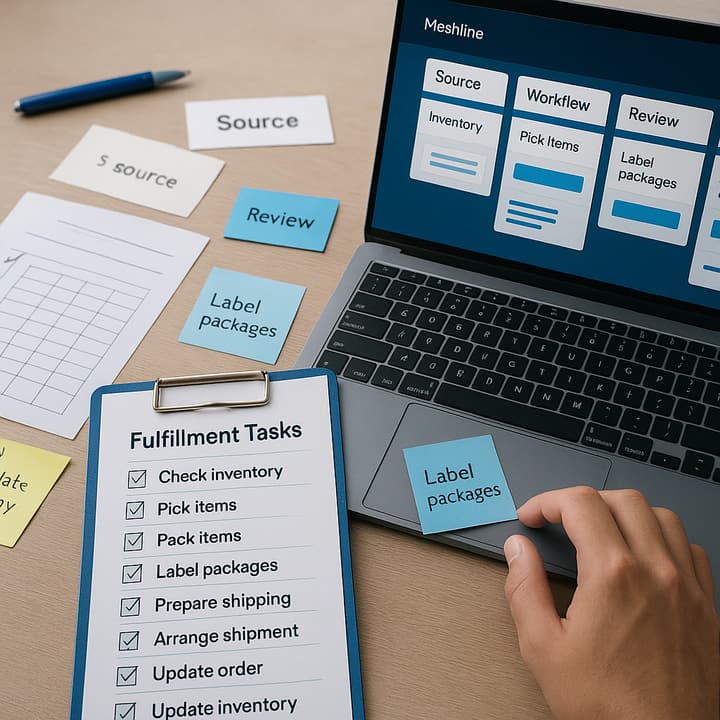
Meshline e-commerce fulfillment ownership-friendly system exports — integration, automation, and implementation guide for marketing ops
Marketing operations teams are judged by two outcomes: speed to market and reliable conversions after purchase. When fulfillment requires constant human coordination — mismatched SKUs, manual export handoffs, and unclear ownership — both suffer. This guide shows how Meshline e-commerce fulfillment ownership-friendly system exports convert exports from a coordination liability into an ownership-first operating layer for fulfillment, delivering measurable improvements in promo uptime, delivery SLAs, and conversion.
This is a decision-stage playbook written for founders, agency operators, and lean marketing teams evaluating whether to hire, outsource, or build an automated organic growth system that includes fulfillment sync. It maps triggers, briefs, keyword ownership, QA gates, publishing cadence, refresh rules, reporting, lead routing, and conversion measurement. If you want this mapped to your stack, Book a strategy call.
Why ownership-friendly system exports matter for marketing ops
Meshline e-commerce fulfillment ownership-friendly system exports are structured, responsibility-aware data outputs that carry authority: owner metadata, intent flags, and source-of-truth pointers. When marketing triggers a promo or content change, downstream fulfillment systems (OMS, WMS, carrier integrations) must act without asking "who should do this?" — exports that include ownership remove that coordination by embedding decision authority directly in the data.
Business outcomes you can measure within 30–90 days:
- Fewer manual tickets and handoffs.
- Faster promo rollouts (reduced time-to-live for campaigns).
- Lower failed-order and late-shipment rates.
- Cleaner attribution linking promotion to conversion and fulfillment outcome.
Key integration patterns referenced here include platform APIs (Shopify, BigCommerce), carrier adapters (FedEx, ShipStation), and streaming/CDC for durable event flows (Apache Kafka and Debezium). See these operator resources in the Appendix for mapping details.
Operating model: how Meshline exports become an e-commerce fulfillment operating layer
High-level rule: every export is a command with an owner, a QA gate, and an exception path. That rule drives deterministic routing, automated escalation, and measurable SLOs.
Contract-first exports
Each export is a lightweight contract. Typical fields:
- owner_id (GUID), owner_role (marketing_ops, merchandising, logistics)
- intent (promo_schedule, publish_preview, publish_live)
- export_type (price_update, inventory_delta, promo_activation)
- accepted_by, accepted_at (QA approval capture)
- idempotency_key and timestamp for replay
- exception_code and exception_metadata
Embedding these fields turns downstream systems into autonomous actors that route errors, trigger rollbacks, or accept writes based on pre-defined ownership rules.
Delivery choices and tradeoffs
- Real-time streaming (CDC into Kafka): best for low-latency, replayable audit trails and high-volume events.
- API push: targeted, low-latency writes for promotional go-lives or catalog updates.
- Batch (signed CSV over SFTP): cost-effective for nightly syncs where sub-second latency isn't required.
Use Kafka and Debezium for durability and ordered replayability; use API pushes for promotional control paths that require immediate QA signoff.
Why owner metadata reduces coordination
When an export carries owner metadata, downstream systems can auto-route exceptions. Example: failed SKU mapping routes to merchandising; carrier mismatch routes to logistics. The data pipeline becomes the coordination layer, not Slack or support tickets.
For supported export formats and ownership templates see the Meshline exports product page and our ownership rules documentation.
Practical operating model: triggers, briefs, keyword ownership, and publishing cadence
This section maps the operating model you must run day-to-day. It’s intentionally prescriptive.
Triggers (what starts an export)
- Event-triggered: order placed, promo scheduled, inventory falls below threshold.
- Manual-triggered: marketing marks a campaign as "ready" and triggers promo_activation.
- Scheduled: nightly catalog snapshot, hourly inventory delta.
Define triggers per export_type and attach SLA_ms to each trigger so the system can escalate if owners don't accept within the window.
Briefs and keyword/offer ownership
- Campaign brief: marketing creates a single canonical brief (campaign_id) that travels in exports and contains keywords, creative IDs, landing URLs, and offer terms.
- Keyword ownership: assign canonical keyword lists and landing-page ownership to marketing ops so SEO/SEM alignment is explicit; include those ownership pointers in content_package_change exports.
This keeps SEO updates, bundling, and fulfillment packaging tied together so content changes that affect packaging (weights/dimensions) trigger WMS checks.
Publishing cadence and refresh rules
- Near-real-time: price updates, promo activation, and inventory deltas when SLA requires sub-5-minute propagation.
- Hourly: shipping_label_response and carrier reconciliation.
- Nightly: broad catalog refresh and reconciliation exports.
Refresh rules: define max age per payload field (e.g., price freshness 5 minutes, description freshness 24 hours) and include refresh metadata on each export.
QA gates and acceptance flow
- Single-step acceptance: owner signs off in Meshline UI or via an integrated Slack workflow.
- Two-step acceptance: required for critical export types (live_publish, promo_activation) — marketing + operations approval.
- Auto-escalation: if the owner doesn't accept within SLA_ms, route to backup owner and create a high-priority task.
Exception routing and lead routing
- Exceptions carry exception_code mapping to owners and incident severity.
- For promotion-related failures, route leads (failed conversions or checkout abandonments tied to the campaign_id) to marketing ops for conversion remediation.
Conversion measurement and reporting
- Tag exports with campaign_id and track post-purchase conversion rate, refund/return rate, and late-shipment rate by campaign.
- Use these signals to attribute fulfillment friction to conversion loss and route budget or messaging changes back to marketing.
Examples and workflows marketing ops can implement today
Below are four concrete workflows that remove coordination and reduce time-to-live for campaigns.
Promo activation with ownership and rollback
Process:
- Marketing creates campaign brief and sets state to "ready". Meshline issues export_type=promo_activation with owner_role=marketing_ops and owner_id=ops_lead.
- Downstream OMS consumes the export. If inventory < threshold, it returns exception_code=insufficient_inventory; Meshline auto-routes to supply-chain owner and pauses the promo_activation.
- When inventory is resolved, owner re-approves; Meshline issues a live_publish export with full audit trail.
This flow prevents promos from going live without inventory backing and eliminates manual tickets.
Staged product launches (marketing preview before warehouse)
Process:
- Meshline issues export_type=staged_product with preview flags and owner=merchandising.
- Marketing builds landing pages off preview exports (no writes to live catalog).
- When stock is available, Meshline issues live_publish to Shopify/BigCommerce with owner metadata and timestamped audit trail.
Preview exports let marketing prepare SEO/paid assets without touching the live catalog or creating fulfillment mismatches.
Reactive shipping exception routing
Process:
- Label creation errors from carrier APIs (e.g., FedEx) are normalized into failure exports with exception_code and owner=operations.
- If the same error repeats in a configurable window, Meshline opens an engineering incident with the event stream attached for deterministic replay.
Evergreen SEO content + fulfillment alignment
Process:
- Marketing updates content or bundle keywords. Meshline issues content_package_change including packing specs, weights, and dimensions.
- WMS consumes packing specs and triggers pick-path or packaging change reviews if dimensions changed.
This prevents late-stage fulfillment surprises that kill conversions.
Implementation runbook: build vs buy decision and step-by-step plan
This section is your operational checklist and vendor-decision framework.
Step 0 — decision criteria: hire, outsource, or implement Meshline
- Choose Meshline (autonomous operations infrastructure for e-commerce fulfillment) when you have multiple sales channels, strict SLAs, and frequent promos.
- Choose Meshline services + integration if engineering bandwidth is limited but you need reliable sync.
- Extend Meshline via APIs if you have heavy custom needs and internal headcount.
Step 1 — map sources and sinks
- Catalog & pricing: Shopify (see Shopify developer docs) or BigCommerce (see BigCommerce API).
- Orders/OMS: native OMS or partner like ShipStation (labeling and carrier orchestration).
- Warehouse/WMS: internal system or 3PL.
- Carriers: FedEx, USPS, or aggregators.
Map write patterns carefully to avoid platform conflicts: Shopify and BigCommerce have specific invariants for catalog writes.
Step 2 — define export contracts
Create templates for your top 10 export types (promo_activation, price_update, inventory_delta, staged_product, live_publish, shipping_label_request, shipping_label_response, return_initiate, exception_notify, content_package_change). For each template specify:
- Required fields and types (owner_id GUIDs, timestamps, SKU lists)
- Accepted enums and business validation rules
- QA gates and approval rules
- Idempotency keys and retry policy
- Exception routing map
A sample export contract and templated fields are available on the Meshline exports product page.
Step 3 — choose delivery mechanism
- CDC + Kafka (Debezium) for low-latency, replayable streams and durable audit trails.
- API push for single-action, high-priority publishes.
- SFTP batch for low-cost nightly jobs.
Use Kafka when you need deterministic replay and ordered processing; otherwise mix API push for critical paths and batch for scale.
Step 4 — implement QA gates and owner workflows
- Pre-flight checks: schema validation, owner availability, business rules.
- Acceptance flow: owner approves via Meshline UI or integrated Slack/Gmail flow; accepted_by and accepted_at recorded.
- Auto-escalation: if no response, route to backup owner and open a transient ticket.
Ownership templates live in our ownership rules documentation.
Step 5 — monitoring, reporting, and KPIs
Track daily:
- Export success rate by type
- Owner acceptance time (median and P95)
- Exception rate and top exception codes
- Promo time-to-live
- Delivery success and late shipment rate
Tag exports with campaign_id for attribution and feed these metrics into BI or Meshline dashboards. For carrier flows align exception mapping with carrier docs (FedEx, ShipStation).
Step 6 — staged rollout and iterate
Roll out by percentage: 10% SKUs, 50%, then full. At each stage measure owner accept time and exception volumes; tune cadence and retry windows.
QA, failure modes, and ownership rules (production playbook)
Ownership rules — deterministic routing
- Primary owner: owner_role + owner_id in export.
- Backup owner: a second contact for escalations.
- Timeouts: SLA_ms triggers auto-escalation.
- Soft lock: when reviewing an export, Meshline marks it as locked to prevent concurrent edits.
QA gates and checks
- Schema validation: reject or quarantine exports missing required fields.
- Business validation: price and inventory thresholds validated before live publish.
- Safety checks: sample writes and test-order creation in staging before live writes.
Common failure modes and recovery paths
- Missing owner metadata: return with code "no_owner" and route to remediation.
- Inventory mismatch: issue inventory_delta and create supply-chain remediation ticket.
- Carrier label failure: set order to "label_pending", retry with alternate carrier, or escalate.
- Conflicting writes: use idempotency keys and event timestamps for replay.
For full QA rules and automation templates see our ownership rules documentation.
Reporting, measurement, and commercial considerations
Measurement rules:
- Attribution: use campaign_id to connect exports to post-purchase analytics and fulfillment outcomes.
- SLOs: owner accept time, publish latency, exception rate.
- Cost controls: monitor API call volume and streaming event volume; streams cost more than batch.
Commercial buyer note: Meshline positions as an autonomous operations infrastructure for e-commerce fulfillment with implementation packages that include carrier and OMS adapters. For a tailored recommendation and cost tradeoffs (CDC vs API vs batch), Book a strategy call.
Practical checklist: deployment and runbook (copy-paste)
- [ ] Inventory systems mapped and source-of-truth defined.
- [ ] Export contract templates created for top 10 export types.
- [ ] Owner metadata (owner_id, owner_role, backup) defined for teams.
- [ ] Delivery channels selected (Kafka/SFTP/API) and tested.
- [ ] QA gates automated; staging publish verified.
- [ ] Escalation and SLA_ms configured for each export type.
- [ ] Dashboards for KPIs wired and baseline metrics captured.
- [ ] Failure-mode playbooks written and owners informed.
Next steps and decision checklist for marketing ops leaders
- If frequent coordination tickets slow promos: pilot promo_activation and shipping_label_response exports.
- If content and fulfillment mismatch often: pilot staged_product and content_package_change exports.
- If you run multi-platform stores (Shopify + BigCommerce): use Meshline as the unified export layer to normalize owner metadata.
To review a custom integration bundle (connectors for Shopify, BigCommerce, carriers, and Kafka-based CDC) Book a strategy call.
!Meshline export flow diagram showing order, export contract, owner metadata, QA gate, and fulfillment sink'/><line x1='420' y1='60' x2='450' y2='60' stroke='%23000' marker-end='url(%23a)'/><line x1='650' y1='60' x2='700' y2='60' stroke='%23000' marker-end='url(%23a)'/><defs><marker id='a' markerWidth='10' markerHeight='10' refX='0' refY='3' orient='auto' markerUnits='strokeWidth'><path d='M0,0 L0,6 L9,3 z' fill='%23000' /></marker></defs></svg>)
Diagram: Meshline export flow with owner metadata and QA gates, illustrating the autonomous operations infrastructure for e-commerce fulfillment.
Appendix: integration references and operator resources
Below are contextual operator links referenced in this guide. Use them to map API semantics and carrier error mappings.
- Shopify developer docs: Shopify developer
- BigCommerce API reference: BigCommerce developer
- ShipStation carrier & label integration: ShipStation developers
- Apache Kafka for durable streams: Apache Kafka
- Debezium for change-data capture: Debezium
- FedEx developer APIs and error codes: FedEx developers
- GS1 identifiers and SKU canonicalization: GS1
- Logistics and retail research: McKinsey Retail Insights
- Organizational coordination research and lessons: Harvard Business Review
- Event-driven design and patterns: Martin Fowler
These sources are useful for outreach and backlink opportunities — consider guest content or partner posts with Shopify Plus partners, ShipStation engineering blog, or logistics analytics blogs to amplify case studies.
If you'd like this plan mapped to your stack and a costed integration recommendation (CDC vs API vs batch), Book a strategy call.
Meshline e-commerce fulfillment ownership-friendly system exports Implementation Checklist
Use this Meshline e-commerce fulfillment ownership-friendly system exports checklist to keep the e-commerce fulfillment workflow specific enough for operators and buyers. Name the owner, source system, destination system, exception route, QA checkpoint, and reporting field before automation goes live.
For Meshline e-commerce fulfillment ownership-friendly system exports, Meshline should confirm the trigger, review path, audit trail, fallback owner, and demo-ready outcome. That keeps Meshline e-commerce fulfillment ownership-friendly system exports from becoming another disconnected workflow and gives teams a practical implementation path.
The operating language should stay consistent: Meshline e-commerce fulfillment ownership-friendly system exports, e-commerce fulfillment automation, e-commerce fulfillment workflow, e-commerce fulfillment operating model, e-commerce fulfillment implementation, e-commerce fulfillment checklist, e-commerce fulfillment QA, e-commerce fulfillment governance, exception routing, automation governance, operational visibility, and Meshline's operating layer. Meshline e-commerce fulfillment should appear where it clarifies search intent and buyer relevance. autonomous operations infrastructure for e-commerce fulfillment should appear where it clarifies search intent and buyer relevance. e-commerce fulfillment operating layer should appear where it clarifies search intent and buyer relevance.