
 MeshLine
Proposal Follow-Up Workflow Guide for Revenue Operations
Map proposal signals, owners, reminders, exceptions, and QA checks so revenue teams follow up on time without inbox coordination.
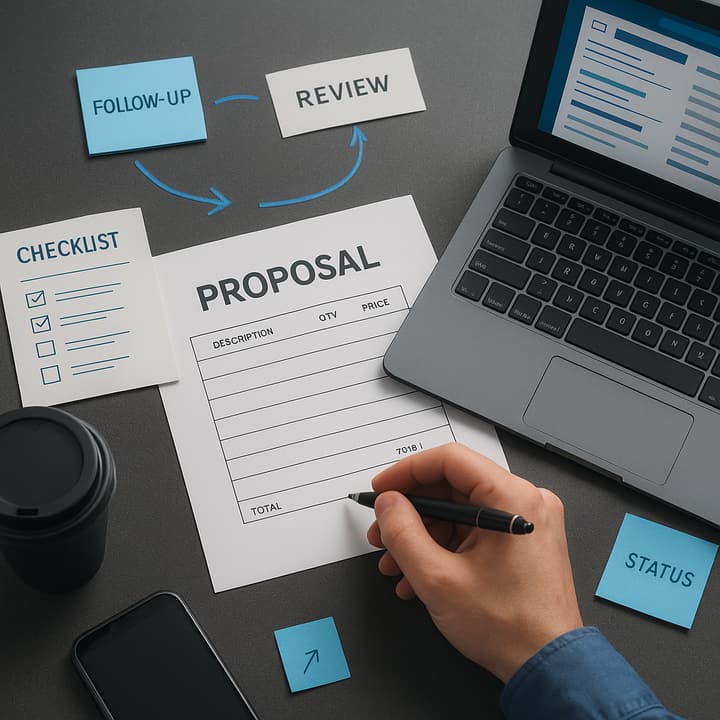
Sales proposals stall because follow-up is manual, ambiguous, and invisible. Revenue operations teams are tasked with predictable pipeline and reliable forecasts, yet many rely on spreadsheets, calendar reminders, and tribal knowledge. This playbook explains how an autonomous operations infrastructure for revenue ops teams proposal follow-up turns ad-hoc handoffs into an enforceable operating system that sets ownership, automates routing and remediation, and measurably speeds closes.
This is a practical, decision-stage resource for revenue ops leaders evaluating implementation, integrations, services, and automation. We use before/after operating stories, implementation patterns, QA checks, and proof themes so you can map this to your stack and Book a strategy call when ready.
Why this matters now: the cost of poor proposal follow-up
- Slow or inconsistent follow-up is a measurable conversion killer. Faster first-response improves outcomes; benchmarking from HubSpot and sales-engagement vendors shows large uplifts when cadence is enforced.
- Unowned follow-up creates noise in forecasting: stale CRM stages, missed upsell windows, and unpredictable close timing. Analysts at Gartner and Forrester identify operational consistency as a top driver of predictable revenue.
- Revenue ops owns the operating model, but not always the execution layer. Meshline provides an operating system — not just point automations — so execution, routing, and remediation live where governance lives.
If your search includes the phrase "autonomous operations infrastructure for revenue ops teams proposal follow-up," this article explains design patterns, integration expectations, and implementation steps you can act on this quarter.
Before / After operating stories (quick examples)

Before: The stalled proposal
- AE sends a PDF proposal using a saved template and marks a manual reminder.
- No enforced cadence. The AE sets a calendar reminder or hopes the prospect replies.
- Prospect asks a question requiring legal/finance review; the AE is in meetings. No clear handoff.
- CRM stage lingers, forecast confidence drops, and the deal cools.
After: Meshline-managed proposal follow-up
- ProposalCreated triggers a ProposalSent event into Meshline.
- Meshline applies a follow-up cadence: Day 2 (value check), Day 5 (pricing clarification), Day 10 (manager escalation if no response).
- Tasks are created, owners assigned, and parallel approval gates are opened for legal/finance when required.
- The AE, manager, and functional owners have clear SLAs; tracking and remediation are automatic. The deal moves faster and forecast accuracy improves.
Customer snapshot: B2B SaaS Sales
A mid-market SaaS customer standardized on a Meshline workflow template and reduced days-to-signature by ~22% in 90 days. Read the full story in Meshline Case Study: B2B SaaS Sales.
Operating framework: an operating system for proposal follow-up
Meshline treats proposal follow-up as an operational flow with state, ownership, and exceptions rather than a chain of ad-hoc reminders.
- System of record: CRM events (ProposalSent, ProposalViewed, SignatureReceived) are the canonical truth.
- Operating layer: Meshline ingests events, applies declared policies, creates tasks, and routes ownership.
- Execution layer: human actions (calls, emails, approvals) are tracked, validated, and logged.
- Remediation layer: breached SLAs trigger escalations, playbooks, and notifications.
This layered model is distinct from point automations that only send alerts. It provides governance, auditability, and consistent outcomes.
Key primitives and terminology
Events, rules, and routes
- Events: ProposalSent, ProposalViewed, LegalRequested, SignaturePending.
- Rules: SLA windows, follow-up cadence, acceptable responses.
- Routes: primary owner (AE), backup owner (AE manager), functional owners (Legal, Finance, CSM).
Templates and playbooks
- Communication templates: email + call scripts + negotiation notes per SLA window.
- Approval playbooks: parallel tasks for procurement, legal redlines, or discount approvals.
Meshline stitches these primitives into a reusable pattern for an autonomous operations infrastructure for revenue ops teams proposal follow-up so your declared intent becomes machine-enforced behavior.
Design patterns and operating rules (practical playbook)
- Ownership-first pattern: every proposal event must have a single primary owner and at least one backup. Persist owner metadata in the CRM and in Meshline.
- SLA windows: define three windows—A (0–48 hours), B (3–7 days), C (8–14 days). Tie each to a playbook and escalation rule.
- Escalation chain: configure manager and executive alerts when Window C is reached and deal value exceeds thresholds.
- Functional gates: open parallel tasks for legal/finance and block move-to-close until gate is cleared.
- Versioned templates: manage communication templates with version control and quarterly reviews.
These patterns are informed by industry playbooks and operational research from McKinsey, Harvard Business Review, and practical sequencing from vendors like Salesloft and Outreach.
Examples and use cases
- New logo proposal follow-up: high-touch cadence, manager check-in at Day 5, legal loop-in before Day 10.
- Renewal upsell proposal follow-up: shorter cadence, CSM co-owned, tailored messaging and value reminders.
- Enterprise multi-stakeholder approvals: open parallel approval tasks for procurement and legal, enforce completion gates, and block signature until clearance.
Each maps to a Meshline workflow template. Browse templates in Meshline Workflows & Templates.
Implementation steps: deploy in 8 weeks (tactical)
This plan assumes you have a CRM, an e-signature tool, and a ticketing system.
Week 0 — Plan
- Stakeholder map: AEs, Revenue Ops, Legal, Finance, CSMs, Sales Engineering.
- Success metrics: time-to-first-followup, days-to-signature, % response within 48 hours, % escalations.
- Baseline: pull 90-day historical metrics from CRM.
Week 1–2 — Model (data & events)
- Build the ProposalSent event model: required fields (owner_id, deal_value, close_date, template_id).
- Define SLAs, escalation thresholds, and gate rules.
Week 3–4 — Integrate
- Connect CRM events to Meshline with bidirectional sync. Meshline supports common connectors; see Meshline Integrations.
- Connect e-sign providers (DocuSign, Adobe Sign) and messaging channels (email + Slack/MS Teams).
- Follow integration best practices from platform guidance at Salesforce and CRM vendor docs.
Week 5 — Author playbooks
- Create communication templates for each SLA window and approval gate.
- Author exception handling rules (e.g., CFO approval required → route to DiscountApproval playbook).
Week 6 — Pilot
- Run a 2-week pilot with 5 AEs and one RevOps owner.
- Monitor dashboards for follow-up completion rates, SLA violations, and event integrity.
Week 7–8 — Rollout
- Roll out broadly with training, ownership rules, and documented exception paths.
- Measure to the Week 0 success metrics and iterate.
For implementation patterns and changemanagement guidance, reference Atlassian Team Playbook and vendor playbooks from Gong and Zendesk.
Handoffs, ownership rules, and exception paths
- Primary owner: AE on the CRM opportunity. Backup owner: AE manager.
- Functional owner: Legal/Finance/CSM assigned when a gate is required.
Common exception paths:
- Custom legal language requested → Meshline routes to Legal and pauses cadence until approval.
- Pricing beyond threshold → DiscountApproval workflow opened and AE restricted from signing.
- No response after Window C → Mark deal as "Follow-Up Failure" and trigger revive playbook.
Enforce ownership programmatically and expose owner/backup in dashboards to remove ambiguity.
QA checks, failure modes, and operational guardrails
Daily and weekly QA checks
- Event integrity: ProposalSent events must include owner_id, deal_value, and send_timestamp.
- SLA adherence: % follow-ups completed in Window A/B/C.
- Escalation accuracy: % escalations reaching intended manager.
- Gate enforcement: % moves-to-close that have required approvals recorded.
Failure modes and remediation
- Missing events (cause: CRM sync lag): remediation is an incremental API fetch to rehydrate events and create missing ProposalSent events.
- Ownership mismatch (cause: duplicates): run de-dup jobs, enforce canonical opportunity IDs, notify RevOps.
- Template drift (cause: outdated scripts): version templates and schedule quarterly review cycles.
Operational guardrails:
- Read-only fields for critical playbook definitions; require RevOps approval for edits.
- Auditable logs: Meshline stores an immutable activity timeline for each proposal event for compliance and audit review.
For governance frameworks and auditability practices, see research from Forrester and Harvard Business Review.
Measurable outcomes and proof themes
Operators should expect concrete uplifts in 60–90 days after rollout:
- Time-to-first-followup: reduce by 40–70% depending on baseline. Benchmarks from HubSpot and sequencing best-practices from Salesloft support faster initial contact as a conversion driver.
- Days-to-signature: shrink by 15–35% when approval gates are parallelized and ownership is enforced; see McKinsey on process parallelization.
- Forecast accuracy: clearer staging and fewer stalled opportunities improve forecast reliability; research guidance from Gartner applies here.
Proof themes:
- Standardization: one source of truth for follow-up behaviors across reps.
- Reduced cognitive load: reps follow playbooks rather than remember cadence rules.
- Auditability & compliance: full logs for legal and finance review.
Read a transformation case in Meshline Case Study: B2B SaaS Sales and see workflow templates at Meshline Workflows & Templates.
Decision-stage guidance: services, automation, and integrations
If you're evaluating vendors to implement this pattern, use this checklist:
- Integrations: two-way sync with CRM and e-sign provider. See Meshline Integrations for supported connectors.
- Implementation services: does the vendor provide playbook templates and guided implementation? Meshline offers services packages tailored to SLA mapping—Book a strategy call.
- Automation depth: conditional routing, parallel approvals, and remediation flows are essential.
- Audit and compliance: immutable activity logs and exportable audit trails.
Ask vendors to run a live simulation of your proposal follow-up process during the demo. Third-party guides from Outreach, Gong, and Salesloft can help you script demos.
Practical checklist for Revenue Ops (actionable)
- Define measurable success metrics (time-to-first-followup, days-to-signature, % escalations).
- Create the ProposalSent event model in CRM with required fields.
- Author SLA windows and playbooks for each window and exception.
- Configure integrations for CRM, e-signature (DocuSign/Adobe Sign), and messaging channels.
- Run a 2-week pilot with a small AE cohort and 1 RevOps owner.
- Monitor QA checks daily for the first 30 days, then weekly.
- Version templates and institute quarterly review cycles.
Comparisons and selection criteria
When comparing vendors, rate them on:
- Integration reliability and latency (real-time event delivery vs batch sync).
- Playbook authoring UX and policy governance (who can change rules and how changes are audited).
- Remediation and exception handling (can the system pause cadence and open parallel gates?).
- Service options (do they provide mapping workshops, template libraries, and a rollout plan?).
Benchmarks from CRM and engagement vendors such as Salesforce, HubSpot, and engagement tooling from Outreach should inform your evaluation criteria.
Next steps (Book a strategy call)
If you are ready to move from reminders to an autonomous follow-up system that enforces ownership and SLAs, Book a strategy call to map your process, confirm integrations, and get a tailored rollout plan. Meshline will run a demo against your sample opportunities and recommend an implementation timeline.
For product details and templates, see:
- For Proposal Follow-Up Workflow Guide for RevOps, Meshline Integrations
References and authority links
The patterns and recommendations here draw on vendor research, operational best-practices, and industry guidance:
- Sales follow-up research: HubSpot
- CRM and platform guidance: Salesforce
- Market and process research: Forrester
- Strategic operations and parallelization: McKinsey
- Sales cadence and sequencing: Salesloft
- Sales engagement playbooks: Outreach
- Conversation intelligence and signals: Gong
- Customer service handoffs and escalation: Zendesk
- Change & team playbooks: Atlassian Team Playbook
- Operational leadership and governance: Harvard Business Review
- Forecasting and revenue ops best-practices: Gartner
- Responsible automation context: OpenAI
- E-signature providers: DocuSign and Adobe Sign
Practical editorial note: treat this page as the canonical implementation playbook for proposal follow-up. If other Meshline pages rank for related queries, link them back here as the operational reference.
Related Meshline Resources
- For Proposal Follow-Up Workflow Guide for RevOps, Meshline workflow automation products
- For Proposal Follow-Up Workflow Guide for RevOps, Meshline pricing and implementation options
Ready to build an autonomous operations infrastructure for revenue ops teams proposal follow-up? Book a strategy call to run a free readiness assessment and get a bespoke implementation plan.
autonomous operations infrastructure for revenue ops teams proposal follow-up Implementation Checklist
Use this autonomous operations infrastructure for revenue ops teams proposal follow-up checklist to keep the proposal follow-up workflow specific enough for operators and buyers. Name the owner, source system, destination system, exception route, QA checkpoint, and reporting field before automation goes live.
For autonomous operations infrastructure for revenue ops teams proposal follow-up, Meshline should confirm the trigger, review path, audit trail, fallback owner, and demo-ready outcome. That keeps autonomous operations infrastructure for revenue ops teams proposal follow-up from becoming another disconnected workflow and gives teams a practical implementation path.
The operating language should stay consistent: autonomous operations infrastructure for revenue ops teams proposal follow-up, proposal follow-up automation, proposal follow-up workflow, proposal follow-up operating model, proposal follow-up implementation, proposal follow-up checklist, proposal follow-up QA, proposal follow-up governance, exception routing, automation governance, operational visibility, and Meshline's operating layer. Meshline for proposal follow-up should appear where it clarifies search intent and buyer relevance. proposal follow-up system design should appear where it clarifies search intent and buyer relevance. operating system for proposal follow-up should appear where it clarifies search intent and buyer relevance.
Practical operating checks
In Proposal Follow-Up Workflow Guide for RevOps, use this section to turn the proposal follow-up idea into a visible operating decision. The goal is to make the next handoff obvious before volume increases.
Monday morning diagnostic
For Proposal Follow-Up Workflow Guide for RevOps, start by checking the last five examples where the workflow stalled. Write down the trigger, the source system, the owner, the next action, and the moment the customer or lead received a response. If one of those fields is missing, the workflow is relying on memory.
First workflow to tighten
For Proposal Follow-Up Workflow Guide for RevOps, step 1 is to choose one handoff and make it measurable. For example, define what should happen when a qualified lead arrives, when a content brief is approved, when a CRM record changes, or when a reconciliation exception appears. The smaller the first rule, the easier it is to prove.
Checklist before you scale
- For Proposal Follow-Up Workflow Guide for RevOps, Confirm the page or workflow has one owner.
- For Proposal Follow-Up Workflow Guide for RevOps, Confirm the source system and destination system agree on the key fields.
- For Proposal Follow-Up Workflow Guide for RevOps, Add one quality check that catches bad data before it reaches a reader, lead, or customer.
- For Proposal Follow-Up Workflow Guide for RevOps, Add one relevant Meshline resource link that helps the reader take the next step.
- For Proposal Follow-Up Workflow Guide for RevOps, Review the result after seven days and improve the rule before adding more volume.