
 MeshLine
Support Triage Workflow Guide for Revenue Operations
Define intake signals, routing rules, SLA owners, enrichment, and escalation paths so support exceptions reach the right operator quickly.
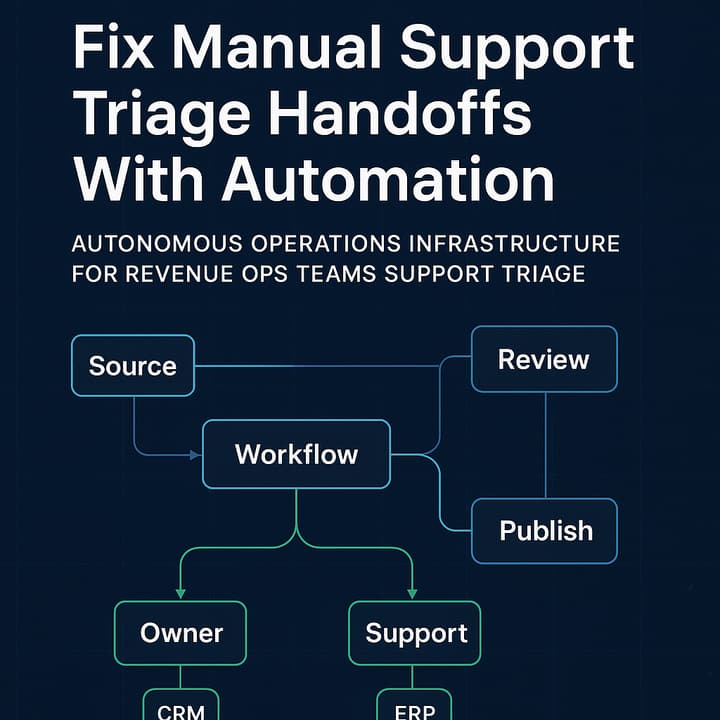
Support triage is a daily battleground for revenue ops teams. Missed SLAs, duplicated work across Sales/CS/Finance, and fragile manual routing leak revenue and frustrate customers. This playbook explains how an autonomous operations infrastructure for revenue ops teams support triage turns noisy inputs into auditable, enforceable workflows.
You'll get before/after operating stories, concrete implementation patterns, ownership and exception rules, QA checks to avoid common failures, and a practical six-week rollout plan. If you're evaluating support triage system design, looking for an operating system for support triage, or comparing vendors, this guide is a decision-stage resource you can use in vendor evaluations and scoping calls.
The gap: why support triage fails revenue ops
Most revenue ops teams experience the same recurring symptoms:
- Duplicate tickets and Slack pings across teams.
- SLA misses on billing or contract items that directly affect renewals.
- Routing rules maintained in spreadsheets or tribal knowledge.
- No single owner when issues cross Sales, CS, and Finance.
These failures cause three direct business harms: churn, delayed revenue recognition, and lost upsell opportunities. The root cause is operational friction: incomplete telemetry, fragile routing, and no enforced exception paths. An autonomous operations infrastructure for revenue ops teams support triage reduces friction by converting routing rules and remedial actions into executed workflows with observable outcomes.
Before / after operating stories that make the case

Hearing how operations run pre- and post-Meshline helps stakeholders visualize the change.
Before Meshline "” typical day
- A billing email lands; triage must decide if it's billing, legal, or renewal.
- The triager copies the message into Slack channels and assigns it manually.
- SLA timers are tracked in spreadsheets; acknowledgments are templated and often delayed.
- High-value cases rely on ad-hoc AE or legal outreach; lower-priority items stall.
After Meshline "” typical day
- Incoming tickets are auto-enriched with contract metadata, MRR tier, and open-opportunity signals pulled from CRM.
- Meshline applies routing rules: high-MRR billing issues route to a billing-SME queue with legal on watch; low-impact items trigger automated payment reminders.
- Automated first responses and idempotent remediation steps reduce SLA exposure and create a clear human handoff when required.
- Immutable audit logs, SLA metrics, and automated escalation reduce ambiguity and protect revenue.
This before/after contrast demonstrates the operating gains: faster resolution, fewer escalations, less manual duplication, and clearer revenue protection.
Why an autonomous operations infrastructure for revenue ops teams support triage matters
That long phrase"”autonomous operations infrastructure for revenue ops teams support triage"”signals a shift from people-in-the-loop routing to an execution layer that enforces business rules.
Three core benefits:
- Predictability: SLAs and escalation rules become code-backed processes instead of tribal knowledge.
- Context: Live CRM, billing, and contract data surface at triage time so decisions reflect revenue impact.
- Auditability: Every routing decision and remediation is logged for finance, legal, and exec review.
Operators evaluating vendors should prioritize measurable outcomes (SLA compliance, time-to-first-action, revenue-at-risk) over feature checklists.
Operating framework: design rules for support triage as an operating system
Treat support triage as a subsystem of your GTM operating system. Meshline recommends a four-layer framework for support triage system design and an operating system for support triage:
- Signals layer "” ingest events and telemetry (email, chat, webhooks, CRM changes) via robust connectors.
- Enrichment layer "” combine signals with authoritative contract, billing, and opportunity context.
- Decision layer "” encoded routing and remediation rules that choose actions: automated reply, route, hold for legal, or escalate.
- Execution & audit layer "” perform actions with idempotency guarantees and store immutable logs for QA and compliance.
Why encode rules? Manual routing decays as organizations change: rules in people's heads don't scale. Encoding rules into your autonomous operations infrastructure ensures consistent execution and traceability.
Ownership and routing primitives
Define a small set of non-negotiable primitives and map them to tool-level constructs:
- Owner-of-record: a single, auditable team or person accountable for each ticket.
- Routing predicates: contract tier, MRR, product module, legal flag, and linked opportunities.
- Escalation windows: time-to-first-action thresholds by tier.
Enforce these primitives with automation so ownership and accountability are visible.
Exception paths and safe defaults
Good systems have safe defaults and explicit exception paths:
- Default: low-touch issues receive a templated auto-response and are closed after a two-step payment reminder sequence.
- Exception: if contract+MRR exceeds a threshold or a legal clause is flagged, override to a high-touch queue and pause auto-close.
These exception paths protect revenue while keeping volume manageable.
Examples and use cases: revenue ops patterns
Below are patterns where Meshline's autonomous operations infrastructure addresses core revenue ops pain.
Billing disputes and revenue protection
Problem: Billing disputes spike around renewals or when invoices are misapplied, risking churn.
Meshline pattern:
- Enrich tickets with subscription term, current balance, open opportunities, and churn risk signals.
- If the customer is in renewal window, route to a renewal-SME plus AE and apply a soft hold on collections.
- Kick off an SLA-aware workflow that tracks legal engagement and payment offers.
Outcome: fewer uncoordinated refunds, faster resolution for high-risk accounts, and safeguarded revenue.
Contract exceptions and legal handoffs
Problem: Contract questions stall due to missing contract context.
Meshline pattern:
- Extract clause flags from CLM and attach them to the ticket.
- Route flagged tickets to legal-ops with pre-populated context and deadline metadata.
- Enforce legal acknowledgment SLAs and send templated status updates to stakeholders.
Outcome: faster legal response and less time spent chasing context.
Sales/CS handoffs and revenue recovery
Problem: Coordination between sales and support is ad-hoc and slow.
Meshline pattern:
- Use CRM opportunity signals to mark tickets linked to open deals as high-priority.
- Route such tickets to a joint queue for AEs and support with a clear owner-of-record and handoff notes.
- Automate status sync back to CRM and trigger revenue playbooks (credit memos, discount approvals) when rules apply.
Outcome: fewer slipped renewals and clearer accountability across functions.
Implementation steps "” a practical six-week rollout plan
This sprint plan fits most mid-market revenue ops teams and keeps timelines tight while reducing risk.
Week 0 "” Discovery
- Map triage inboxes, volume by type, and current SLA misses.
- Inventory systems: CRM, billing, support platform, CLM, and communication channels.
- Identify a pilot category (billing or contract questions) and gather a 30-day ticket sample.
Week 1 "” Design
- Define routing predicates, ownership rules, and escalation windows.
- Specify exception paths and approval authorities.
- Peer-review rules with AEs, legal-ops, and finance.
Week 2 "” Signals & enrichment
- Configure Meshline connectors to ingest email, webhooks, and CRM events.
- Build enrichment pipelines for contract and billing metadata.
- Validate enrichment accuracy against the sample tickets.
Week 3 "” Decision models & safety
- Encode routing logic and templates into Meshline flows.
- Add safe defaults and test idempotent execution for automated replies.
- Create a fast-override human path and logging for all overrides.
Week 4 "” Pilot
- Run a shadow pilot on 10"“20% of volume and observe metrics: time-to-first-action, escalations, SLA compliance.
- Collect feedback from triage agents, AEs, legal, and finance.
Week 5 "” Iterate
- Harden rules, add exception flows, and refine templates.
- Build dashboards for ops and executive stakeholders.
Week 6 "” Rollout & training
- Cut over with staged enablement, runbooks, and an FAQ for triage agents.
- Schedule a retrospective in 30 days and set ongoing cadence.
Meshline provides connectors, implementation playbooks, and managed rollout support. See our product and docs for integration patterns and implementation details: Meshline Product, Meshline Docs - Support Triage, and Meshline Integrations.
QA, risk controls, ownership, and failure modes
Operationalizing triage requires guardrails. Below are ownership rules, QA checks, and common failure modes with mitigations.
Ownership rules
- Single owner principle: every ticket must have an owner-of-record responsible for the SLA lifecycle.
- Team ownership mapping: map routing predicates to owning teams (billing, legal, renewal).
- Escalation authority list: who can bypass auto-closures and who approves credits.
QA checks and monitoring
Run these checks daily during rollout and weekly thereafter:
- SLA compliance by routing predicate and MRR tier.
- Rate of automated action rollbacks (a signal of enrichment or decision logic problems).
- False positive rate on legal flags (quality of CLM extractions).
- Time-to-owner assignment and handoff audit logs.
Encode these checks into Meshline dashboards and workflow gates so anomalies trigger exception reviews.
Failure modes and mitigation
- Failure: enrichment misses contract data.
- Mitigation: fallback lookups, required fields for manual triage, and heartbeat alerts when enrichment success drops below 95%.
- Failure: misrouted high-MRR ticket.
- Mitigation: fast-override path, 15-minute human acknowledgment SLA, and postmortem logs.
- Failure: automated replies escalate frustration.
- Mitigation: empathetic templates, visible escalation path, and monitoring of NPS and reply rescind rates.
Compliance and audit
- Keep immutable logs of every routing decision for finance and legal audits.
- Provide exportable evidence: ownership chain, timestamps, and enrichment payloads.
- Treat routing rules as code with version control and PR reviews; restrict edit access and require change audits.
Practical checklist: launch-readiness and ongoing ops
Green=go, red=stop.
- Signals: All inbound channels connected and validated (email, webhook, CRM).
- Enrichment: Contract and billing metadata accuracy >95% on a sample.
- Routing: Predicates encoded and peer-reviewed.
- Ownership: Owner-of-record mapping defined and enforced.
- Escalations: Windows and authorities documented.
- Templates: Customer messaging approved by comms/legal.
- Audit: Immutable logging enabled; exportable reports configured.
- Pilot: Shadow pilot completed with KPI improvements.
- Training: Triage agents and SMEs trained; runbooks published.
Use this checklist as a launch gate and publish it in your triage runbook.
Proof themes and measurable outcomes
Operators measure success by business outcomes. Typical improvements we see after implementing Meshline patterns:
- SLA compliance improves 3x for high-MRR tickets within 60 days.
- Time-to-first-action is reduced by 40"“60% on routed tickets.
- Escalations to legal drop up to 30% because context is pre-attached.
- Fewer collection errors and faster revenue recognition for disputed invoices.
Track business KPIs (churn, days-to-recognize revenue, dispute volume) alongside ops KPIs to make the case to executives.
Implementation comparisons and vendor selection guidance
When comparing vendors, weigh these axes:
- Integration depth: bidirectional sync with CRM and billing is table stakes for revenue ops. Verify connector maturity and data fidelity.
- Decision transparency: can you view the reasoning trail for every routing decision?
- Extensibility: are routing rules authored as code/config and versioned?
- Service & onboarding: does the vendor offer implementation services, playbooks, and a rollout plan?
Meshline provides implementation, connectors, and managed rollout support. For a side-by-side tailored to your stack, bring sample tickets to a scoping session.
Next steps "” operate, iterate, and scale
Concrete next steps for revenue ops teams evaluating Meshline:
- Book a scoping call and share a 30-day ticket sample so we can baseline metrics. (Decision CTA: Book a strategy call.)
- Run a 30"“60 day shadow pilot on a single category (billing or contracts) and measure before/after KPIs.
- Formalize ownership and exception playbooks; treat routing logic as code with PR reviews.
- Scale to additional flows once enrichment quality and SLA compliance stabilize.
If you want a tailored implementation plan or demo using your tickets, Book a strategy call with our revenue ops specialists.
Related Meshline resources
- For Support Triage Workflow Guide for RevOps, Meshline Integrations
Editorial outreach and backlink opportunities
Suggested outreach targets for co-marketing and backlinks (editorial teams and SEO owners):
- Customer co-marketing: identify a Zendesk- or Salesforce-powered customer who used Meshline for billing triage and produce a joint case study.
- Guest posts: pitch GTM-integration and ops playbooks to industry blogs focused on customer service and revenue operations.
- SaaS directories and ops communities: submit tactical how-to pieces and a demo checklist to relevant SaaS directories and operations-focused communities.
These outreach paths support referral traffic and authoritative backlinks.
If you're evaluating vendors, ask for a live demo using your sample tickets and a timeline for pilot-to-production. Book a strategy call to run a sample through Meshline's autonomous operations infrastructure and see the impact on your triage metrics.
autonomous operations infrastructure for revenue ops teams support triage Implementation Checklist
Use this autonomous operations infrastructure for revenue ops teams support triage checklist to keep the support triage workflow specific enough for operators and buyers. Name the owner, source system, destination system, exception route, QA checkpoint, and reporting field before automation goes live.
For autonomous operations infrastructure for revenue ops teams support triage, Meshline should confirm the trigger, review path, audit trail, fallback owner, and demo-ready outcome. That keeps autonomous operations infrastructure for revenue ops teams support triage from becoming another disconnected workflow and gives teams a practical implementation path.
The operating language should stay consistent: autonomous operations infrastructure for revenue ops teams support triage, support triage automation, support triage workflow, support triage operating model, support triage implementation, support triage checklist, support triage QA, support triage governance, exception routing, automation governance, operational visibility, and Meshline's operating layer. Meshline for support triage should appear where it clarifies search intent and buyer relevance. support triage system design should appear where it clarifies search intent and buyer relevance. operating system for support triage should appear where it clarifies search intent and buyer relevance.
Sources for Workflow Implementation
- For Support Triage Workflow Guide for RevOps, Google Cloud Architecture Framework
- For Support Triage Workflow Guide for RevOps, AWS Well-Architected Framework
- For Support Triage Workflow Guide for RevOps, Microsoft Azure Well-Architected Framework
- For Support Triage Workflow Guide for RevOps, CNCF Platform Engineering Maturity Model
- For Support Triage Workflow Guide for RevOps, Martin Fowler on distributed systems patterns
- For Support Triage Workflow Guide for RevOps, Atlassian incident management guide
- For Support Triage Workflow Guide for RevOps, HubSpot API documentation
- For Support Triage Workflow Guide for RevOps, Salesforce integration patterns
- For Support Triage Workflow Guide for RevOps, Shopify Admin API documentation
- For Support Triage Workflow Guide for RevOps, NetSuite SuiteTalk REST web services
- For Support Triage Workflow Guide for RevOps, Stripe API documentation
- For Support Triage Workflow Guide for RevOps, Zapier platform documentation
Practical operating checks
In Support Triage Workflow Guide for RevOps, use this section to turn the support triage idea into a visible operating decision. The goal is to make the next handoff obvious before volume increases.
Monday morning diagnostic
For Support Triage Workflow Guide for RevOps, start by checking the last five examples where the workflow stalled. Write down the trigger, the source system, the owner, the next action, and the moment the customer or lead received a response. If one of those fields is missing, the workflow is relying on memory.
First workflow to tighten
For Support Triage Workflow Guide for RevOps, step 1 is to choose one handoff and make it measurable. For example, define what should happen when a qualified lead arrives, when a content brief is approved, when a CRM record changes, or when a reconciliation exception appears. The smaller the first rule, the easier it is to prove.
Checklist before you scale
- For Support Triage Workflow Guide for RevOps, Confirm the page or workflow has one owner.
- For Support Triage Workflow Guide for RevOps, Confirm the source system and destination system agree on the key fields.
- For Support Triage Workflow Guide for RevOps, Add one quality check that catches bad data before it reaches a reader, lead, or customer.
- For Support Triage Workflow Guide for RevOps, Add one relevant Meshline resource link that helps the reader take the next step.
- For Support Triage Workflow Guide for RevOps, Review the result after seven days and improve the rule before adding more volume.