
 MeshLine
NetSuite vs Marketo for Proposal-to-Revenue Handoffs
Compare NetSuite and Marketo across proposal ownership, finance alignment, follow-up timing, and recovery when a handoff fails.
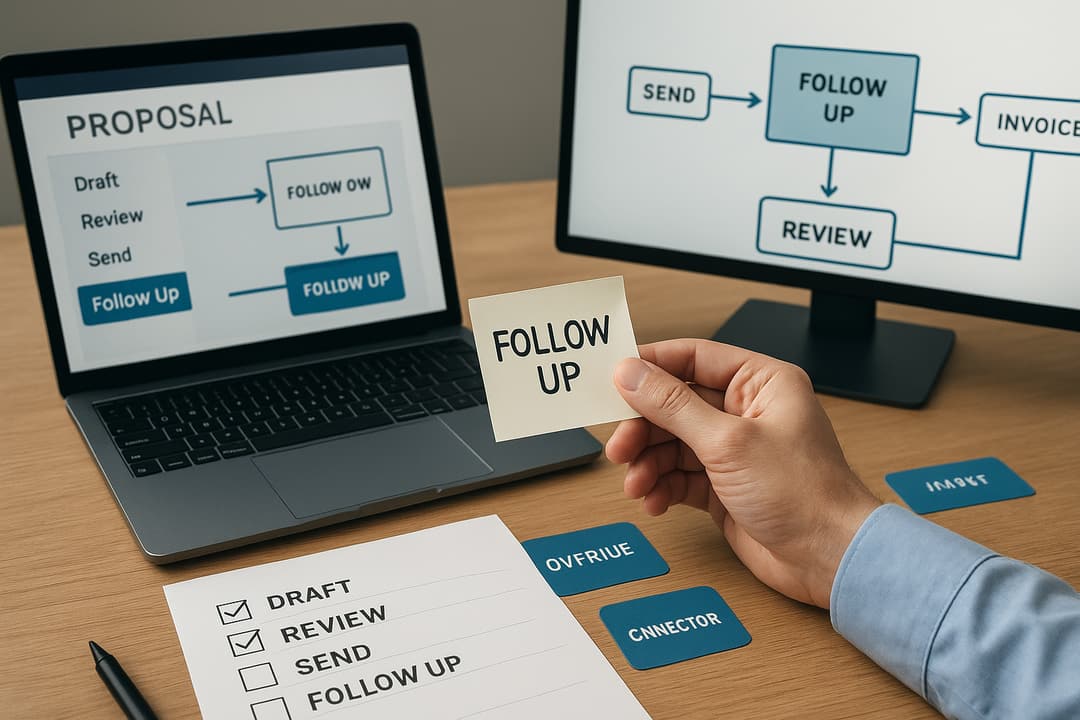
Why this comparison matters: founders searching for "netsuite vs marketo for proposal follow-up" are usually at a decision point: which system will reliably move proposals toward signed contracts under real-world conditions? The vendor feature lists are noisy and misleading. The actual point of failure is execution quality — sync delays, mismatched SLAs, brittle field ownership, and missing reconciliation.
This practical guide reframes the debate away from feature checkboxes and toward orchestration: who owns the canonical fields, which timestamps start SLA timers, how retries and dead-letter queues behave, and what to monitor so the next dropped proposal is caught before revenue evaporates.
What founders really mean when they search "netsuite vs marketo for proposal follow-up"
Search intent for this query is tactical and decision-stage. Teams want to know whether proposal follow-up should be driven by the engagement engine (Marketo), the transactional ledger (NetSuite), or an orchestration layer that enforces SLAs and reconciliation. The right answer is not a vendor pick — it’s an enforcement pattern.
Key outcome after reading: you will be able to name the authoritative owner for each critical field (proposal_sent_at, proposal_status, next_follow_up), specify SLA tiers and retry rules, and add the minimal dashboards and reconciliation jobs that prevent execution loss.
Decision-stage signals we watch
- You already use Marketo for nurture and want to trigger a proposal email.
- NetSuite is your system of record for contracts and revenue, and you need accurate contract lifecycle data.
- Your team sees proposals marked "sent" but later no follow-up or late escalation emails.
If that sounds like you, this post maps failure modes to concrete operator checks and a remediation sprint.
Why feature checklists lose — orchestration is the real battleground
Vendors list templates, scoring, saved searches, and native connectors. Those features matter, but only if they are stitched into an orchestration plan. Execution fails when teams assume connectivity equals correctness.
Operators should decide orchestration first. The levers that actually protect revenue are:
- Ownership of truth for transactional fields (who owns proposal_status and contract_signed_at?).
- Source timestamps vs ingestion timestamps (which clock starts SLAs?).
- API throttling and queuing strategies (how do we handle 429s and spikes?).
- Idempotency and duplicate prevention (how do we collapse retries?).
- Dead-letter queues and daily reconciliation (how do we recover missed events?).
- Human-in-the-loop gates for hot proposals (when must an AE confirm?).
If you reframe "NetSuite vs Marketo" as "Which layer enforces the SLA and reconciles state?", the decision becomes clear: use each platform for its strengths and insert a small orchestrator as the arbiter of timing and correctness.
Platform engineering profiles for follow-up (short)
NetSuite: transaction-first, authoritative for revenue events
NetSuite is built to manage transactions, contracts, and financial state. Use it as the system of record for acceptances, signed contracts, and any event that triggers billing or delivery. NetSuite's SuiteScript and saved searches support scheduled reconciliation and complex transaction logic, but it is not optimized for high-touch, multi-step engagement sequences.
Official NetSuite resources: netsuite.com
Marketo (Adobe Marketo Engage): engagement-first, sequencing and personalization
Marketo is designed for multi-touch nurture, event-driven campaigns, and behavioral segmentation. It excels at email sequencing, personalization, and engagement scoring. Marketo should own engagement timestamps (proposal_sent_at, template_id, opens, clicks), not contract outcomes.
Official Marketo resources: adobe.com products / marketo.html
Integration mechanics that typically break proposal follow-up
When Marketo and NetSuite are connected without orchestration, failures cluster into repeatable modes. For each mode below, you'll get an operator test you can run in under 10 minutes.
API throttling, queuing delays, and hidden latency
Problem: Integrations push events in near-real time but hit API rate limits; calls are queued, delayed, or dropped.
Operator test: inspect integration logs for 429/503 responses and measure average latency from proposal_sent (Marketo) → proposal_record_created (NetSuite). If median latency is >30 minutes for hot proposals, you have a reliability problem.
Tooling note: enterprise middleware like Celigo exposes throttling events and queuing metrics (see Celigo templates for Marketo–NetSuite). Example vendor: celigo.com
Ownership confusion for canonical fields
Problem: Marketo writes proposal_status="sent" and then NetSuite overwrites with stale values because there’s no last-writer logic or source tag.
Operator test: query records for last_modified_by and last_modified_timestamp in both systems for a sample of proposals created in the past 48 hours. Look for contested records where source tags differ.
Fix pattern: add source_system and last_modified_timestamp fields on every write and implement last-writer-wins or source-priority rules in the orchestrator.
SLA drift: wrong clock, wrong timer
Problem: SLA dashboards start timers from ingestion timestamps instead of the event's canonical timestamp. When integrations delay, SLAs look missed even though the team acted on time.
Operator test: pick a missed-SLA incident and compare proposal_sent_at (originating system) to the NetSuite ingestion timestamp. If ingestion > event timestamp, rebase SLA to event time.
Idempotency and duplicate outreach
Problem: Retries without idempotency keys create duplicate follow-ups and rep confusion.
Operator test: search for multiple activities with the same proposal_id and similar timestamps in Marketo or NetSuite. Implement idempotency keys that include proposal_id + source_system + event_version.
Human-in-the-loop gates not enforced
Problem: Hot opportunities incorrectly advance through an automated cadence because the orchestrator didn't require AE confirmation.
Operator test: locate hot proposals (tagged demo/RFP) and check whether next_follow_up advanced without AE_ack=true. If yes, add a gate.
Concrete failure scenario (named fields, timestamps, recovery steps)
Scenario summary: 50-person SaaS, Marketo sends proposal, Celigo integrates to NetSuite. A 6-hour integration delay causes SLA false-positives, late escalations, and a lost deal.
Sequence (detailed):
- AE sends proposal in Marketo: activity_type=proposal_sent, proposal_id=PR-2026-600, proposal_sent_at=2026-06-01T09:20:00Z, source_system=marketo.
- Celigo flow picks up the event and attempts to push to NetSuite with payload {proposal_id, account_id, proposal_sent_at, proposal_status: 'sent', next_follow_up: 2026-06-03T09:20:00Z}.
- Celigo hits API rate limit; request is queued and only succeeds at 2026-06-01T15:30:00Z, writing to NetSuite with ingestion_timestamp=2026-06-01T15:30:00Z.
- Sales ops runs SLA report at 11:00 that flags the proposal as missed because the SLA timer was anchored to NetSuite ingestion_timestamp.
- An escalation email triggers at 11:05; AE calls at 16:00 and discovers the prospect signed elsewhere at 14:00.
Root causes:
- SLA started from ingestion_timestamp, not proposal_sent_at.
- No integration acknowledgement or short-term cache to represent in-flight events.
- No dead-letter queue for delayed pushes; retries silently succeeded late.
Specific recovery steps:
- Start SLA timers from the event timestamp (proposal_sent_at) and persist the source_system tag.
- Add an integration_ack flag on the Marketo activity when the orchestrator receives the event.
- Implement idempotent writes using a composite idempotency_key = sha256(proposal_id + source_system + event_version).
- Add a dead-letter queue for any event with retry_count > N and a daily reconciliation job that surfaces mismatches older than 1 hour to an SDR or ops queue.
You can configure these changes in middleware (Celigo, Mulesoft, or a small custom service) and validate in non-prod before rolling to pilot.
Diagram (conceptual): Marketo → Orchestrator → NetSuite (alt text below)
Alt: Diagram showing Marketo sending proposal_sent events to a middleware orchestrator (queue, backoff, idempotency, dead-letter), which then writes transactional records into NetSuite. Key fields: proposal_sent_at (Marketo), proposal_status and contract_signed_at (NetSuite), next_follow_up and integration_ack (orchestrator).
Orchestration playbook: minimal controls to prevent execution loss
This checklist is sprint-ready — prioritize items top-down.
- Field ownership mapping (example):
- Marketo owns: proposal_sent_at, initial_template_id, engagement_events (opens, clicks).
- NetSuite owns: proposal_status (sent/accepted/rejected), contract_signed_at, billing triggers.
- Orchestrator owns: next_follow_up, integration_ack, idempotency_key, retry_count, dead_letter_flag.
- SLA tiers (example):
- Hot (RFP/demo requested): human touch in 30 minutes; integration ack in 10 minutes.
- Warm (proposal after discovery): human touch in 4 hours or automated touch within 24 hours.
- Cold: standard Marketo nurture cadence.
- Integration controls:
- Use middleware that supports exponential backoff, retry limits, idempotent writes, and dead-letter queues (Celigo templates are a common starting point). celigo.com
- Always start SLA timers from the event's canonical timestamp (proposal_sent_at), never the ingestion timestamp.
- Surface 429/5xx as immediate alerts and track them on an integration health dashboard.
- Human-in-loop gates:
- If source_segment == 'Hot', require AE_ack before escalation or breakup sequences run.
- Day-zero reconciliation:
- Daily job that compares Marketo proposal_sent events to NetSuite proposal records; mismatches create a triage ticket for ops/SDR.
QA checks and monitoring you must build
- Integration health dashboard: success rate, average latency, 429/503 counts, dead-letter counts.
- SLA dashboard: % of hot proposals contacted within SLA across rolling 7/30/90-day windows.
- Reconciliation report: % of proposals with mismatched proposal_status across systems and a prioritized list of offending accounts.
- Synthetic testing: hourly automated events that assert end-to-end delivery within SLA; fail the build if threshold breached.
Run the reconciliation query on a rolling 7-day window and require <1% mismatch within 24 hours for production readiness.
Internal Meshline resources to consult while building these dashboards:
- Meshline orchestration playbook: Meshline orchestration playbook
- Proposal-specific templates and workflows: Meshline proposal follow-up playbook
- Reliable sync patterns and idempotency guidance: Meshline sync patterns
- SLA monitoring examples and alerting: Meshline SLA monitoring guide
Decision guide: when to let NetSuite, Marketo, or an orchestrator own follow-up
Let NetSuite be authoritative when
- You require auditable contract lifecycle events that influence finance, legal, or delivery.
- Contract acceptance triggers billing, fulfillment, or downstream operational workflows.
Let Marketo own follow-up when
- You need multi-touch nurture, segmentation-driven content, or behavioral triggers (page views, product usage events).
- Volume and personalization matter more than transaction auditing.
Make the orchestrator the conductor when
- You require strict SLAs, cross-system rules, retries, and reconciliation.
- API limits or burst traffic require queuing, backoff, and dead-letter handling.
Most mature teams use a hybrid: Marketo for engagement, NetSuite for transaction state, and an orchestration layer to enforce SLA timers, idempotency, and reconciliation.
Commercial and implementation notes (tradeoffs and vendor options)
- Connectors and templates (time-to-value): Celigo provides templates for Marketo–NetSuite flows and surfaces throttling and error metrics. celigo.com
- Low-code options (small volume): Zapier can stitch events quickly but lacks enterprise-grade queuing, idempotency, and dead-letter control.
- Developer-first flow platforms: Vendors like Vertify or APIWORX allow custom dead-letter queues and fine-grained retries; choose them if you need custom field-level reconciliation.
When evaluating partners, insist on a walkthrough of their error-handling, SLA timers, dead-letter queue behavior, and reconciliation reports — not just a list of supported fields.
If you want to see an example orchestrator that maps fields, enforces a five-minute SLA for hot proposals, and auto-reconciles mismatches, See the engine structure.
How to test a new NetSuite–Marketo follow-up orchestration in 7 days (practical sprint)
Day 1: Field map and SLA tiers — finalize authoritative owners.
Day 2: Build middleware flows with idempotency, source tags, and last_modified timestamps.
Day 3: Deploy synthetic event generator in Marketo sandbox and mark events with event_version.
Day 4: Validate end-to-end within SLA; inject 429 and verify exponential backoff.
Day 5: Run reconciliation job; fix mapping mismatches and edge cases.
Day 6: Pilot with 5% of proposals (low-risk cohort) and monitor dashboards.
Day 7: Evaluate SLA performance; if hot proposals miss SLA, pause and patch orchestrator rules.
Recovery patterns when things go wrong
- Re-run reconciliation for missed days and bulk re-ingest missing events into the orchestrator.
- Collapse duplicates using idempotency_key = sha256(proposal_id + source_system + event_version).
- Backfill SLA reports using proposal_sent_at and recompute historical compliance.
- Route persistent failures to manual triage and escalate to engineering for connector fixes.
What the research says about speed and follow-up
Speed-to-contact remains a dominant driver of conversion after proposal. The classic "Short Life of Online Sales Leads" shows fast response materially increases conversion odds. When proposals go cold because of orchestration issues, it's usually timing and reliability — not email copy. (HBR link in references.)
Use established response benchmarks as a baseline, then tune by cohort: hot proposals demand minute-level SLAs; warm proposals live on hour/day windows.
Closing: what to inspect in the next 30 minutes
- Run a reconciliation for proposals created in the past 48 hours — compare Marketo proposal_sent_at to NetSuite proposal records.
- Inspect integration logs for recent 429/5xx spikes and compute mean latency from event generation to NetSuite write.
- Confirm SLA timers start from proposal_sent_at (source event) and not the ingestion timestamp.
- If you find gaps, add a dead-letter queue and a short-term manual triage process for in-flight events.
If you finish these checks and still see >5% missed SLA on hot proposals, the next step is to add a small orchestrator that ensures idempotency, explicit field ownership, and automatic reconciliation.
Selected external references
- NetSuite (official): netsuite.com
- Adobe Marketo Engage (official): adobe.com products / marketo.html
- Celigo Marketo–NetSuite integration overview: celigo.com
- HBR: "The Short Life of Online Sales Leads": hbr.org 03 / the-short-life-of-online-sales-leads
- HubSpot on lead response time: hubspot.com reduce-lead-response-time
For proposal follow-up Automation Guide for Founders, ## Implementation Evidence and Reliability Checks
Use these references to validate the proposal follow-up implementation model, reliability assumptions, integration controls, and incident-response expectations before rollout.
- For proposal follow-up Automation Guide for Founders, Google Cloud Architecture Framework
- For proposal follow-up Automation Guide for Founders, AWS Well-Architected Framework
- For proposal follow-up Automation Guide for Founders, Microsoft Azure Well-Architected Framework
- For proposal follow-up Automation Guide for Founders, CNCF Platform Engineering Maturity Model
- For proposal follow-up Automation Guide for Founders, Martin Fowler on distributed systems patterns
Where proposal follow-up usually breaks in practice
The useful test for netsuite vs marketo for proposal follow-up is not whether the team can draw a clean workflow. It is whether the workflow still behaves when a record arrives late, a required field is missing, or two systems disagree about who owns the next action.
Start by writing down the first signal, the field that proves it is trustworthy, the person who can override the route, and the timestamp that shows whether the handoff happened on time. Those details make proposal follow-up automation reviewable instead of merely automated.
For buyers comparing netsuite vs marketo for proposal follow-up, the decision should center on proposal follow-up automation, proposal follow-up reporting, proposal follow-up exception handling, proposal follow-up ownership, and whether the team can inspect the audit trail without asking engineering to reconstruct the incident. netsuite marketo comparison belongs in the article only where it clarifies a real operator decision, not as a stray keyword. proposal follow-up platform comparison belongs in the article only where it clarifies a real operator decision, not as a stray keyword. founders proposal follow-up tools belongs in the article only where it clarifies a real operator decision, not as a stray keyword.
When proposal follow-up needs an operating layer
Meshline fits when proposal follow-up is no longer a single automation but a recurring operational commitment. The warning sign is usually simple: people trust the tool when everything is normal, then leave Slack messages, spreadsheet notes, and manual fixes behind as soon as the edge case appears.
For proposal follow-up, the operating layer should define the proposal event, account owner, timing rule, review moment, retry behavior, and evidence trail before sales teams rely on it. That gives revenue teams a way to adjust follow-up without chasing every exception manually.
The commercial question is whether proposal follow-up needs another connector or a maintained execution layer. If the workflow touches CRM ownership, billing readiness, customer handoffs, reporting, or rep follow-up, implementation should be scoped around recovery and auditability as much as speed.
- Ask which system wins when proposal status disagrees.
- Ask who can pause or override follow-up without creating a side process.
- Ask what evidence remains after a proposal handoff fails and is recovered.