
 MeshLine
QuickBooks Automation Services for Revenue Ops
Decision-stage commercial playbook for Revenue Operations: how Meshline scopes, builds, QA-checks, and runs QuickBooks automation services — integrations, invoice automation, exception routing, and a direct CTA to Book a strategy call.
QuickBooks Automation Services for Revenue Ops — Faster Billing, Fewer Reconciliations
Revenue operations teams must close books faster, reduce unapplied cash, and keep CRM, payments, and accounting in tight sync. QuickBooks automation services from Meshline replace brittle manual handoffs with auditable, SLA-backed finance workflows so revenue teams scale without adding headcount.
This page is a buyer-focused solution brief for revenue ops teams deciding between connectors, custom builds, and managed automation. It describes outcomes, integration patterns, implementation scope, QA rules, failure modes, and how Meshline scopes, builds, QA-checks, and operates QuickBooks automation workflows in production. Ready to move from evaluation to a working pilot? Book a strategy call with our team.
Why QuickBooks automation services matter for Revenue Ops
- The pain: disconnected invoice processes, late recognition, and manual reconciliations that increase DSO and obscure cash forecasting.
- The outcome: automated invoice issuance, matched payments, synchronized AR ledger and CRM, event-driven recognition triggers, and auditable exception routing.
- Who buys: Revenue Ops, Billing, Accounting Ops, and Finance leaders who need reliable QuickBooks integration services and invoice automation services for predictable month-end close.
QuickBooks automation services are not just generic connectors. Production-grade automation includes orchestration, business rules, idempotency, observability, and an operational playbook so exceptions are routed and resolved quickly.
Meshline operating framework for QuickBooks automation
Meshline treats QuickBooks automation as an Autonomous Operations Infrastructure layer: an execution plane that enforces rules, routes exceptions, and provides SLAs for data sync and process completion.
Key components we design and deliver
- Integration adapters: secure QuickBooks API integration with scoped OAuth 2.0, token refresh, and credential vaulting. See Intuit developer docs for partner-ready API patterns.
- Orchestration engine: event-driven flows with idempotency keys, retries, backoff, DLQs, and monitoring.
- Business rule engine: configurable mapping for invoice structures, tax treatment, recognition schedules, and custom fields.
- Exception routing: automated tickets with SLA-driven escalation and human-in-the-loop consoles for disputes.
- Observability & audit: immutable audit logs, reconciliation dashboards, automated variance detection and alerts.
Meshline design rules (operating principles)
- Authoritative-source mapping: identify a single source of truth for customer, product, and pricing before any write to QuickBooks.
- Idempotency-first writes: every write includes idempotency keys and reconciliation IDs to prevent duplicates.
- Fail-safe receipts: failed payments are quarantined and a remediation ticket created; entries are reversed or held per policy.
- Least-privilege access: connectors use scoped OAuth tokens, rotated in a secrets manager, and audited for access.
Typical performance targets: sub-60s for single-event invoice syncs; sub-5min for bulk batches under normal load.
Use cases revenue ops teams actually buy
Below are implementation patterns Meshline frequently delivers when buyers evaluate QuickBooks automation services.
CRM-driven invoice automation
- Trigger: closed-won in CRM with approved contract attachments.
- Flow: map opportunity line items -> apply discounts & taxes via rule engine -> create invoice in QuickBooks -> return invoice URL and ledger ID to CRM.
- Benefit: single-touch sales-to-cash handoff and improved AR aging accuracy.
Subscription billing and revenue recognition
- Trigger: subscription renewal, proration, or plan change.
- Flow: billing events map to QuickBooks invoices or sales receipts depending on collection approach; deferred revenue schedules posted for ASC 606 compliance.
- Benefit: auditable recognition and cleaner month-end close.
Invoice automation services for professional services firms
- Trigger: project milestone or approved timesheet.
- Flow: timesheets + expenses -> apply client billing rules -> create invoice draft in QuickBooks or auto-send.
- Benefit: faster billing cycles and fewer disputes.
Payment matching and bank reconciliation
- Trigger: payment transaction from Stripe, payment gateway, or bank feed.
- Flow: match bank/processor deposits to QuickBooks invoices or create unapplied payment entries and route mismatches for review.
- Benefit: fewer unapplied cash items and faster reconciliations.
Implementation roadmap: scoping to production
Typical timings: SMB pilots 6–10 weeks; enterprise with complex multi-entity or recognition logic 8–16 weeks. Meshline engagements follow a staged, measurable approach.
Phase 1 — Discovery & intent (Week 0–1)
- Stakeholders: RevenueOps lead, Accounting manager, IT, Sales Ops.
- Deliverables: integration matrix, canonical data model, SLA targets, exception policies.
- Gate: authoritative source disputes resolved (CRM vs billing).
Phase 2 — Design & mapping (Week 1–3)
- Map CRM/billing objects to QuickBooks entities: Customers, Items, Invoices, Payments.
- Define idempotency keys, reconciliation IDs, and error taxonomy.
- Security review: OAuth scopes, vault policy, and PCI/PII handling.
Phase 3 — Build & connect (Week 2–6)
- QuickBooks API integration: OAuth 2.0 flows, refresh tokens, and sandbox testing (see Intuit developer docs).
- Payment integration: Stripe Connect metadata and reconciliation fields (see Stripe docs).
- Middleware: implement retries, exponential backoff, dead-letter queues, and monitoring (recommended patterns in AWS Lambda best practices).
Phase 4 — QA & staging (Week 4–8)
- Data validation: reconcile 100 sample invoices, verify tax mapping, and confirm totals.
- Simulation: synthetic failed payments, duplicate events, and reconsent flows.
- Audit: attach immutable logs for review and compliance.
Phase 5 — Pilot & rollout (Week 6–10)
- Phased rollout per business unit or region; operate for 2 billing cycles and collect KPIs.
- Measure: time-to-close, unapplied cash, exception volume, and reconciliation variance.
Phase 6 — Run & operate (Ongoing)
- SLAs: 99% event delivery, mean time to triage (MTTT) < 1 hour for critical exceptions.
- Continuous improvement: weekly dashboards and monthly rule tuning with Revenue Ops and Accounting.
Engineering details and integrations (how it actually connects)
This section lists the technical patterns Meshline uses and references authoritative sources for implementers.
Authentication & API patterns
- Implement OAuth 2.0 with short-lived access tokens and automated refresh stored in a secrets manager. (See the OAuth 2.0 spec and Intuit guidance.)
- Use scoped permissions and rotation to minimize blast radius on credential leaks.
Webhooks & event orchestration
- Prefer event-driven webhooks and idempotent event IDs for low latency. Use retry semantics and signature verification to secure listeners (recommended by GitHub Webhooks best practices).
- Store incoming events in a queue, validate schema, and process idempotently.
Payments & reconciliation
- Use payment metadata to link processor transactions to QuickBooks invoices. Stripe supports per-charge metadata that simplifies mapping (Stripe docs).
- For marketplaces, use Stripe Connect to capture platform vs seller flows and reconciliation metadata.
Bank feeds & transaction enrichment
- Standardized bank transaction data and enrichment via Plaid can accelerate matching and deposit reconciliation (Plaid docs).
- Where direct bank feeds are not available, use payment processor webhooks plus daily settlement reports.
Security & compliance
- For card data flows, follow PCI-DSS controls and scope-reduction patterns (see PCI SSC).
- For identity controls and assurance, reference NIST SP 800-63 recommendations.
Operational automation & deployment models
- Small-scale: serverless functions (AWS Lambda) with DLQ and tracing.
- Complex or multi-tenant: containerized microservices with namespace isolation and per-tenant routing.
- Always include dead-letter queues, a human-in-the-loop console, and immutable logs for audit trails.
QA, risk controls, ownership, and failure modes
This is the operations manual for owners and technical responders.
Ownership rules (who does what)
- Revenue Ops: owns business rules, mapping logic, approval thresholds, and exception decisions.
- Accounting: owns chart-of-accounts mapping, revenue recognition policy, and month-end signoff.
- Platform/IT: owns connector credentials, secrets vault, and infrastructure costs.
- Meshline (managed): operates the orchestration layer, runs QA playbooks, and escalates financial control issues.
Exception paths & routing
- Data mismatch: create a review task with context and suggested actions; escalate per SLA if unresolved.
- Failed write to QuickBooks: auto-retry with exponential backoff; if still failing, send to DLQ and notify Ops.
- Duplicate invoice attempts: deduplicate using idempotency keys and log incidents.
QA checks (preflight & runtime)
- Pre-deploy: 100% schema validation of sample invoices, tax checks, and reconciliation of totals.
- Runtime monitors: alert on >1% failure rate over 1 hour or any QuickBooks auth failures.
- Nightly reconciliation: count and notional dollar variance between CRM-billed and QuickBooks-posted amounts.
Common failure modes & mitigations
- Token expiry / revoked consent: automated refresh and re-consent flows; admin alerts when manual re-consent needed.
- Schema drift upstream: gating and contract testing in staging; unknown fields cause tombstoning and human review.
- Tax calculation mismatches: central tax library synced to QuickBooks mapping and flagged variances.
Pricing, scope, and decision criteria when comparing vendors
Meshline offers three engagement levels tailored to buyer intent.
Service tiers
- Fixed-scope pilot: a defined set of invoice types, sandbox integration, and 30-day post-launch support.
- Managed automation: ongoing SRE, monitoring, and monthly rule tuning.
- Full outsourcing: Meshline operates orchestration, triage console, and runs under SLA.
Buyer decision checklist
- Does the vendor write to QuickBooks with idempotency keys and reconciliation IDs? (Essential)
- Can the vendor integrate with your payment stack (Stripe, bank feeds) and CRM with minimal custom middleware? (Important)
- Is there clear exception routing and finance-team SLAs? (Critical)
- Does the vendor support multi-entity accounting and multi-currency handling? (If applicable)
Vendor comparison questions to ask
- Show me a live demo where an invoice fails and how the system surfaces and resolves it.
- How are OAuth re-consent and token expiry handled? Walk me through the flow.
- Can you provide immutable audit logs per transaction?
- What are your SLOs for event delivery and mean time to triage?
Proof themes and evidence buyers want
- Real customers report reduced DSO and faster reconciliations after implementing invoice automation services and payment matching.
- Typical reconciliations reduction: 60–80% decrease in manual hours for matched customers.
- Meshline pilots include measurable KPIs: reconciliation variance, unapplied cash reduction, and time saved per billing cycle.
Diagram alt text
Alt text: "Diagram: CRM -> Meshline orchestration -> QuickBooks API with event queues, retries, dead-letter queue, human-in-the-loop, and bank/payment connections."
Mid-article resources & links (authoritative references)
- Intuit QuickBooks developer docs: developer.intuit.com
- OAuth 2.0 specification: oauth.net 2
- Stripe integration and metadata patterns: stripe.com docs
- Plaid bank data and enrichment: plaid.com docs
- GitHub webhook best practices (delivery & retries): docs.github.com webhooks-and-events / about-webhooks
- AWS Lambda best practices (retries, DLQs, scaling): docs.aws.amazon.com dg / best-practices.html
- PCI DSS standards and guidance: pcisecuritystandards.org
- NIST SP 800-63 identity assurance guidance: pages.nist.gov 800-63-3
Next steps and buying guidance — Book a strategy call
If you're choosing between a quick connector and a production-grade automation layer, prioritize idempotency, exception routing, SLA-backed operations, and payment-stack integration.
Meshline offers:
- A 6–10 week pilot: scope, implement, and prove ROI with real invoices and reconciliation reports.
- Managed operations: monitoring, rule tuning, and runbooks for finance teams.
- Full operating model: Meshline runs orchestration and triage under SLA.
Book a strategy call to get a tailored pilot scope. We will demo a failing invoice flow, review audit logs, and estimate time-to-value for your environment. Book a strategy call
Related Meshline resources (internal links)
- Canonical scoping guide: QuickBooks automation services for revenue operations
- Integration service overview: Integration & Connector Services
- Finance automation playbook: Finance Automation Playbook
- Revenue Ops glossary and ownership rules: Revenue Ops Glossary
Practical checklist: launch readiness and 30/60/90-day rules
Pre-launch (must complete)
- Authoritative data model signed off.
- Sandbox sync validated with 100 sample invoices.
- OAuth tokens and secrets stored in a vault with rotation.
- Exception queues configured and tested.
30 days post-launch
- Reconciliation variance <0.5% by count and <1% by dollar value.
- Audit 50 random transactions end-to-end and attach independent evidence.
60 days post-launch
- Confirm reduction in manual reconciliation hours and DSO improvements versus baseline.
- Implement any deferred custom rules for edge-case customers.
90 days post-launch
- Finalize SLOs and operational SLA if needed.
- Plan next-phase integrations (multi-entity, tax automation, or deeper payments reconciliation).
Final notes for vendor comparison
Many vendors promise automation; only a disciplined integration layer, idempotent writes, and a formal operations playbook produce sustainable outcomes. When evaluating partners, insist on a live demo of exception handling, a sample audit log, and proof of reconciliation IDs.
If you are ready to move from evaluation to execution, Book a strategy call and we will map your first 90-day pilot to measurable finance outcomes.
Contact: Book a strategy call
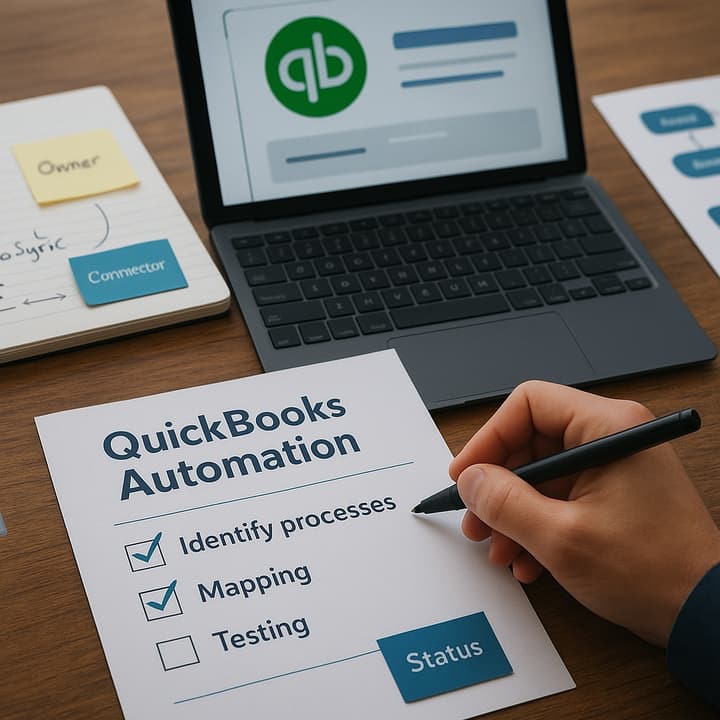
QuickBooks automation services Implementation Checklist
Use this QuickBooks automation services checklist to keep the QuickBooks automation workflow specific enough for operators and buyers. Name the owner, source system, destination system, exception route, QA checkpoint, and reporting field before automation goes live.
For QuickBooks automation services, Meshline should confirm the trigger, review path, audit trail, fallback owner, and demo-ready outcome. That keeps QuickBooks automation services from becoming another disconnected workflow and gives teams a practical implementation path.
The operating language should stay consistent: QuickBooks automation services, QuickBooks automation automation, QuickBooks automation workflow, QuickBooks automation operating model, QuickBooks automation implementation, QuickBooks automation checklist, QuickBooks automation QA, QuickBooks automation governance, exception routing, automation governance, operational visibility, and Meshline's operating layer. QuickBooks integration services should appear where it clarifies search intent and buyer relevance. invoice automation services should appear where it clarifies search intent and buyer relevance. finance workflow automation should appear where it clarifies search intent and buyer relevance. QuickBooks API integration should appear where it clarifies search intent and buyer relevance.
Meshline Implementation Fit
Meshline is the right fit when the QuickBooks automation path needs more than a one-off automation. The implementation should include a named source of truth, a visible owner, deterministic routing rules, QA checks before each write, an exception queue, and a recovery path that operators can inspect without asking engineering to reconstruct what happened.
For QuickBooks Automation Services for Revenue Ops, for commercial evaluation, Meshline scopes the workflow as an operating system: discovery, data contracts, integration logic, review gates, observability, launch support, and post-launch optimization. That makes the page useful for buyers comparing tools, agencies, low-code automations, and custom integration work.
For QuickBooks Automation Services for Revenue Ops, the Meshline implementation narrative must stay anchored in Autonomous Operations Infrastructure: an operating layer above scattered tools, an execution layer for system-led execution, trigger-to-outcome execution for revenue-critical work, ownership and control for the business team, engines that continue improving after launch, and self-operating business systems that reduce manual coordination.
- For QuickBooks Automation Services for Revenue Ops, Book a strategy call when the workflow touches revenue, billing, CRM ownership, attribution, customer handoffs, or reporting.
- For QuickBooks Automation Services for Revenue Ops, Use Meshline when the buyer needs implementation accountability, not only a connector recommendation.
- For QuickBooks Automation Services for Revenue Ops, Keep this page as the primary URL for the keyword family; related glossary and blog posts should link here as supporting context.
Keyword Ownership and Supporting Links
This page is the primary Meshline URL for the QuickBooks automation services keyword family. Supporting glossary, blog, and comparison pages should link here when they discuss this buyer-intent cluster.