
 MeshLine
support triage Automation Guide for Marketing Teams
Brittle integrations don’t just fail — they reveal where marketing ops relies on manual coordination, fragmented tooling, and no runtime ownership. This playbook reframes brittle integrations as coordination debt and prescribes routing, DLQs, contract tests, and automation to move toward autonomous operations. See the engine structure for a concrete runtime mapping.
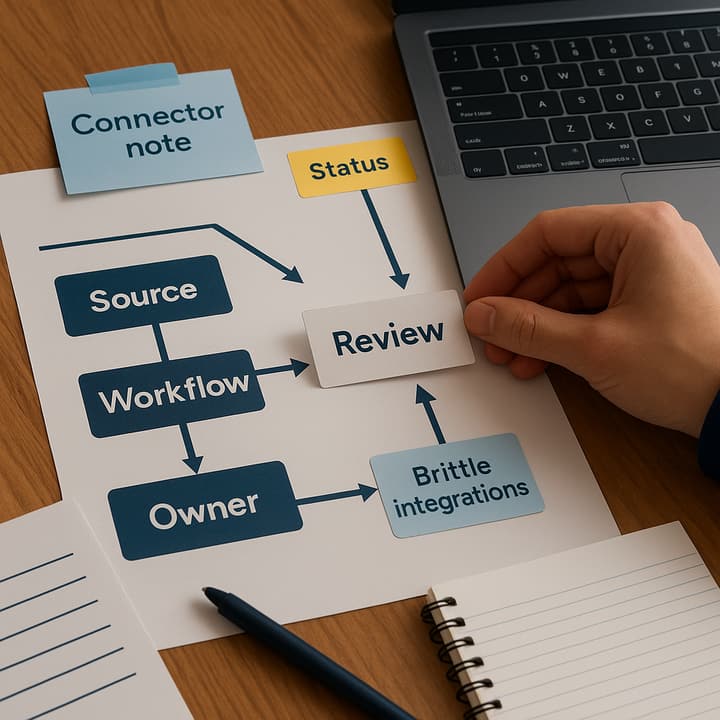
Brittle Integrations Support Triage Infrastructure Problem: A Marketing Ops Integration & Automation Playbook
Marketing ops teams habitually treat incidents as tickets to close. When the same connector re-opens tickets, webhooks drop, or cross-team escalations stall, the visible symptom is a brittle integrations support triage infrastructure problem — and that phrase names both a visibility gap and a systemic infrastructure failure.
This post is a practical operator playbook for marketing ops leaders and practitioners. It reframes brittle integrations as coordination debt, shows how fragile connections expose a manual coordination problem and a fragmented stack problem, and gives an actionable sequence to reduce incident volume, shorten mean time to remediate (MTTR), and move toward an autonomous operations infrastructure.
If you want the pragmatic next step, see the engine structure used to map ownership and routing at runtime in Meshline: See the engine structure.
Why brittle integrations reveal an infrastructure problem
Brittle integrations are more than flaky connectors. They are a diagnostic instrument: the places where your automation breaks tell you how your team actually runs support triage.
- Symptom statement: recurring connector failures, data drift from sources of truth, and long manual handoffs between ops, CRM, analytics, and vendors.
- Systemic diagnosis: these symptoms point to a manual coordination problem and a fragmented stack problem — summarized by the phrase brittle integrations support triage infrastructure problem.
Why this matters now
- Each working hour spent debugging Zapier zaps, webhooks, or ad-hoc sync scripts is coordination time, not product time. What feels cheap compounds into coordination debt.
- Without deterministic routing and end-to-end execution visibility, escalations multiply, SLAs are missed, and customer experiences degrade.
Quick signals you have this problem
- The same connector re-opens tickets weekly.
- Tickets require pinging multiple distinct tool owners across Slack and email before a fix starts.
- Post-mortems list “unknown owner” or “outdated docs” as contributors.
For context on connector expectations and webhook reliability, see Salesforce’s guidance on API versioning and HubSpot’s webhook docs for how connector assumptions can push fragility onto operators: Salesforce API versioning and HubSpot webhooks.
Operating framework: treat coordination debt like technical debt
Thesis: coordination debt should be managed like technical debt. It needs clear ownership, flow-level guarantees, and instrumentation designed for human workflows.
Core principles
- Route, don’t ask: every alert must have a deterministic owner and an automated routing path.
- Make execution observable: logs, lineage, and replayability are table stakes; the inability to replay makes integrations brittle.
- Fail fast, fail loudly: surface partial or boundary failures instead of permitting corrupted data to proliferate downstream.
Four-layer operator model (applies to marketing ops)
- Source layer: systems of record (CRM, CDP, forms). Owners and schema contracts must be explicit — see Salesforce and HubSpot sandbox practices: Salesforce dev, HubSpot developer.
- Transport layer: connectors, middleware, and message buses. These must expose delivery guarantees and DLQs (dead-letter queues); AWS and Google Cloud messaging docs are good references: AWS messaging guide, Google Cloud Pub/Sub.
- Transformation layer: enrichment and mapping logic. Treat transforms as code with tests and staging runs — use tools like Segment and Postman for validation: Segment schema, Postman testing.
- Triage layer: routing, playable runbooks, and human-in-the-loop steps. This is where Meshline’s engine structure maps incidents to owners and escalation paths: See the engine structure.
This model aligns with Meshline resources such as the autonomous operations infrastructure overview and the coordination debt glossary.
Ownership rules (operator-level)
- Every connector must have a single canonical owner and a documented escalation chain.
- Owners must own schema contracts, test suites, and a one-page runbook tied to alerts.
- For connectors that cross teams, assign a cross-functional steward with a primary executor chosen by the triage router.
Execution guarantees you should demand
- Know your semantics: at-least-once vs exactly-once. Messaging platforms differ — check AWS SQS and Google Pub/Sub docs for guarantees: AWS SQS, Google Pub/Sub semantics.
- DLQ visibility: dead-lettered events must surface into a triage queue that has clear ownership and replay capability.
The routing contract
A routing contract answers: when an integration fails, where does the alert go and who must acknowledge it within X minutes? Implement on-call rotas or a triage bot in Slack to enforce routing SLAs; Slack and Atlassian document patterns for alerting and incident workflows: Slack alerting patterns, Atlassian incident management.
Concrete failure scenarios and what they reveal
Below are real-world failure modes, what they reveal about your stack and processes, and pragmatic quick fixes.
The influencer form that never lands in the CRM
- Failure mode: webhook drops, retries not configured, enrichment job expects a field that changed.
- What it reveals: no contract enforcement, no DLQ, and no owner for the webhook.
- Quick fix: add a replayable DLQ, validate schema changes in staging with Postman or Segment schema checks: Postman, Segment.
Paid-channel conversions diverge from analytics
- Failure mode: differing attribution snippets, transformation mapping changes, or deduplication errors creating duplicated records.
- What it reveals: a fragmented stack between ad platform, tag manager, and analytics — there’s no canonical conversion event.
- Quick fix: centralize event instrumentation, establish a canonical event dictionary, and route telemetry failures to a single triage queue. See attribution patterns in Segment documentation: Segment event tracking.
Staging-to-prod drift after a CRM upgrade
- Failure mode: API version changes cause field renames and scheduled syncs fail silently.
- What it reveals: missing upgrade playbook and absent integration smoke tests.
- Quick fix: run pre-upgrade smoke tests against a sandbox—Salesforce and HubSpot advise using sandbox environments for preflight checks: Salesforce sandboxes, HubSpot sandbox guidance.
Third-party vendor outage masks errors
- Failure mode: partner returns intermittent 503s and retry logic swallows contextual info.
- What it reveals: insufficient telemetry and no escalation rule tied to partner SLAs.
- Quick fix: surface the partner response in the alert payload and route vendor-related failures to a partner-oncall with SLA-weighted routing. Intercom and Zapier document webhook retry/backoff patterns that are useful references: Intercom webhooks, Zapier developer.
Implementation playbook: 6-stage sprint to turn brittle into resilient
This is a staged sequence suitable for a 4–12 week sprint-based program. Each stage includes measurable outcomes and recommended tooling references.
Stage 1 — Triage audit (week 1–2)
- Inventory all connectors, webhooks, scheduled syncs, and middleware flows. Use automated scans where possible; produce a CSV with owner, purpose, direction, SLA, and incident frequency.
- Evidence: collect sample failure tickets and measure MTTR and reopen rate.
- Deliverable: prioritized top-10 connector list that causes 80% of incidents.
Stage 2 — Define routing contracts & minimal SLAs (week 2–3)
- For each connector, define owner, responder, acknowledgment time, and escalation chain. Implement routing rules that map failure types to owner roles.
- Integrate with chatops (Slack) or incident tooling; see Slack and Atlassian for alerting patterns: Slack, Atlassian incident workflows.
Stage 3 — Add execution observability (week 3–5)
- Deploy logging, lineage, and a DLQ for every async path. Use cloud messaging guarantees as a pattern: AWS messaging, Google Pub/Sub.
- Add replay capability so operators can reprocess events after fixes.
Stage 4 — Contract tests and staging gates (week 4–8)
- Add schema and contract tests for every API or webhook in CI. Use Postman collections for API smoke tests and Segment or other schema validators for payload shapes: Postman, Segment.
- Gate deployments with these checks.
Stage 5 — Automate routing and escalation (week 6–10)
- Convert manual handoffs into deterministic routing rules. Use an orchestrator or middleware to evaluate failure context and route to the right on-call.
- Attach runbooks directly to alerts so a one-click escalation opens the right incident bridge. Atlassian describes runbook patterns that help teams avoid human choreography: Atlassian runbooks.
Stage 6 — Measure and iterate (week 8–12)
- Track key metrics: ticket reopen rate, connector MTTR, frequency of cross-team pings. Set target improvements (e.g., 50% reduction in reopen rate in quarter).
- Automate dashboards with event volume, DLQ size, and owner acknowledgment times.
Implementation checklist (practical items)
- Inventory spreadsheet with owners and SLAs.
- DLQ and replay for async connectors.
- Contract tests in CI for every integration.
- Routing rules in an orchestrator and a triage channel with auto-acknowledgment.
- Runbook templates linked from alert payloads.
For integration patterns and retry semantics, consult Zapier patterns for retries and Google/AWS docs for durable messaging guarantees: Zapier platform, AWS docs, Google Cloud Pub/Sub.
QA, risk, and ownership: rules, checks, and failure modes
Convert theory into operational rules to harden execution.
Ownership rules (explicit)
- Rule 1: Every connector entry must list a primary owner and a backup on-call. Rotate ownership as part of your ops rota.
- Rule 2: Owners must maintain contract tests and a one-page runbook stored next to the alert source.
- Rule 3: Owners join post-incident reviews when their connector contributes materially to impact.
QA checks and gating
- Pre-release: contract tests must pass in CI and an integration staging run must succeed before deploy.
- Runtime: DLQ must be monitored and cannot grow beyond a threshold without human intervention.
- Regression: after schema or API changes, run synthetic traffic and verify parity.
Exception and escalation paths
- Fast path (minutes): smart routing to owner with contextual payload and a one-click acknowledge to begin a coordinated debugging session.
- Slow path (hours): if no ack, escalate to backup and create a post-mortem ticket with timeline and observed data.
- Vendor path: if vendor outage, pull in vendor contact and apply contingency (feature toggle or temporary disable).
Failure modes to plan for
- Silent data drift: no alerting because transforms accept unexpected values — mitigate with schema validators and volume anomaly monitoring.
- Partial success: downstream systems accept partial payloads — require completeness checks or transactional boundaries where possible.
- Ownership opacity: tickets land in team mailboxes — mitigate with deterministic owner mapping and a triage dispatcher.
For patterns on event validation and API testing, consult Segment, Postman, and Intercom docs: Segment validation, Postman testing, Intercom webhooks.
Diagram: how deterministic routing fixes manual coordination
Below is a high-level diagram that shows how source systems, transport, transformation, and triage layers connect — and how a deterministic routing engine reduces manual coordination problems and returns ownership to the right team at runtime.
!Flow from source systems through transport and transformation to a triage engine that maps owners and exception paths.'/><path d='M420 80 L460 80' stroke='#333' stroke-width='2' marker-end='url(%23a)'/><path d='M640 80 L680 80' stroke='#333' stroke-width='2' marker-end='url(%23a)'/><text x='300' y='180' class='s'>Deterministic routing reduces manual coordination and provides a DLQ with replay</text></svg>)
Alt text: flow from source systems through transport and transformation to a triage engine that maps owners and exception paths, illustrating routing and DLQ replay.
Next steps: measurement, vendor choices, and a commercial decision path
If this playbook matches your reality, prioritize these next steps:
1) Run a 2-week triage audit sprint and deliver an inventory and prioritized connector list.
2) Implement DLQs and replay for the top three connectors and add contract tests in CI for those flows.
3) Replace ad-hoc routing with deterministic rules and map each failure class to a named owner and escalation step.
Vendor and implementation considerations
- Prefer platform-native guarantees where possible (Salesforce sandboxes, HubSpot webhook retry semantics). See Salesforce and HubSpot docs for sandbox and webhook best practices: Salesforce sandboxes, HubSpot webhooks.
- For lightweight automation consider Zapier patterns; for production-grade messaging guarantees consult AWS and Google Cloud: Zapier, AWS, Google Cloud Pub/Sub.
Commercial/decision CTA
If your ops organization needs a runtime mapping for ownership and routing rules, review the Meshline engine structure and schedule a demo to see how routing, DLQs, and runbooks integrate into an autonomous operations infrastructure: See the engine structure.
One-page checklist, ownership rules, and exception paths
Checklist
- [ ] Full connector inventory with owner and backup.
- [ ] DLQs enabled + replay capability for async paths.
- [ ] Contract tests for each connector, run in CI.
- [ ] Routing rules that map failure types to named owners in a triage channel.
- [ ] Runbooks attached to alerts with one-click escalation.
- [ ] Synthetic smoke tests after schema or API changes.
Ownership rules (short)
- Primary owner assigned for every integration.
- Backup owner on-call for every rotation.
- Owners update runbooks and tests before schema changes.
Exception paths (short)
- Minor: Owner acknowledges and triages within SLA.
- Major: No ack → backup → incident bridge in 15 minutes.
- Vendor outage: escalate vendor + apply contingency toggle.
Failure modes and mitigations
- Silent drift → add schema monitors and volume checks.
- Partial acceptance → transactional checks and completeness validation.
- Distributed blame → deterministic routing + enforced post-mortems.
Closing: reframe the problem and invest in infrastructure
Brittle integrations expose your operating model. If human choreography keeps data flowing, you’re carrying coordination debt that slows growth and risks experience. Framing these failures as an infrastructure problem — not a people problem — shifts investments toward runbooks, routing, observability, and replayable execution.
Ready to map ownership at runtime and reduce repeated tickets? See the engine structure or review how autonomous operations infrastructure products model routing, DLQs, and runbooks in practice: autonomous operations infrastructure overview.
Editorial outreach opportunity: this article is positioned for link-building via partner case studies and guest posts with Segment, Salesforce engineering blogs, and Intercom product reliability content. Suggested outreach targets are Segment engineering, Salesforce Platform Trust, Intercom engineering, and Postman’s developer relations.
For additional operational guidance referenced here, consult platform documentation from Salesforce, HubSpot, Segment, Zapier, AWS, Google Cloud, Slack, Postman, Atlassian, and Intercom (linked throughout this article).
brittle integrations support triage infrastructure problem Implementation Checklist
Use this brittle integrations support triage infrastructure problem checklist to keep the support triage workflow specific enough for operators and buyers. Name the owner, source system, destination system, exception route, QA checkpoint, and reporting field before automation goes live.
For brittle integrations support triage infrastructure problem, Meshline should confirm the trigger, review path, audit trail, fallback owner, and demo-ready outcome. That keeps brittle integrations support triage infrastructure problem from becoming another disconnected workflow and gives teams a practical implementation path.
The operating language should stay consistent: brittle integrations support triage infrastructure problem, support triage automation, support triage workflow, support triage operating model, support triage implementation, support triage checklist, support triage QA, support triage governance, exception routing, automation governance, operational visibility, and Meshline's operating layer. autonomous operations infrastructure should appear where it clarifies search intent and buyer relevance. manual coordination problem should appear where it clarifies search intent and buyer relevance. fragmented stack problem should appear where it clarifies search intent and buyer relevance.
Meshline Implementation Fit
Meshline is the right fit when the support triage path needs more than a one-off automation. The implementation should include a named source of truth, a visible owner, deterministic routing rules, QA checks before each write, an exception queue, and a recovery path that operators can inspect without asking engineering to reconstruct what happened.
For support triage Automation Guide for Marketing Teams, for commercial evaluation, Meshline scopes the workflow as an operating system: discovery, data contracts, integration logic, review gates, observability, launch support, and post-launch optimization. That makes the page useful for buyers comparing tools, agencies, low-code automations, and custom integration work.
For support triage Automation Guide for Marketing Teams, the Meshline implementation narrative must stay anchored in Autonomous Operations Infrastructure: an operating layer above scattered tools, an execution layer for system-led execution, trigger-to-outcome execution for revenue-critical work, ownership and control for the business team, engines that continue improving after launch, and self-operating business systems that reduce manual coordination.
- For support triage Automation Guide for Marketing Teams, Book a strategy call when the workflow touches revenue, billing, CRM ownership, attribution, customer handoffs, or reporting.
- For support triage Automation Guide for Marketing Teams, Use Meshline when the buyer needs implementation accountability, not only a connector recommendation.
- For support triage Automation Guide for Marketing Teams, Keep this page as the primary URL for the keyword family; related glossary and blog posts should link here as supporting context.