
 MeshLine
Fix CRM Sync Failures to Restore Pipeline Hygiene
Trace CRM sync failures, assign exception owners, validate corrected records, and prevent stale or duplicated opportunities from returning.
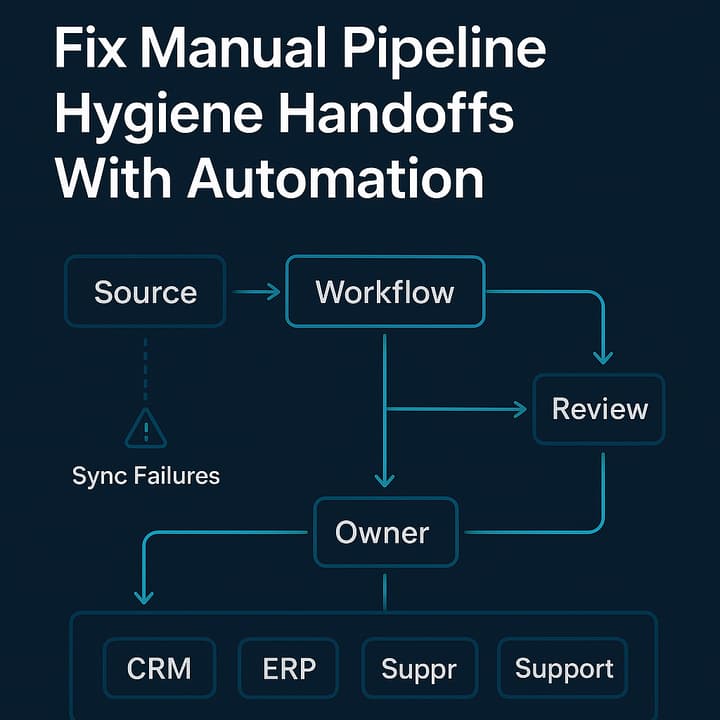
Sync failures pipeline hygiene infrastructure problem. For revenue operations teams chasing stale deals, missed commissions, and broken dashboards, "sync failures" is not a quaint engineering term — it's the recurring outage that eats forecast accuracy and trust. When you treat every failed sync as a ticket rather than a symptom, you accumulate coordination debt: repeated human triage, tribal workarounds, and undocumented fixes that compound into an operational liability.
This piece reframes those symptoms as an infrastructure problem and teaches a practical operating model for revenue ops: convert manual coordination into durable, observable automation. The guide explains why solving sync failures is the fastest, highest-leverage route to pipeline hygiene, shows concrete quick wins, and offers a decision-stage next step for implementation and demoing Autonomous Operations Infrastructure. If you're ready to move from firefighting to reliable pipelines, the immediate CTA is: See the engine structure.
Why sync failures are an infrastructure problem, not just tickets
Sync failures expose three systemic issues that together create chronic pipeline fragility:
Fragmented stack problem
Modern revenue technology is a mosaic: CRM, marketing automation, billing, product telemetry, data warehouse, and analytics. Each component assumes clean inputs and reliable handoffs. When any link breaks, the ripple looks like an ops problem but its root is architecture: the stack is fragmented and lacks a shared contract and enforcement layer.
Manual coordination problem
Teams build temporary fixes: spreadsheets, Slack escalations, manual CSV imports, and ad-hoc backfills. Those patterns are human glue — they work short-term but generate coordination debt. Every manual fix bypasses instrumentation and increases long-term MTTR.
Infrastructure problem
The real failure is missing infrastructure primitives: durable retries, idempotency keys, schema enforcement, dead-letter queues (DLQs), observability, and clear ownership. Without an execution layer that enforces contracts and automates remediation, sync failures persist as recurring toil.
Together these dynamics turn single failures into chronic hygiene problems. The right framing — sync failures as an infrastructure problem — changes the remediation path from one-off fixes to investment in durable automation and contract governance.
What sync failures look like in revenue workflows

Sync failures pipeline hygiene infrastructure problem manifests in ways revenue ops teams rely on every day.
Observable symptoms
- Stale opportunity stages and forecast drift.
- Missed commissions and reconciliation mismatches.
- Duplicate or fragmented customer records across systems.
- Incorrect segmentation or MQL/SQL transitions.
- Dashboards that show partial or missing data.
Common root causes
- Schema drift and unversioned changes.
- Webhook retries exhausted or dropped events.
- API rate-limits and throttling without backpressure.
- Missing idempotency or deduplication logic.
- Ownership gaps and unclear escalation paths.
Seeing these symptoms should trigger the same hypothesis: a contract between systems was violated and the execution fabric failed to detect, contain, and remediate the violation automatically.
An operating framework: treat sync failures as coordination debt
To move from firefighting to hygiene, adopt a framework that treats each sync failure as a contract violation with a defined remediation path. The framework has four pillars: contracts, observability, ownership, and automation.
Contracts: define what you expect
- Contract-first integrations: every cross-system field or event has a minimal, versioned contract that defines schema, semantics, and cardinality.
- Source-of-truth tags: each write includes a provenance tag and a monotonic change token so consumers can reason about ordering and authority.
- Contract registry: a single registry (machine-readable) that documents owners, SLOs, and test vectors.
Observability: detect and quantify
- Schema enforcement and contract validation at ingestion boundaries.
- Centralized logs and metrics for fail/accept counts, DLQ growth, and latency.
- Synthetic end-to-end tests that surface regressions before they hit production dashboards.
Ownership: remove ambiguity
- Contract owner (product or revenue ops) defines business semantics and priorities.
- Execution owner (platform or integration team) is responsible for instrumentation and runbooks.
- Business owner (revenue manager) owns the SLA for business impact and deconfliction.
Automation: remediate faster
- Automated retries with exponential backoff and idempotency.
- Durable DLQs plus escalation thresholds that page owners when thresholds breach.
- Compensating transactions and replay tools for safe backfill.
- Autonomous Operations Infrastructure as the execution layer that enforces contracts and automates remediation.
Meshline’s angle: Autonomous Operations Infrastructure applies these pillars as an execution engine so you convert recurring manual work into observable, auditable automation. See the execution model: Autonomous Operations product overview.
Four H3s: quick governance rules to start today
Rule 1 — Contract and test before rollout
No integration change goes live without a contract version and a test harness that injects missing, duplicate, and malformed cases.
Rule 2 — Enforce source-of-truth and idempotency
Every cross-system write must carry a provenance token and an idempotency key so downstream can dedupe and replay safely.
Rule 3 — DLQs with paging thresholds
Create DLQs for failed events and set actionable thresholds that trigger paging to named owners, not noisy alerts.
Rule 4 — Synthetic E2E tests in CI and on a schedule
Run end-to-end flows as part of CI and nightly runs to detect regressions before they affect revenue.
Concrete use cases and where to find fast wins
Below are common revenue ops flows and pragmatic fixes you can implement in days or weeks.
Lead handoff: marketing → CRM
- Symptom: leads created in marketing never appear in CRM.
- Quick wins: persistent DLQ, payload validation against the contract, and automated replay with ownership notifications.
- Outcome: reduced handoff misses and fewer manual CSV imports.
Quote-to-cash: CRM → billing/ERP
- Symptom: closed-won deals in CRM don’t create invoices.
- Quick wins: idempotent invoice creation, sandboxed end-to-end test for closing flows, and contract versioning for pricing fields.
- Outcome: fewer revenue leakage incidents and cleaner audits.
Warehouse backfills and analytics
- Symptom: ETL fails silently and dashboards show gaps.
- Quick wins: incremental loading with watermarking, preflight checks, and alerting for load rate deviations.
- Outcome: stable dashboards and fewer surprise anomalies in forecast models.
Subscription updates: product → billing
- Symptom: product plan changes don’t reflect in billing.
- Quick wins: durable event queues, event replay, and compensating transactions for missed updates.
- Outcome: fewer billing disputes and faster reconciliation.
For a library of patterns and real-world cases, consult Meshline resources: Pipeline hygiene resources and the category manifesto: Meshline manifesto and patterns.
Implementation playbook: phases from triage to hardened pipelines
This is a pragmatic, time-boxed plan revenue ops can run with platform partners or internally.
Phase 0 — Rapid triage (day 0–7)
- Inventory the top 10 revenue-impacting contracts.
- Add lightweight observability and enable detailed logs for those paths.
- Create DLQs and set initial alert thresholds.
- Assign temporary owners for DLQ responses.
Phase 1 — Reduce repeat incidents (weeks 1–4)
- Implement retries with exponential backoff and idempotency tokens.
- Add schema validation at producer and consumer boundaries.
- Publish playbooks and runbooks for the top 5 contracts.
Phase 2 — Harden the fabric (weeks 4–12)
- Introduce contract versioning and deprecation paths.
- Add safe automated remediation: replay tooling, compensating writes, and backfill scripts.
- Integrate with on-call and incident systems for escalation.
- Measure SLOs and MTTR for sync failures.
Phase 3 — Eliminate manual coordination (ongoing)
- Deploy an Autonomous Operations Infrastructure to enforce contracts and automate repairs.
- Move approvals into the engine layer and free humans to handle true exceptions.
- Adopt progressive releases and feature flags for integration changes.
If you need a decision-stage evaluation, schedule an implementation review and demo to validate support for durable retries, DLQ visibility, schema enforcement, idempotency, and automation. Start with Meshline’s demo path: See the engine structure.
Ownership, QA, and risk controls
Ownership clarity is the fastest way to reduce drift.
Ownership roles
- Contract owner: accountable for schema and business semantics.
- Execution owner: responsible for runbooks, automation, and tooling.
- Business owner: sets priorities and accepts residual risk.
QA acceptance criteria
- 100% of critical contracts have automated schema validation.
- Daily synthetic tests for all prioritized revenue flows with 90-day history retained.
- DLQ thresholds that trigger paging to named owners.
- MTTR goals: <4 hours for P1 sync failures; <24 hours for P2.
Risk and compliance controls
- PII handling: redact sensitive data in retries, DLQs, and logs.
- Audit logs: retain immutable records for 90–365 days per policy.
- Emergency paths: a documented, auditable hotfix workflow and rollback.
For runbook templates and ownership models that align with this approach, see Meshline’s sync practices guide: Sync practices guide.
Practical checklist: run this audit now
Score each item for the top 10 flows and prioritize the top 3 with highest impact and lowest remediation cost.
- Inventory: have all cross-system contracts been cataloged? (Y/N)
- Critical path: top 10 revenue flows identified and scored? (Y/N)
- Observability: centralized logs and metrics? (Y/N)
- DLQs: configured and alerting? (Y/N)
- Synthetic tests: daily E2E tests? (Y/N)
- Schema validation: producer + consumer checks? (Y/N)
- Idempotency: tokens present? (Y/N)
- Auto-retries: configured with backoff? (Y/N)
- On-call: named escalation path? (Y/N)
- Backfill: tools and scripts available? (Y/N)
- Postmortems: documented and shared? (Y/N)
- Compliance: PII and audit controls in place? (Y/N)
Prioritize items that fix a single systemic failure (e.g., introduce idempotency across a flow) rather than many one-off manual patches.
Decision-stage next steps (commercial and implementation)
If you accept that sync failures are your fastest path to hygiene, take these decision-stage actions:
- Run a 2-week discovery sprint to map contracts, owners, DLQs, and alerts.
- Implement three automated synthetic tests for your top revenue flows.
- Formalize ownership, SLOs, and runbooks; publish them to stakeholders.
- Evaluate Autonomous Operations Infrastructure for contract enforcement and auto-remediation. For hands-on exploration: See the engine structure and book an implementation review or demo with Meshline.
Commercial evaluation criteria: ensure the vendor supports durable retries, DLQ visibility, schema enforcement, idempotency tokens, replay/backfill tooling, integration with your on-call system, and an implementation plan that includes professional services or a managed integration option.
Editorial outreach and backlink opportunities (QA notes)
To build authority and secure backlinks, consider these editorial approaches:
- Co-author a case study with an integration vendor demonstrating before/after MTTR and forecast accuracy improvements.
- Pitch guest posts to revenue ops and CRM vendor blogs showing measurable outcomes.
- Publish a downloadable audit toolkit (contract registry template) to attract directory links and marketplace listings.
Meshline is pursuing partner case studies and vendor integrations to demonstrate impact and to provide PR-ready assets for partner blogs and SaaS directories.
Appendix: glossary, failure-mode playbooks, and QA checks
- DLQ: persistent store for events that fail processing repeatedly.
- Idempotency token: a value to enable safe retries without duplication.
- Contract: machine-readable schema and semantics for cross-system messages.
- MTTR: mean time to repair.
Failure-mode playbooks (brief)
- Silent drops: enable shadow consumers, compare counts, route to DLQ, and replay.
- Schema mismatch: automated contract diff, staging reject on unknown fields, consumer opt-in to new fields.
- Partial writes: backfill with idempotent tokens and compensating transactions.
- Throttling: introduce queuing and token-bucket rate limiting with backpressure.
Operational QA checks
- Are synthetic tests running daily for critical flows?
- Is there a single, versioned contract registry?
- Do alerts page named owners with an actionable runbook?
- Is there a documented rollback and backfill path for each critical contract?
If you want a templated contract registry, runbook artifacts, or an implementation playbook, request an implementation review and demo: See the engine structure.
sync failures pipeline hygiene infrastructure problem Implementation Checklist
Use this sync failures pipeline hygiene infrastructure problem checklist to keep the pipeline hygiene workflow specific enough for operators and buyers. Name the owner, source system, destination system, exception route, QA checkpoint, and reporting field before automation goes live.
For sync failures pipeline hygiene infrastructure problem, Meshline should confirm the trigger, review path, audit trail, fallback owner, and demo-ready outcome. That keeps sync failures pipeline hygiene infrastructure problem from becoming another disconnected workflow and gives teams a practical implementation path.
The operating language should stay consistent: sync failures pipeline hygiene infrastructure problem, pipeline hygiene automation, pipeline hygiene workflow, pipeline hygiene operating model, pipeline hygiene implementation, pipeline hygiene checklist, pipeline hygiene QA, pipeline hygiene governance, exception routing, automation governance, operational visibility, and Meshline's operating layer. autonomous operations infrastructure should appear where it clarifies search intent and buyer relevance. manual coordination problem should appear where it clarifies search intent and buyer relevance. fragmented stack problem should appear where it clarifies search intent and buyer relevance.
Sources for Workflow Implementation
- For Pipeline Hygiene Workflow Guide for Operators, Google Cloud Architecture Framework
- For Pipeline Hygiene Workflow Guide for Operators, AWS Well-Architected Framework
- For Pipeline Hygiene Workflow Guide for Operators, Microsoft Azure Well-Architected Framework
- For Pipeline Hygiene Workflow Guide for Operators, CNCF Platform Engineering Maturity Model
- For Pipeline Hygiene Workflow Guide for Operators, Martin Fowler on distributed systems patterns
- For Pipeline Hygiene Workflow Guide for Operators, Atlassian incident management guide
- For Pipeline Hygiene Workflow Guide for Operators, HubSpot API documentation
- For Pipeline Hygiene Workflow Guide for Operators, Salesforce integration patterns
- For Pipeline Hygiene Workflow Guide for Operators, Shopify Admin API documentation
- For Pipeline Hygiene Workflow Guide for Operators, NetSuite SuiteTalk REST web services
- For Pipeline Hygiene Workflow Guide for Operators, Stripe API documentation
- For Pipeline Hygiene Workflow Guide for Operators, Zapier platform documentation
Practical operating checks
In Pipeline Hygiene Workflow Guide for Operators, use this section to turn the pipeline hygiene idea into a visible operating decision. The goal is to make the next handoff obvious before volume increases.
Monday morning diagnostic
For Pipeline Hygiene Workflow Guide for Operators, start by checking the last five examples where the workflow stalled. Write down the trigger, the source system, the owner, the next action, and the moment the customer or lead received a response. If one of those fields is missing, the workflow is relying on memory.
First workflow to tighten
For Pipeline Hygiene Workflow Guide for Operators, step 1 is to choose one handoff and make it measurable. For example, define what should happen when a qualified lead arrives, when a content brief is approved, when a CRM record changes, or when a reconciliation exception appears. The smaller the first rule, the easier it is to prove.
Checklist before you scale
- For Pipeline Hygiene Workflow Guide for Operators, Confirm the page or workflow has one owner.
- For Pipeline Hygiene Workflow Guide for Operators, Confirm the source system and destination system agree on the key fields.
- For Pipeline Hygiene Workflow Guide for Operators, Add one quality check that catches bad data before it reaches a reader, lead, or customer.
- For Pipeline Hygiene Workflow Guide for Operators, Add one relevant Meshline resource link that helps the reader take the next step.
- For Pipeline Hygiene Workflow Guide for Operators, Review the result after seven days and improve the rule before adding more volume.
How Meshline helps
Meshline helps turn lead qualification from scattered tool work into a managed operating workflow. In a strategy call, the team maps the source systems, owner rules, exception routes, review checkpoints, and rollout path so the work can move without depending on manual coordination.
For Pipeline Hygiene Workflow Guide for Operators, use Meshline when the problem touches revenue, customer handoffs, reporting, or follow-up and the team needs implementation accountability rather than another disconnected automation. Book a strategy call to map the workflow and define the first pilot.