
 MeshLine
Fix Tool Sprawl in Agency Delivery Operations
See why tool sprawl slows agency delivery operations and how Meshline helps teams consolidate handoffs, owners, QA, and execution visibility.
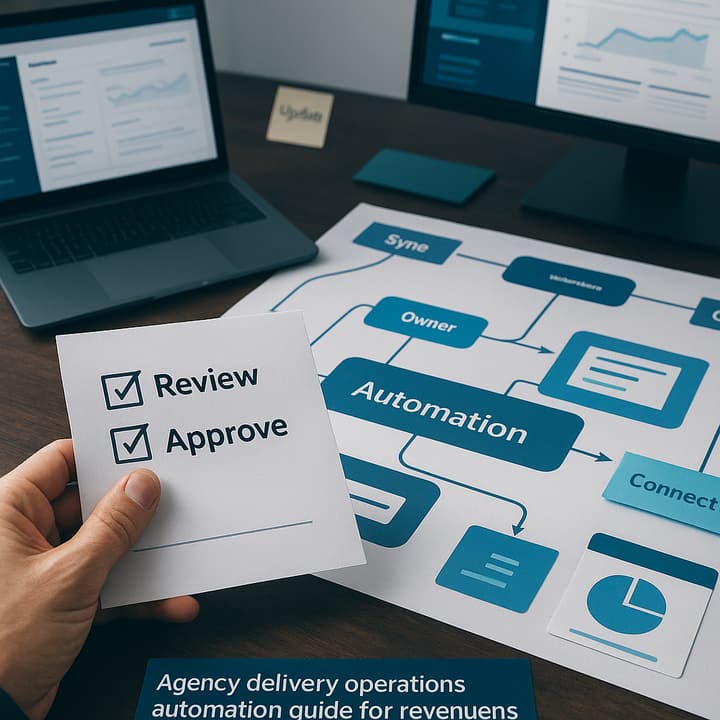
Solve the tool sprawl agency delivery operations infrastructure problem — An operator guide to end coordination debt
Tool selection at agencies is rarely a procurement exercise. When unchecked, it becomes the fastest path to slow delivery, margin erosion, and chronic firefighting. For revenue ops teams and agency founders this article reframes tool sprawl as coordination debt and an infrastructure failure, then gives a concrete operating model you can run in 30–90 days.
This guide intentionally targets the search phrase "tool sprawl agency delivery operations infrastructure problem" and maps symptoms to concrete fixes, ownership rules, and a reproducible Autonomous Operations Infrastructure (AOI) you can pilot with minimal engineering.
What is tool sprawl and why it matters to agency delivery
Tool sprawl is the fragmentation of functions, data, and workflows across many point solutions. In delivery operations that fragmentation creates three predictable, measurable failure modes:
- Manual coordination problem: people spend time reconciling tasks, chasing assets, and translating data between apps instead of doing client work.
- Fragmented stack problem: unknown handoffs, duplicated effort, missed SLAs, and inconsistent tagging that breaks reporting and attribution.
- Delivery drag: slower launch cycles, higher QA rework, billing leakage, and capacity loss.
These are not abstract risks. Research from Harvard Business Review and McKinsey shows productivity is disproportionately affected by tool fragmentation. Gartner and Atlassian guidance also trace repeatable governance patterns that reduce incidents and rework when platforms are rationalized (Gartner, Atlassian).
Why this is the fastest path to improved delivery: removing tool sprawl directly reduces coordination debt. Coordination debt is the accumulated human effort required to keep an ecosystem of disconnected tools working. When you shorten delivery loops and replace human coordination with reliable mechanics—canonical data, event buses, worker agents, and QA gates—velocity improves without adding headcount.
The Autonomous Operations Infrastructure (AOI) model
AOI is an operator-first design pattern that replaces manual coordination with orchestrated automation, clear ownership, and human-in-the-loop QA where it matters.
AOI components (H3)
- Canonical data layer: a single source of truth for contacts, projects, content metadata, and campaign identifiers.
- Event bus: lifecycle events (brief.created, task.assigned, content.published, lead.routed) that propagate changes reliably.
- Worker agents: lightweight automations that enrich data, route tasks, apply tags, and create tickets in downstream systems.
- Human QA gates: prescriptive checks where judgment beats automation—editorial sign-off, legal, or client review.
Each component addresses elements of the fragmented stack problem and the manual coordination problem: the canonical layer prevents divergent records, the event bus standardizes notifications, worker agents remove manual handoffs, and QA gates preserve quality.
How AOI reduces coordination debt (H3)
- Fewer app handoffs = fewer human translations and fewer exceptions.
- Deterministic routing = reproducible SLA compliance and reliable lead routing.
- Automated tagging and analytics parity = fewer attribution mismatches and cleaner conversion measurement.
(Operational references: Zapier on automation tradeoffs, Slack on reducing context switching, and Google Developers on webhook best practices.)
Operator playbook: triggers, briefs, and keyword ownership
This section is the practical operating model you’ll run. It’s built for revenue ops teams deciding whether to hire, outsource, or build an automated organic growth system.
Triggers (H3)
Define the events that create work and start the engine. Typical triggers:
- New client onboarding (creates project, campaign, and brief)
- Campaign kickoff (creates content and paid-to-organic handoffs)
- Content request or refresh alert (engagement drop or SEO signal)
- SLA breach (alert triggers exception workflow)
- Quarterly stack review (audit trigger)
Each trigger must be machine-detectable (webhook or manual intake form) and create a canonical brief object.
Canonical briefs and required fields (H3)
Standardize a 5-field brief to eliminate ambiguous handoffs:
- Objective (conversion goal or KPI)
- Deliverable (format, length, channel)
- Deadline (business days; SLA bucket)
- Quality gate (pass/fail checklist)
- Analytics tag (campaign id, topic cluster, keyword owner)
Keep briefs short and enforce them with intake logic. Every automation and worker agent reads and validates these fields before work proceeds.
Keyword ownership and content routing (H3)
For organic and content work, assign keyword ownership per topic cluster. A small team (1–2 owners) manages topical briefs, publishing cadence, and refresh rules. Ownership rules:
- Keyword Owner: accountable for content briefs, internal QA, and SERP health for the topic cluster.
- Delivery Owner: accountable for SLA (time-to-publish, QA rework rate).
- Engine Owner: single accountability for tool policies, integrations, and the AOI configuration.
Keyword ownership maps to publishing cadence and refresh rules: owners prioritize pages for refresh vs. new content using traffic and conversion signals from your analytics stack (see Measurement section).
QA gates, publishing cadence, and refresh rules
Automation must be complemented by predictable QA. Gate structure and cadence are where AOI retains quality while reducing manual coordination.
QA gate model (H3)
Structure QA into four automated + human checkpoints:
- Structural check: schema and tags—ensure canonical brief fields and analytics tags are present.
- Content check: editorial pass for voice, accuracy, and keyword alignment.
- Functional check: link validation, asset presence, and UX sanity.
- Launch check: analytics firing, lead routing configured, and post-publish checks.
Automate gate 1 and parts of 3, keep gate 2 human, and automate gate 4 where possible (smoke tests).
Publishing cadence and refresh rules
- Default cadence: weekly content publish, monthly product/feature updates, quarterly strategic refreshes.
- Refresh rules: pages older than 12 months go into the review bucket; high-traffic or high-conversion pages get 90-day refresh cycles. Use Ahrefs and SEO operator data to prioritize refresh vs. new content (Ahrefs).
- Exceptions: Product Marketing can pause cadence for launches or embargo windows.
A predictable cadence reduces the ad-hoc requests that generate tool sprawl and manual coordination.
Implementation plan: run an AOI pilot in 30–90 days
This phased plan is designed for revenue ops teams or lean agency founders who must choose between hire, outsource, or build.
Phase 0 — Pre-flight (week 0–2)
- App inventory: list every app, owner, monthly cost, and exportable artifacts.
- Friction heatmap: collect time lost and manual steps from delivery teams (use a simple 7-day observation sprint).
- Quick wins: enforce canonical brief adoption and stop new app purchases for 30 days.
Phase 1 — Audit & policy (week 2–4)
- Policy: adopt a 3-for-1 rule for new tools (new tool must replace at least 3 minutes of manual work per user per day) and require an integration plan.
- Integration catalog: document APIs, webhooks, CSV exports, and failure modes.
- Prioritize retirements where features overlap.
Phase 2 — AOI skeleton (week 4–8)
- Build canonical data layer using existing CRM or a lightweight datastore.
- Define event bus topics and a small set of worker agents (tagging, enrichment, routing).
- Create the brief intake form that emits canonical brief.created events.
- Assign Engine Owner and name Workflow Owners.
Phase 3 — Pilot (week 8–12)
- Pilot 1–2 workflows (organic publishing and lead routing are ideal).
- Run live with automated structural/functional checks and human editorial QA.
- Measure time-to-publish, defect rate, and attribution parity.
Phase 4 — Scale (month 3–6)
- Retire redundant apps after dependency scans and staff interviews.
- Expand worker agents to cover other repetitive tasks (asset resize, tag enforcement, notification routing).
- Implement SLA dashboards and integrate reporting into ops cadence.
If you need a reproducible template, see Meshline's engine structure and the Autonomous Operations Infrastructure implementation pages. For templates and cadence playbooks, consult the Organic Growth Automation pillar.
Measurement: reporting, lead routing, conversion, and refresh rules
You must measure both velocity and quality. Key metrics and how to interpret them:
- Time-to-publish (median): target a 30–60% reduction in initial pilots.
- Defect/rework rate: percent of items sent back after QA. This should fall as automation reduces handoffs.
- Lead attribution parity: weekly checks comparing analytics to CRM revenue records.
- Capacity freed: calculate hours reclaimed and translate to project capacity or margin improvement.
Reporting cadence:
- Weekly: velocity and defect rate for pilot workflows.
- Monthly: attribution parity and capacity impact.
- Quarterly: full stack audit and retirement schedule.
Lead routing: the canonical lead object must carry campaign, content, and keyword tags so CRMs and sales automation can route without manual touches. Use deterministic tags and UTM hygiene to keep analytics and conversions aligned (Statista and Forbes articles document the revenue impact of poor attribution).
Conversion measurement: implement deterministic tagging and server-side events where possible; verify parity nightly with automated checks.
Failure modes, risk controls, and exception handling
Consolidation carries risk. Protect delivery with explicit contingency plans and monitoring.
Ownership and runbooks (H3)
- Engine Owner: single accountability for configuration, retirements, and SLA enforcement.
- Workflow Owners: product or delivery owners responsible for exceptions and QA.
- Integration Owner: engineering or platform responsible for API contracts and uptime.
Runbooks and SLAs:
- Short outage (<4 hours): Engine Owner triggers manual runbooks and notifies clients.
- Long outage (>4 hours): escalate to Integration Owner; if necessary, rollback to a documented legacy path.
- High rework (>threshold): freeze retirements and run QA diagnostics.
Monitoring stack and smoke tests
Suggested monitoring: integration uptime alerts, analytics parity dashboards, and delivery SLA dashboards. Automate schema validation and webhook delivery checks daily (see Google Developers for webhook patterns).
Examples and operator case studies
- Content operations: a 35-person agency reduced time-to-publish from 6 days to 2.5 days by consolidating editorial, CMS, and analytics flows into a single engine and removing three point tools—capacity rose 40%.
- Paid-to-organic handoffs: standardized analytics schema removed a 25% mismatch in lead attribution.
- Onboarding: standard intake forms and one owner decreased onboarding tasks by 60% and lowered churn.
Industry resources that informed these plays include Harvard Business Review, McKinsey, Gartner, Atlassian, Zapier, Slack, Forbes, and Ahrefs.
Playbook checklist (copyable)
- [ ] Inventory: complete app, owner, cost, and artifact table
- [ ] Outcomes: define delivery SLA, rework target, and conversion goals
- [ ] Engine Owner: named and budgeted
- [ ] Canonical briefs: template created and enforced
- [ ] Integration catalog: API/webhook matrix
- [ ] Pilot workflows: 1–2 live in AOI
- [ ] QA gates: automated smoke tests + human QA checklist
- [ ] Publish cadence: default + exception rules
- [ ] Reporting: SLA dashboards and attribution parity
- [ ] Retirement plan: sunset schedule and rollback runbook
Decision-stage guidance: hire, outsource, or build
- Outsource when short-term throughput is the highest priority and you accept lower long-term visibility.
- Hire when domain expertise and headcount are available and the business requires bespoke delivery craft.
- Build the AOI when you need predictable, repeatable delivery, owning long-term margin and velocity.
Meshline recommends building an AOI skeleton and integrating vendor services behind it. See Meshline products and pricing and implementation options for integration and implementation language.
Next steps and CTA
If you want a reproducible organic growth workflow with briefs, keyword ownership, QA gates, publishing cadence, refresh rules, reporting, and lead routing:
- Run a 7-day app and handoff sprint using the canonical brief template.
- Name an Engine Owner and schedule a 30-day consolidation roadmap.
- Book a working session to map your canonical data model and event bus.
See the engine structure and the Autonomous Operations Infrastructure pages for concrete layouts and templates. For ready-made templates and cadence playbooks, visit the Organic Growth Automation pillar and the case studies library.
Ready to start the audit this week? Need help designing the engine or a pilot implementation? Contact Meshline for a focused demo and a scoped implementation plan.
Appendix: operator reading and outreach opportunities
Authority sources and backlinks to pursue for outreach and credibility:
- Harvard Business Review — tool fatigue and productivity research (HBR)
- McKinsey — digital tool proliferation and governance (McKinsey)
- Gartner — application sprawl and platform standardization (Gartner)
- Atlassian — team playbooks and tool selection (Atlassian)
- Zapier — automation tradeoff analysis (Zapier)
- Slack — reducing context switching (Slack)
- Google Developers — integration and webhook guidance (Google Developers)
- Ahrefs — content refresh rules and cadence (Ahrefs)
- Forbes — organizational drag and tooling pieces (Forbes)
- Statista — SaaS app counts and usage trends (Statista)
Editorial outreach note: pitch AOI case-study interviews to Atlassian, Ahrefs, and Zapier blogs; propose a data-backed guest post with HBR/McKinsey-style framing and Meshline implementation outcomes.
tool sprawl agency delivery operations infrastructure problem Implementation Checklist
Use this tool sprawl agency delivery operations infrastructure problem checklist to keep the agency delivery operations workflow specific enough for operators and buyers. Name the owner, source system, destination system, exception route, QA checkpoint, and reporting field before automation goes live.
For tool sprawl agency delivery operations infrastructure problem, Meshline should confirm the trigger, review path, audit trail, fallback owner, and demo-ready outcome. That keeps tool sprawl agency delivery operations infrastructure problem from becoming another disconnected workflow and gives teams a practical implementation path.
The operating language should stay consistent: tool sprawl agency delivery operations infrastructure problem, agency delivery operations automation, agency delivery operations workflow, agency delivery operations operating model, agency delivery operations implementation, agency delivery operations checklist, agency delivery operations QA, agency delivery operations governance, exception routing, automation governance, operational visibility, and Meshline's operating layer. autonomous operations infrastructure should appear where it clarifies search intent and buyer relevance. manual coordination problem should appear where it clarifies search intent and buyer relevance. fragmented stack problem should appear where it clarifies search intent and buyer relevance.
Meshline Implementation Fit
Meshline is the right fit when the agency delivery operations path needs more than a one-off automation. The implementation should include a named source of truth, a visible owner, deterministic routing rules, QA checks before each write, an exception queue, and a recovery path that operators can inspect without asking engineering to reconstruct what happened.
For Fix Tool Sprawl in Agency Delivery Operations, for commercial evaluation, Meshline scopes the workflow as an operating system: discovery, data contracts, integration logic, review gates, observability, launch support, and post-launch optimization. That makes the page useful for buyers comparing tools, agencies, low-code automations, and custom integration work.
For Fix Tool Sprawl in Agency Delivery Operations, the Meshline implementation narrative must stay anchored in Autonomous Operations Infrastructure: an operating layer above scattered tools, an execution layer for system-led execution, trigger-to-outcome execution for revenue-critical work, ownership and control for the business team, engines that continue improving after launch, and self-operating business systems that reduce manual coordination.
- For Fix Tool Sprawl in Agency Delivery Operations, Book a strategy call when the workflow touches revenue, billing, CRM ownership, attribution, customer handoffs, or reporting.
- For Fix Tool Sprawl in Agency Delivery Operations, Use Meshline when the buyer needs implementation accountability, not only a connector recommendation.
- For Fix Tool Sprawl in Agency Delivery Operations, Keep this page as the primary URL for the keyword family; related glossary and blog posts should link here as supporting context.