
 MeshLine
Zoho vs Mailchimp for CRM Pipeline Hygiene
Compare Zoho and Mailchimp for lifecycle fields, lead ownership, routing controls, and the exception handling clean pipeline data requires.
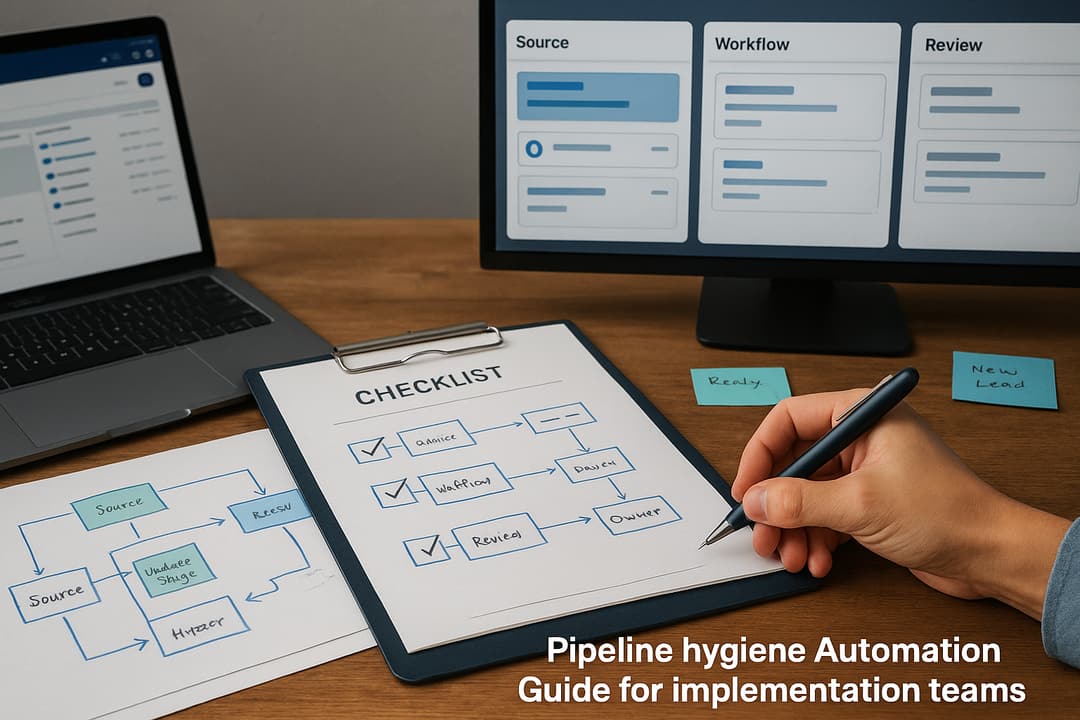
Execution thesis (short): pick the ownership model that matches your operational contract, not the feature checklist. This isn’t a generic zoho mailchimp comparison; it’s a tactical playbook for implementation teams to stop losing leads between systems, close visibility gaps, and convert hygiene from checklist to enforceable contract.
In this article you’ll get: a clear thesis, the top operator failure patterns for zoho vs mailchimp for pipeline hygiene, field-level mappings and SLAs for a concrete scenario, explicit QA gates and reporting signals, connectors and caveats, and an earned Meshline next step (See the engine structure) for teams ready to move hygiene into infrastructure.
Why this matters for implementation teams: people search "zoho vs mailchimp for pipeline hygiene" when deciding whether to centralize hygiene inside a CRM (Zoho) or an ESP (Mailchimp). Feature parity rarely decides outcomes — orchestration and ownership do. If you pick the wrong ownership model or leave sequencing to ad-hoc connectors, the pipeline leaks, deliverability falters, and reps chase ghosts. Zoho and Mailchimp expose similar primitives — audiences, tags, segments, fields — but your runbook and orchestration layer determine who enforces the contract.
What implementation teams mean by "pipeline hygiene"
Pipeline hygiene is the operational system of rules, data transformations, and enforcement gates that keep contacts canonical, deduplicated, scored, and routed correctly into a revenue workflow. Key primitives:
- Canonical identity (single source of truth for contact_id)
- Enrichment confidence and timestamping
- Lead scoring thresholds and timing windows
- Duplicate detection and merge policies
- Bounce, unsubscribe, and suppression handling
- SLA-based handoff windows to sales (0–5m, 5–60m, 1–24h)
This is not an inbox cleanup exercise. Hygiene is a real-time contract: when a form or API event hits your stack, what happens in the next 0–5 minutes (validation), 5–60 minutes (enrichment & dedupe), and 1–24 hours (scoring & routing)? The question for any zoho mailchimp comparison is: who enforces the contract?
Where Zoho and Mailchimp diverge on primitives (and why it breaks execution)
- Ownership model: Zoho is CRM-first and built for lead lifecycle enforcement; Mailchimp is email-first and built for campaign audiences. That distinction changes which system teams declare canonical for contact data — and that declaration should drive your orchestration.
- Identity & dedupe: Zoho has CRM-native duplicate rules and merge operations; Mailchimp enforces dedupe at the audience level (email primary). If you rely on Mailchimp as a pseudo-CRM, duplicates and inconsistent canonical IDs proliferate when records move between systems.
- Enrichment & scoring paths: Enrichment providers (Clearbit, BuiltWith, etc.) can run before or after the CRM create. When enrichment is applied asynchronously in the wrong system, routing misfires and high-value leads are delayed.
- Integration mechanics: Native connectors, Zapier, and similar tools are convenient but often asynchronous, retry-prone, and lack idempotency. That creates race conditions that break short SLAs unless an orchestration layer sequencers events and enforces idempotency.
These differences are why a simple feature comparison misses the point. A practical zoho mailchimp comparison must measure orchestration cost, failure surface, and the operational contracts you are prepared to enforce.
Three recurring operator failure patterns (what to watch for)
Failure pattern A — duplicate handoffs caused by audience vs CRM ownership
Symptom: the same email is created as a marketing lead in Mailchimp and again as an inbound lead in Zoho; sales gets duplicate tasks.
Root cause: Mailchimp audiences are treated like a CRM source while Zoho is canonical, yet there is no single canonical ID or cross-system dedupe policy. Connectors import contacts back into Zoho without global key checks.
Owner: Integration engineer + CRM ops.
Recovery path: block direct creates from Mailchimp to Zoho. Implement an orchestration step (CDP/middleware) that reconciles by canonical key (email + normalized domain + hashed contact_id). On match, update marketing_touch timestamp instead of creating a new record.
Exception path: if create must happen immediately, create a stub record with an orchestration flag and route the lead to a triage queue until the canonical reconciliation completes.
Failure pattern B — enrichment race causes wrong routing
Symptom: demo or trial requests reach SDRs with incomplete company data; scoring misfires and routing sends leads to wrong queues.
Root cause: enrichment runs asynchronously and routing fires on default criteria. Leads are evaluated before enrichment updates fields needed for routing.
Owner: Data engineering + SDR ops.
Recovery path: introduce an enrichment_confidence integer and enrichment_timestamp. Route only when confidence >= threshold (e.g., 70%) or after a short hold window (5–15 minutes). If SLAs forbid holding, route to a triage SDR queue tagged "pending-enrichment" with a 15-min escalation SLA.
Failure signal: sudden routing-to-low-touch queue rate spike after a marketing campaign.
Failure pattern C — bounce/reputation because campaign audiences include stale CRM contacts
Symptom: deliverability drops after a campaign; Mailchimp reports a spike in bounces and complaints.
Root cause: CRM contacts that should be suppressed were not synced to Mailchimp because integration was one-way, delayed, or misconfigured.
Owner: Email ops + integration engineer.
Recovery path: maintain a shared suppression list in orchestration and enforce near-real-time sync for unsubscribes and bounces. Backfill suppression updates from campaign reports and pause sends to risky segments until reconciliation completes.
Exception path: when webhooks fail, enforce a daily suppression reconciliation job and make campaign sends contingent on last reconciliation age.
A concrete scenario: fields, timing, and a failure sequence operators recognize
Scenario: a product-trial signup form creates a contact in Zoho, enrichment runs via Clearbit, and Mailchimp sends a welcome series. The required contract: create → dedupe → enrich → score → route → email, with the first marketing email sent only after enrichment completes or after an explicit fallback.
Field-level mapping (practical example)
- Source form fields: email, first_name, last_name, company_domain, phone, utm_campaign
- Canonical CRM fields (Zoho): Contact.email (primary), Contact.external_id (hashed_guid), Contact.company_domain, Contact.enrichment_status, Contact.enrichment_timestamp, Contact.score
- Mailchimp audience fields: EMAIL (primary), FNAME, LNAME, COMPANY_DOMAIN, LAST_MARKETING_TOUCH
Operational rule: the orchestration layer writes the canonical external_id into both Zoho and Mailchimp and rejects creates that lack canonical_id resolution.
Timing & SLA contract (enforceable)
- T0: Create event arrives.
- 0–30s: validation & canonical_id lookup/dedupe.
- 30–180s: enrichment calls execute and return confidence.
- 180s–15m: scoring and routing decisions finalize.
- If enrichment completes by T0+180s with confidence >=70%, set enrichment_status=complete and allow marketing send.
- If enrichment incomplete at T0+180s, either: (A) route to triage queue, or (B) send a low-context transactional acknowledgment (no marketing content).
Failure sequence operators see (example)
- Zapier connector creates Mailchimp record at T0+10s.
- Zoho merge runs at T0+300s; canonical_id assigned only in Zoho.
- Enrichment completes at T0+240s but only updates Zoho; Mailchimp never receives the enrichment update.
- Mailchimp sends a personalized welcome using stale data; bounces accrue and deliverability degrades.
Operational rule: do not send campaign emails to records before orchestration confirms canonical_id and suppression checks. If you cannot guarantee confirmation within 3 minutes, send only a plain, non-marketing transactional acknowledgment.
!Orchestration diagram: canonical ID flow, enrichment, dedupe, and sync checks for zoho mailchimp comparison</text></g><g><rect x='520' y='30' width='180' height='80' fill='#ffffff' stroke='#dd6b20' rx='6'/><text x='610' y='70' text-anchor='middle' class='t' fill='#dd6b20'>Zoho CRM</text><text x='610' y='90' class='t' text-anchor='middle'>Leads / Scoring</text></g><g><rect x='520' y='140' width='180' height='80' fill='#ffffff' stroke='#6b46c1' rx='6'/><text x='610' y='180' text-anchor='middle' class='t' fill='#6b46c1'>Mailchimp</text><text x='610' y='200' class='t' text-anchor='middle'>Audience / Campaigns</text></g><g><path d='M210 70 L260 70' stroke='#2b6cb0' stroke-width='2' marker-end='url(#arr)'/><path d='M480 70 L520 70' stroke='#68a391' stroke-width='2' marker-end='url(#arr)'/><path d='M430 110 L520 110' stroke='#68a391' stroke-width='2' marker-end='url(#arr)'/><path d='M610 110 L610 140' stroke='#999' stroke-width='2' marker-end='url(#arr)'/><defs><marker id='arr' markerWidth='6' markerHeight='6' refX='5' refY='3'><path d='M0 0 L6 3 L0 6 z' fill='#2b6cb0'/></marker></defs></g></svg>)
Diagram alt: Orchestration diagram showing canonical ID reconciliation, enrichment, dedupe, Zoho and Mailchimp syncs — a zoho mailchimp comparison diagram for pipeline hygiene.
Orchestration patterns that prevent execution loss (concrete)
- Centralized canonical ID service: generate a canonical external_id at ingestion (deterministic hash) and require any downstream create/update to validate against it.
- Idempotent writes and retry-safe connectors: middleware should issue idempotency-keys for each create/update. Connectors that retry without idempotency cause double-creates.
- Enrichment confidence gate: include enrichment_confidence and enrichment_timestamp. Routing rules check confidence or intentionally route to a "pending-enrichment" queue.
- Shared suppression-as-a-service: suppression lists should live in orchestration and be referenced on every write to Mailchimp or Zoho.
- Observability, audit logs, and synthetic tests: event id, canonical_id, action, timestamp, connector status. Synthetic tests must exercise create→enrich→route under noisy network conditions.
- Canary sends and delivery controls: after pipeline changes, send to a 1% canary audience and wait 24 hours for bounce metrics before opening the floodgates.
These patterns are what separate a feature-level zoho mailchimp comparison from an operational implementation.
Connectors and caveats (what implementation teams must know)
- Native Zoho connectors: can be quick to deploy but often assume CRM-first ownership and may not export required webhooks in real time. Validate whether the connector writes canonical_id and supports merge events.
- Mailchimp APIs & webhooks: reliable for campaign events but audience model is email-centric; use webhooks for bounces and unsubscribes and ensure your orchestration listens to them in near-real-time.
- Zapier and low-code tools: easy to prototype but are asynchronous and retry-prone. They are fine for low-volume, low-SLA paths — not for sub-5-minute routing guarantees.
- CDPs and orchestration engines (Twilio Segment, RudderStack, custom middleware): built for canonicalization and sequencing. Use them when you have multiple sources and destinations.
Implementation checklist for connectors:
- Confirm idempotency support or implement idempotency keys in middleware.
- Verify webhook coverage: create/update/merge/unsubscribe/bounce.
- Validate field mapping and write access for canonical_id.
- Confirm SLA expectations with vendor (latency and retry behavior).
QA gates, reporting signals, and SLAs to instrument
Signals to monitor and automated actions (owner in parentheses):
- Duplicate create rate > 0.2% per day → Block connector and run dedupe (integration engineer).
- Enrichment average latency > 3 minutes → Open triage; increase parallelism or relax routing windows (data engineering).
- Mail bounce rate spike > 0.5% above baseline after campaign → Pause campaigns; run suppression reconciliation (email ops).
- Sales task abandonment > 10% (tasks untouched in 24h) → Audit routing rules and enrichment completeness (revops).
Operational QA check: every change must ship a runbook that documents canonical_id derivation, enrichment fallback, dedupe rules, and a synthetic test proving create→enrich→route under noisy network conditions.
Recommended dashboards and signals:
- Incoming events latency histogram (0–5m bucket), enrichment latency, and confidence distribution.
- Duplicate-key alert (counts per source/destination).
- Suppression sync age (how stale is last reconciliation).
- Delivery canary metrics: bounce rate, open rate, complaint rate for canary and control groups.
Decision guide for implementation teams (practical)
- If CRM is canonical and you need desk-level routing and reporting, choose CRM-first hygiene: keep canonical records in Zoho and push only segmented audiences to Mailchimp. Mailchimp should be campaign-only; do not depend on it for routing logic.
- If GTM is marketing-led and campaigns drive routing decisions, treat Mailchimp as a campaign store but still enforce canonical identity and routing in an orchestration layer.
- If you have multiple marketing sources (ad platforms, website events, forms), implement a CDP or orchestration engine to enforce canonical identity, dedupe, and sequencing before writes to Zoho or Mailchimp.
Checklist for choosing path:
- Number of inbound sources (>3?) → use CDP/middleware.
- Desired SLA for routing (<5 minutes?) → require orchestration with synchronous checks or triage queues.
- Need for auditability and compliance → require auditable logs in middleware.
When to call in specialists — and what to ask them to deliver
Bring in data engineering or a middleware specialist when:
- You have more than three inbound sources or more than two destinations requiring canonical consistency.
- You need sub-5-minute routing SLAs.
- Your enrichment cadence or tooling costs mandate batching/queuing logic.
Ask specialists to deliver:
- A canonical-id service with deterministic hashing logic and API contract.
- Idempotent write patterns for connectors and retry/backoff logic.
- Queryable audit logs for "missing enrichment" and "duplicate creates."
- A suppression microservice and reconciliation job that ingests campaign feedback.
Suggested vendors and docs for validation: Twilio Segment (CDP patterns), Clearbit (enrichment best practices), LeanData (routing patterns), and connector caveats on Zapier. Use partner docs to validate deliverables and incorporate vendor SLAs in your runbook.
Recovery playbook for a badly leaking pipeline (step-by-step)
- Pause outbound campaigns for the affected segment.
- Export creates from Zoho and Mailchimp for the last 72 hours.
- Run a dedupe using canonical rules (email + domain + hashed_guid).
- Reconcile suppression lists using campaign bounces and unsubscribes.
- Re-run enrichment for records missing confidence; mark route changes with "manual-review" tags.
- Re-enable campaigns behind a 1% canary and monitor delivery metrics for 24 hours.
Note: without orchestration, these steps are manual and spreadsheet-heavy — that is the operational signal that hygiene must become an engineering requirement.
How to evaluate the platform tradeoff (practical checklist)
- APIs & dedupe: Does the platform expose reliable dedupe/merge APIs? (Zoho: yes; Mailchimp: audience-level email dedupe.)
- Sync & webhook latency: Are suppression and bounce events available via webhook in near-real-time?
- Enrichment behavior: Can enrichment run synchronously or is it always async? If async, plan your orchestration accordingly.
- Auditability: Does the platform provide queryable audit logs? If not, capture them in middleware.
- Connector behavior: Do connectors support idempotency-keys and predictable retry semantics?
Answering these questions turns a superficial pipeline hygiene platform comparison into an operational specification for implementation teams.
Signals that show your hygiene is infrastructure, not a feature
- You have automated synthetic tests that exercise the 0–5m/5–60m/1–24h contract.
- You publish SLA metrics for enrichment confidence, dedupe rate, and suppression sync age to stakeholders.
- You can rewind and replay events from your audit trail to recreate the state of a lead at any given timestamp.
When hygiene is infrastructure, recovery becomes predictable and fast; when it’s a feature, recovery is manual and slow.
Final recommendation and earned next step
For implementation teams deciding zoho vs mailchimp for pipeline hygiene: treat Zoho and Mailchimp as complementary. Zoho should be the canonical CRM and routing engine; Mailchimp should be the campaign engine. The real investment is in the orchestration layer between them — canonical_id service, enrichment gating, suppression-as-a-service, idempotent connectors, and auditable logs.
If you want to inspect an example orchestration engine that turns these rules into infrastructure, See the engine structure — a single audited hub that keeps canonical_id, applies enrichment gates, enforces suppression, and exposes observability for ops. Start with a short technical spike: build a canonical-id API, wire enrichment with a confidence gate, and run a 48-hour canary on live traffic.
External resources and outreach opportunities
- Zoho lead management docs — CRM lead lifecycle primitives. (zoho.com)
- Mailchimp developer audience & API docs — audience model and webhook behavior. (mailchimp.com)
- Zapier Mailchimp–Zoho notes — connector limits and retry behaviors. (help.zapier.com)
- Clearbit enrichment documentation — enrichment best practices and confidence handling. (clearbit.com)
- Twilio Segment CDP patterns — canonicalization and event sequencing. (twilio.com docs / segment)
Editorial backlink opportunity: reach out to partner product teams at Zoho, Mailchimp, Clearbit, and Twilio Segment to co-publish implementation checklists or customer stories. A targeted outreach to LeanData or a channel partner who has implemented canonical-id services is a high-value link and reference for our audience.
Meshline internal links (operational next-read and checkpoint)
- For operators building contracts: Lead Hygiene Playbook — deterministic runbook for canonical-id and dedupe.
- For orchestration patterns: Orchestration & Routing Patterns — middleware patterns, idempotency keys, and audit logs.
- For QA and Search Console alignment: Operational QA for Marketing Automation — synthetic tests and content hygiene checks.
- To inspect Meshline’s technical engine: See the engine structure — request a demo or read the integration spec.
After reading this, implementation teams should be able to: decide which system is canonical, define the 0–5m/5–60m/1–24h SLAs for new records, and choose an orchestration approach (CDP, middleware, or lightweight API) to enforce that contract.
Implementation Evidence and Reliability Checks
Use these references to validate the pipeline hygiene implementation model, reliability assumptions, integration controls, and incident-response expectations before rollout.
Where pipeline hygiene usually breaks in practice
The useful test for zoho vs mailchimp for pipeline hygiene is not whether the team can draw a clean workflow. It is whether the workflow still behaves when a record arrives late, a required field is missing, or two systems disagree about who owns the next action.
Start by writing down the first signal, the field that proves it is trustworthy, the person who can override the route, and the timestamp that shows whether the handoff happened on time. Those details make pipeline hygiene automation reviewable instead of merely automated.
For buyers comparing zoho vs mailchimp for pipeline hygiene, the decision should center on pipeline hygiene automation, pipeline hygiene reporting, pipeline hygiene exception handling, pipeline hygiene ownership, and whether the team can inspect the audit trail without asking engineering to reconstruct the incident. zoho mailchimp comparison belongs in the article only where it clarifies a real operator decision, not as a stray keyword. pipeline hygiene platform comparison belongs in the article only where it clarifies a real operator decision, not as a stray keyword. implementation teams pipeline hygiene tools belongs in the article only where it clarifies a real operator decision, not as a stray keyword.
When pipeline hygiene needs an operating layer
Meshline fits when pipeline hygiene is no longer a single automation but a recurring operational commitment. The warning sign is usually simple: people trust the tool when everything is normal, then leave Slack messages, spreadsheet notes, and manual fixes behind as soon as the edge case appears.
For Zoho vs Mailchimp: Pipeline Hygiene Workflow Comparison, define the authoritative data, routing rule, review checkpoint, retry policy, and evidence trail before launch. This lets the operating team adjust exceptions without turning each failure into an engineering investigation.
The decision behind Zoho vs Mailchimp: Pipeline Hygiene Workflow Comparison is whether a connector is enough or the workflow needs a maintained execution layer. When revenue, customer handoffs, reporting, billing, or CRM ownership are involved, scope auditability and recovery alongside launch speed.
- For Zoho vs Mailchimp: CRM Pipeline Hygiene, document which system wins when two records disagree.
- For Zoho vs Mailchimp: CRM Pipeline Hygiene, name who can pause or override execution without creating a hidden side process.
- For Zoho vs Mailchimp: CRM Pipeline Hygiene, specify what evidence remains after a failed handoff is recovered.