
 MeshLine
AI Agent Guardrails: Keep Automated Work Grounded
AI and automation controls gets easier when operators can see the owner, exception, and next step before automated decisions move faster than review and recovery paths.
AI Agent Guardrails: Keep Automated Work Grounded
AI Agent Guardrails: Keep Automated Work Grounded breaks when automated decisions move faster than review, rollback, and evidence trails. For operators, the painful part is the manual recovery that follows: operators cannot explain why a workflow acted the way it did, ownership is unclear, and the team has to rebuild context while the customer, lead, campaign, or report is already waiting.
Here is the catch: a grounded answer is not automatically a safe action. A retrieval system can bring back the right document and the agent can still overstate it. A tool schema can be correct and the agent can still call it too early. A citation can exist and the workflow can still violate policy because the wrong person, account, region, contract, or approval state was in scope. Grounding only becomes useful when it lives inside a practical execution layer with trigger, evidence, policy, owner, exception, and outcome controls.
This guide is intentionally built for operators, founders, revenue teams, support leaders, and technical teams that want grounded AI agents without turning every workflow into a research project. It covers RAG guardrails, hallucination guardrails, groundedness detection, citations, tool-use guardrails, evaluation loops, and Meshline's operating-layer approach to making agent work inspectable. The goal is not just to make an agent sound right. The goal is to make the work trustworthy enough to run inside a business.
What AI agent guardrail grounding means
ai agent guardrail grounding keep agents means an agent cannot rely on vibes, stale training memory, or unsupported reasoning when it produces an answer or takes action. It must connect its response to grounding sources, retrieved context, validated records, approved policy, and the exact tool permissions available at that moment. In a simple Q&A chatbot, grounding might mean citing the document used to answer. In an operating workflow, grounding means more: the agent must know which source governs the decision, whether the source applies to the current case, and which action is allowed next.
The broader market is converging around this idea. AWS grounding and RAG for agentic AI frames grounding and RAG as a way to connect foundation models to domain-specific knowledge. Google Vertex AI grounding overview describes grounding as connecting generative models to data such as websites, documents, or search-backed sources. Microsoft groundedness detection filter focuses on whether LLM responses are based on provided source materials. Different vendors use different language, but the operational theme is the same: the model needs a controlled source of truth.
The reason this matters is that AI agents are not just answer generators. They are becoming execution systems. They write customer replies, qualify leads, summarize calls, recommend next actions, update CRM records, route support tickets, draft marketing assets, reconcile operational data, and trigger automations. In that environment, hallucination is not only a content-quality issue. It becomes a workflow risk.
For example, a lead-routing agent might say an account is enterprise-ready because it found a related document. But did it use current account data? Did it check territory rules? Did it respect suppression lists? Did it know whether sales already owns the account? Did it cite the evidence behind the route? Did it log the exception if evidence was missing? Those are grounding questions, but they are also ownership questions.
The five layers of grounded agent control
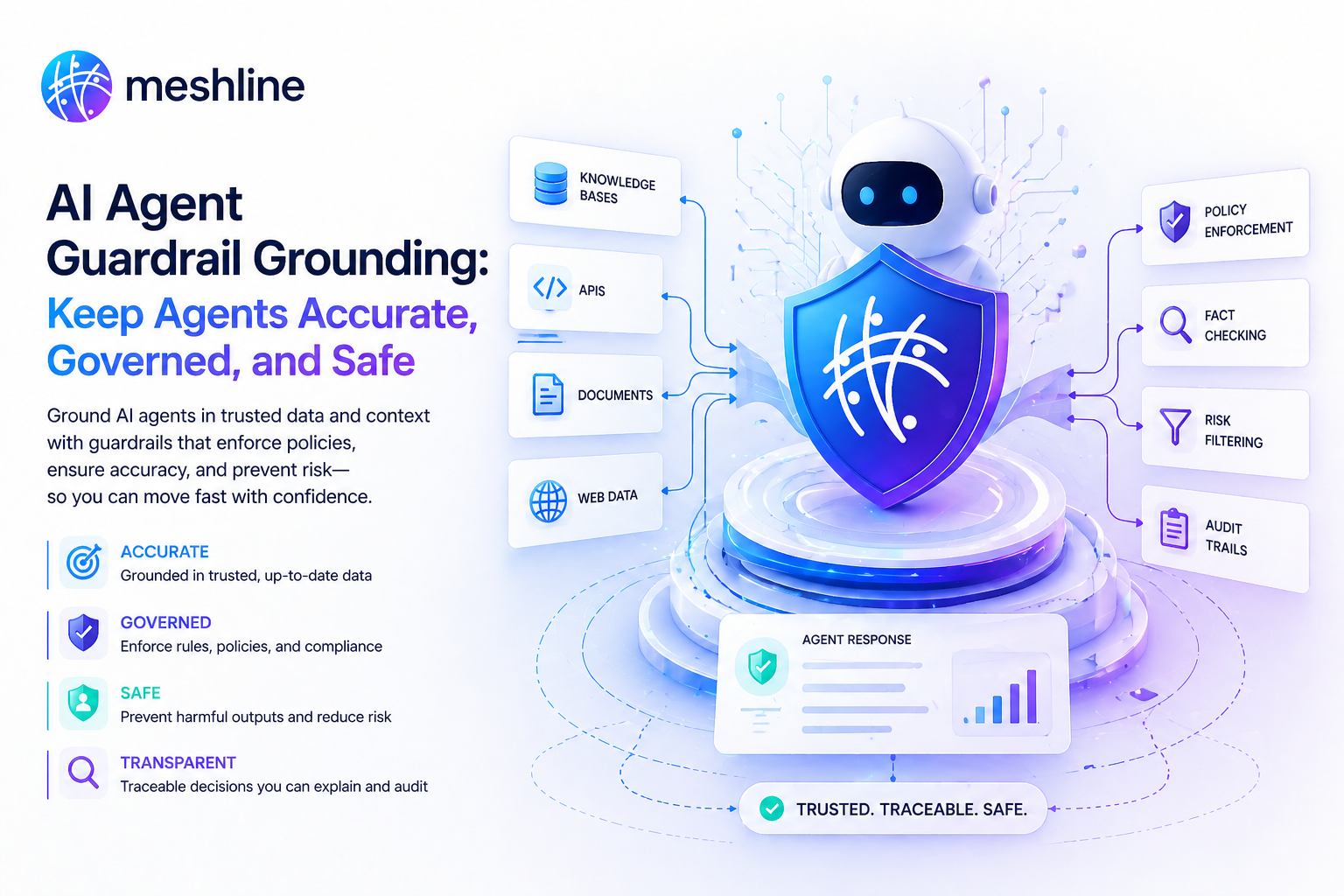
A practical guardrail grounding system has five layers: source grounding, instruction grounding, policy grounding, tool grounding, and outcome grounding. Miss one and the agent can still look intelligent while behaving unreliably.
Source grounding answers the factual question: what evidence is the agent allowed to use? This can include knowledge-base articles, product docs, support policies, CRM fields, account records, campaign data, contract terms, warehouse states, or approved playbooks. Source grounding needs retrieval quality, metadata, freshness, and citation behavior. Anthropic search results for citations and Anthropic citations are useful references because they show how source attribution can be built into model responses rather than left as an afterthought.
Instruction grounding answers the role question: what job is the agent doing right now? A support-response agent should not quietly become a refund approver. A marketing-content agent should not invent compliance claims. A revenue-operations agent should not change lead ownership unless the workflow explicitly allows it. Instruction grounding keeps the agent scoped to the task, and it should be validated at every major step.
Policy grounding answers the boundary question: what is allowed, blocked, escalated, or human-reviewed? This is where guardrails move beyond "please be safe" prompt text. Azure AI Content Safety overview is useful because it separates features such as Prompt Shields, groundedness detection, protected material detection, and task adherence. The operating lesson is that different risks need different controls. A hallucination guardrail is not the same as a tool-use guardrail.
Tool grounding answers the action question: which tool can be called, with which inputs, under which conditions, and with what review path? Anthropic prompt injection mitigation is relevant here because prompt injection risk often appears when an agent consumes external content and then calls tools. The agent should not be able to treat untrusted text as instruction. Tool access needs a boundary outside the model.
Outcome grounding answers the business question: did the workflow produce the intended result, and can someone inspect it? This is where Meshline's operating layer matters. A grounded answer is useful, but a grounded workflow is better.Meshline cares about trigger-to-outcome execution: the event that started the agent, the evidence it used, the policy it applied, the tool action it proposed. or took, the owner who reviewed it, the exception path, and the measurable outcome.
Why RAG alone is not enough
RAG is one of the most important grounding patterns, but RAG alone is not a complete guardrail strategy. Retrieval can pull in relevant content, but it does not guarantee the agent interprets the content correctly. It does not guarantee the source applies to the current user, region, product version, contract term, or workflow stage. It does not guarantee the agent refuses when evidence is weak. It does not guarantee the tool call is safe.
This is why NVIDIA NeMo fact-checking guardrails matters as a reference: it focuses on checking whether output is grounded in evidence. OpenAI hallucination guardrails cookbook is also valuable because it shows guardrails as checks designed to improve accuracy and alignment with user expectations. The practical move is to treat RAG as one layer in a chain, not the whole system.
Imagine a customer-success agent asked, "Can this customer upgrade without a contract review?" RAG retrieves the latest pricing guide. The answer still needs account status, region, contract terms, plan type, renewal window, discount rules, and maybe a finance approval threshold. If the agent only uses the pricing guide, it may sound grounded while still being wrong for that customer.
That is the real problem: source grounding can create false confidence if the workflow does not also ground the decision. A strong agent does not only retrieve. It asks whether the retrieved source is authoritative for the case. It checks whether newer structured data overrides the document. It routes exceptions. It logs evidence. It knows when to stop.
A practical guardrail-grounding architecture
The architecture starts with a trigger. A customer asks a question, a lead submits a form, a ticket arrives, a campaign result changes, a record fails validation, or an operator requests a recommendation. The trigger must declare the task: answer, classify, enrich, draft, route, recommend, reconcile, or execute. Without a task label, the agent has too much room to improvise.
Next comes context assembly. The system retrieves documents, records, policies, past interactions, and tool state. Retrieval should be filtered by permissions, freshness, source authority, and workflow relevance. Hybrid search can help when teams need both semantic recall and keyword precision; Weaviate hybrid search is useful background for how hybrid search combines retrieval styles. But retrieval should still be treated as evidence, not permission.
Then comes evidence ranking. The workflow should identify which source governs the answer. A public article may help explain a concept, but an internal policy may govern action. A CRM note may provide color, but a contract field may govern eligibility. A product doc may describe a feature, but a region-specific compliance note may block a claim. Good grounding design separates helpful context from binding context.
After evidence ranking, the agent drafts or reasons. But the draft should not go straight to the user or system. It should pass through output checks, groundedness checks, policy checks, and tool checks. Azure groundedness quickstart shows groundedness detection as a testable control. Ragas faithfulness metric and DeepEval faithfulness metric provide evaluation language for whether generated output is faithful to context. Those ideas should be part of the operating workflow, not only offline experiments.
Finally, the workflow chooses an action: respond, ask for more information, route to human review, call a tool, create a task, update a record, or decline. Every action should create an audit trail: trigger, evidence, policy, confidence, decision, owner, exception, and outcome. That is what turns grounded AI from a prompt technique into operational infrastructure.
Use case 1: grounded marketing automation
Marketing automation is a perfect place to see why guardrail grounding matters. A content agent might draft landing-page copy, email sequences, LinkedIn posts, nurture paths, ad variants, or SEO briefs. If it is not grounded, it can invent performance claims, overstate product capabilities, cite unsupported statistics, or send leads into the wrong funnel.
In a grounded marketing workflow, the agent starts with approved positioning, offer rules, audience segment, campaign objective, previous performance data, and compliance constraints. The trigger might be "create a nurture sequence for high-intent demo visitors." The grounding sources might include the current product page, pricing rules, brand claims, conversion data, and the segment definition. The guardrails might block unsupported ROI claims, require source-backed product claims, and route legal-sensitive copy to review.
For example, an agent writing a campaign for Meshline's Organic Marketing Engine should be grounded in approved claims: content operations, lead capture, follow-up, pipeline visibility, and marketing workflow automation. It should not invent a guaranteed revenue percentage. It should not claim headcount reduction without context. It should not route every lead the same way. A strong workflow grounds the message, the audience, and the next action.
The practical outcome is faster campaign production without turning the brand into a risk surface. The agent can create more drafts, but the operating layer decides what can ship. That is the category shift: AI content generation becomes system-led marketing execution with ownership and control.
Use case 2: grounded revenue and lead routing
Lead-routing agents are attractive because speed matters. A fast response can improve conversion. But a fast wrong route creates friction: the wrong owner, wrong territory, wrong product motion, wrong priority, or wrong message. Grounding is how a revenue agent avoids turning routing into guesswork.
A grounded lead-routing workflow uses the lead source, form answers, enrichment data, account ownership, lifecycle stage, campaign attribution, consent status, and sales rules. The agent can summarize intent and recommend a route, but the workflow should check whether the recommendation is supported. If account ownership is missing, route to review. If the lead matches an existing opportunity, attach context instead of creating a duplicate. If the lead asks for something outside the approved offer, send a clarifying path.
This is where tool-use guardrails matter. The agent should not be able to update Salesforce, HubSpot, or an internal system just because it sounds confident. Tool actions should require validated inputs, allowed states, and a clear owner. Research such as GuardAgent OpenReview paper and LlamaFirewall paper is useful because agent safety increasingly includes access control, prompt injection, goal alignment, and tool/action risk.
The example decision rule is simple: the agent may recommend, but the operating layer authorizes. That separation keeps automation useful without making the model the final authority.
Use case 3: grounded support and customer operations
Support agents face grounding pressure every day. Customers ask about refunds, warranties, shipping, plan limits, account status, known issues, billing, and product behavior. A support answer can be polite and still be wrong if it is not grounded in the right account, policy, or product state.
A grounded support workflow retrieves the customer record, plan, ticket history, current policy, product doc, order state, and any incident status. The agent drafts the response with citations or source references. The guardrail checks whether the response is faithful to the retrieved context. The exception path catches refunds, legal-sensitive topics, high-value customers, unclear policy, and missing account data.
For example, if a customer asks whether they are eligible for a refund, the agent should not answer from a generic refund article alone. It should check purchase date, plan type, region, previous concessions, account status, and current policy. If any required field is missing, the grounded answer is not "yes" or "no." The grounded answer is "needs review."
That is an underrated guardrail: sometimes the safest grounded output is a routing decision, not a final response.
Use case 4: grounded data and reporting agents
Reporting agents can be dangerous because a chart or metric summary looks authoritative. If the agent misunderstands a metric definition, time window, data freshness rule, or schema relationship, it can give leadership a confident wrong answer. Grounding in data workflows means tying outputs to metric definitions, query lineage, schema constraints, and report context.
A grounded reporting agent should cite the dashboard, metric definition, query, source table, or calculation rule. It should identify freshness: last sync, delayed data, excluded segments, missing rows, or schema changes. It should explain confidence and route ambiguous analysis to a data owner. LlamaIndex evaluation module guide is useful in this context because evaluation is not a one-time QA step; it becomes part of how teams decide whether generated answers are trustworthy.
Meshline's operating-layer view is that reporting agents should not merely answer questions. They should expose the path from question to source to calculation to decision. When a team asks "why did pipeline drop?" the agent should not invent a narrative. It should retrieve the relevant sources, compare them against definitions, identify possible causes, and show what evidence supports or weakens each hypothesis.
Use case 5: grounded workflow automation
The most serious grounding challenge appears when agents trigger actions. Drafting a response is one thing. Updating a customer record, assigning a lead, issuing a refund, pausing a campaign, changing inventory status, or publishing content is another. Action-bearing agents need grounding before execution and after execution.
Before execution, the agent needs verified evidence, allowed state, tool permission, policy match, and clear owner. During execution, it needs structured tool calls with validated arguments. After execution, it needs an outcome log, replay path, and exception record. The agent should never be the only place where policy lives.
This is where symbolic and policy-based guardrails become interesting. Symbolic guardrails for domain-specific agents explores guardrails that can provide stronger guarantees in domain-specific settings. AI Agent Code of Conduct paper looks at automated guardrail policy synthesis. Whether a team uses symbolic controls, validator pipelines, policy engines, or structured approval logic, the point is the same: prompts alone should not be load-bearing.
The guardrail grounding checklist
Use this checklist before putting a grounded agent into production:
- What trigger starts the agent workflow?
- What task is the agent allowed to perform?
- Which sources are authoritative for this task?
- Which sources are helpful context but not governing policy?
- How does the workflow detect stale, missing, conflicting, or low-authority evidence?
- Does the answer need citations, evidence IDs, or source snippets?
- Which policy rules must be checked before output?
- Which tool actions require validated fields or human approval?
- Which user roles are allowed to request, approve, or execute the action?
- What happens when grounding confidence is low?
- What does the agent do when sources disagree?
- Can operators inspect the prompt, retrieved context, decision, and outcome?
- Can failed or risky cases be replayed?
- Which metrics prove the guardrail is working?
- Who owns the exception queue?
This checklist is deliberately operational. It does not stop at "use RAG." It forces the team to decide how grounding shows up in the real workflow.
Evaluation: how to know grounding is working
Evaluation should happen before launch, during rollout, and after production. Before launch, create a test set of normal cases, edge cases, prompt injection attempts, stale documents, conflicting sources, missing data, and risky tool actions. Measure factuality, faithfulness, citation correctness, policy adherence, route accuracy, and human-review precision.
During rollout, sample real agent traces. Pull twenty cases every week and ask: did the agent use the right source? Did it ignore a stronger source? Did it overstate evidence? Did it cite accurately? Did it call the right tool? Did it stop when it should have stopped? Did the human reviewer have enough context?
After production, monitor drift. Source documents change. Policies change. Products change. Teams add tools. Customer language changes. Attack patterns change. Guardrail grounding needs maintenance. Mozilla guardrails for AI agent safety is useful because it treats guardrails as something that must be benchmarked and tested against agent-specific risks, not just assumed to work.
The most useful metrics are not only model metrics. Track ungrounded answer rate, unsupported-claim rate, citation mismatch rate, wrong-tool-call rate, preventable escalation rate, exception backlog, human override rate, and outcome quality. For marketing agents, track unsupported claim blocks and lead-routing accuracy. For support agents, track policy mismatch and escalation quality. For reporting agents, track metric-definition adherence. For revenue agents, track duplicate creation and route correction.
Where validators fit
Validators are useful when the workflow needs explicit checks. Guardrails AI validators describes validators as quality controls that check whether output meets criteria and define what happens when it does not. In a grounded agent workflow, validators can check JSON schema, citations, forbidden claims, missing fields, URL validity, tone, PII handling, or source support.
The important design decision is what the validator does on failure. Does it ask the agent to repair? Does it block? Does it route to review? Does it ask for more context? Does it fall back to a safer template? There is no single correct answer. The right action depends on the workflow risk.
For a marketing draft, a validator failure might create a revision loop. For a refund decision, it might block and route to a human. For a report summary, it might attach a caveat and request a data-owner review. For a tool call, it might fail closed. The key is that failure behavior should be designed before the agent goes live.
The Meshline operating-layer pattern
Meshline's view is simple: grounded AI agents need an operating layer, not just a better prompt. The workflow control layer connects the event, evidence, policy, owner, tool action, exception path, and outcome. It makes agent work visible enough for operators to trust and improve.
In Meshline terms, the workflow looks like this:
- Ingest the trigger and identify the task.
- Retrieve and rank authoritative evidence.
- Apply policy, role, and source constraints.
- Draft, recommend, or prepare an action.
- Run groundedness, citation, and tool checks.
- Route exceptions to the right owner.
- Execute only when inputs and permissions are valid.
- Log the outcome for inspection, replay, and learning.
This is trigger-to-outcome execution. It is also why guardrail grounding belongs in the category of Autonomous Operations Infrastructure. The agent can reason, but the workflow owns the business boundary. The agent can draft, but the workflow control layer decides what ships. The agent can recommend, but the policy layer decides what can execute.
Common mistakes teams make
The first mistake is treating grounding as a retrieval problem only. Retrieval matters, but workflow context matters too. A retrieved source can be true and still not apply to the current case.
The second mistake is treating citations as proof. A citation is evidence attribution, not a policy decision. The agent still needs to interpret whether the cited source governs the requested action.
The third mistake is letting prompts carry the whole safety load. Prompt instructions are useful, but tool permissions, policy checks, validators, and approval states should live outside the model.
The fourth mistake is skipping negative tests. Teams test happy paths and then act surprised when agents fail under conflicting sources, indirect prompt injection, stale records, unusual customer requests, or malformed tool inputs.
The fifth mistake is hiding exceptions. A grounded agent should make uncertainty visible. Low confidence, missing evidence, source conflict, policy ambiguity, and tool mismatch should create reviewable work instead of silent output.
Final takeaway
ai agent guardrail grounding keep agents keep agents keep agents is not about making agents cautious for the sake of caution. It is about making agentic work dependable enough to operate inside real business systems. The future belongs to teams that can automate more work while keeping evidence, policy, ownership, and outcomes visible.
The strongest AI agents will not be the ones that always answer.They will be the ones that know when evidence is strong, when policy applies, when a tool action is allowed, when a human should. review, and how to leave behind a record that operators can inspect. That is the shift from impressive demos to self-operating business systems.
For Meshline, this is exactly where the operating-layer opportunity sits. Grounding connects the agent to truth. Guardrails connect the agent to boundaries. Workflow infrastructure connects both to execution. When all three work together, AI agents can move from experimental assistants to governed systems that help teams act faster without losing control.
How to use this playbook
Start with one real ai agent guardrail grounding keep agents keep agents keep agents keep agents workflow, not a theoretical transformation program. Pick the path where work gets stuck, customers wait, or a manager has to ask, "who owns this now?" That is where the useful signal lives.
A concrete example
For AI Agent Guardrails: Keep Automated Work Grounded, for example, map the moment a request enters the business, the system that records it, the owner who decides the next action, and the notification that proves the work moved. If any of those four pieces are fuzzy, the workflow is still running on hope and calendar reminders. Brave, but not exactly scalable.
Common mistakes to avoid
- For AI Agent Guardrails: Keep Automated Work Grounded, Do not automate a vague process. You will only make the confusion faster.
- For AI Agent Guardrails: Keep Automated Work Grounded, Do not let two systems disagree without a named owner for reconciliation.
- For AI Agent Guardrails: Keep Automated Work Grounded, Do not treat exceptions as edge cases if they happen every week. That is the process waving a tiny red flag.
- For AI Agent Guardrails: Keep Automated Work Grounded, Do not measure activity when the real question is whether the outcome happened.
Monday morning checklist
- For AI Agent Guardrails: Keep Automated Work Grounded, Pick the workflow with the most visible handoff pain.
- For AI Agent Guardrails: Keep Automated Work Grounded, Write down the trigger, owner, next action, exception path, and success metric.
- For AI Agent Guardrails: Keep Automated Work Grounded, Find one failure mode from last week and decide how it should be routed next time.
- For AI Agent Guardrails: Keep Automated Work Grounded, Add one QA check that catches bad data before it becomes customer-facing work.
- For AI Agent Guardrails: Keep Automated Work Grounded, Review the result after seven days and tighten the rule instead of adding another meeting.
Practical operating checks
In AI Agent Guardrails: Keep Automated Work Grounded, use this section to turn the workflow automation idea into a visible operating decision. The goal is to make the next handoff obvious before volume increases.
Monday morning diagnostic
For AI Agent Guardrails: Keep Automated Work Grounded, start by checking the last five examples where the workflow stalled. Write down the trigger, the source system, the owner, the next action, and the moment the customer or lead received a response. If one of those fields is missing, the workflow is relying on memory.
First workflow to tighten
For AI Agent Guardrails: Keep Automated Work Grounded, step 1 is to choose one handoff and make it measurable. For example, define what should happen when a qualified lead arrives, when a content brief is approved, when a CRM record changes, or when a reconciliation exception appears. The smaller the first rule, the easier it is to prove.
Checklist before you scale
- For AI Agent Guardrails: Keep Automated Work Grounded, Confirm the page or workflow has one owner.
- For AI Agent Guardrails: Keep Automated Work Grounded, Confirm the source system and destination system agree on the key fields.
- For AI Agent Guardrails: Keep Automated Work Grounded, Add one quality check that catches bad data before it reaches a reader, lead, or customer.
- For AI Agent Guardrails: Keep Automated Work Grounded, Add one relevant Meshline resource link that helps the reader take the next step.
- For AI Agent Guardrails: Keep Automated Work Grounded, Review the result after seven days and improve the rule before adding more volume.
Related Meshline resources
Use AI Agent Guardrails: Keep Automated Work Grounded with Organic Marketing Engine, Revenue Intel Module, Meshline glossary, and Book a Meshline demo when you want the workflow to connect back to pipeline instead of stopping at planning.