
 MeshLine
AI Safety Boundaries: Guardrails for Workflow Decisions
Define what an AI agent may read, decide, and change. Set approval boundaries, route exceptions, and review actions to keep workflows under control.
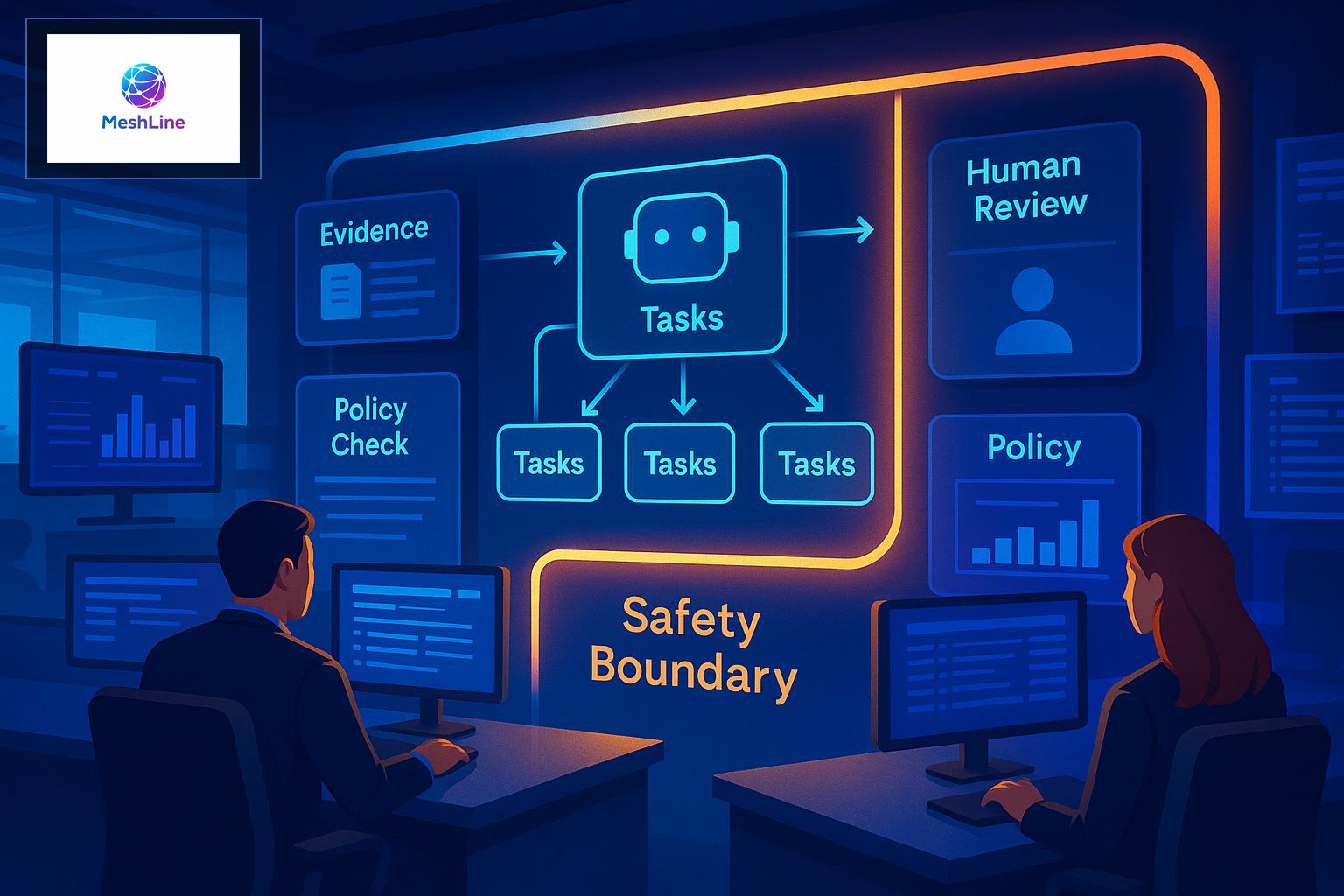
AI Safety Boundaries: Guardrails for Workflow Decisions breaks when automated decisions move faster than review, rollback, and evidence trails. For operators, the painful part is the manual recovery that follows: operators cannot explain why a workflow acted the way it did, ownership is unclear, and the team has to rebuild context while the customer, lead, campaign, or report is already waiting.
Software teams do not feel AI safety controls problems as an abstract planning topic. They feel them when a handoff stalls, a record goes stale, an owner is missing, and a customer-facing decision waits on someone to rebuild context. AI Safety Boundaries: Guardrails for Workflow Decisions matters because the workflow needs visible triggers, clear ownership, exception routing, and review checkpoints before the next revenue-critical step slips.
Software teams do not feel AI safety controls problems as an abstract planning topic. They feel them when a handoff stalls, a record goes stale, an owner is missing, and a customer-facing decision waits on someone to rebuild context. AI Safety Boundaries: Guardrails for Workflow Decisions matters because the workflow needs visible triggers, clear ownership, exception routing, and review checkpoints before the next revenue-critical step slips.
Search Console showed the query "ai safety boundaries explained" with 4 impressions and an average position near 4.5. That is a practical signal.Google is already testing Meshline for the concept, which means the next step is to give the topic a stronger article, better examples, more. authority references, and a clearer link between the term and Meshline's operating-layer point of view.
What AI safety boundaries explained means
In a Meshline context, AI safety boundaries explained describes the operating challenge that appears when AI agents summarize, recommend, route, classify, draft, or take. action inside business workflows that still need human policy and operational limits. The phrase may look narrow, but the workflow underneath it is usually cross-functional. It touches data quality, ownership, customer experience, automation boundaries, and reporting confidence.
A strong definition has four parts. The trigger is the signal that starts the workflow: an agent receives a task, retrieves context, calls a tool, proposes an action, changes a record, or reaches a low-confidence decision. The owner is the team or role accountable for the decision: business owners define policy, technical owners enforce tool limits, and operations owners review exceptions. The exception path decides when automation should pause: customer-impacting actions, missing evidence, low confidence, sensitive data, regulated decisions, and tool calls beyond scope should pause automation. The outcome defines what the business expects to improve: teams use AI agents without letting speed outrun trust.
For AI Safety Boundaries: Guardrails for Workflow Decisions, that four-part definition matters because most operational problems do not fail because a team lacks a tool. They fail because the trigger is vague, the source of truth is unclear, the owner is implied instead of assigned, or the exception path depends on someone noticing a problem manually.
Meshline's perspective is simple: terms like AI safety boundaries explained should become inspectable workflows. If the business cannot see what triggered the action, why the decision happened, who owns the result, and whether the outcome improved, the system is not ready to scale.
For AI Safety Boundaries: Guardrails for Workflow Decisions, that is the shift from scattered automation to system-led execution. Meshline treats the workflow as an operating layer and execution layer for trigger-to-outcome execution. It gives teams ownership and control, turns repeatable work into engines, and helps them move toward self-operating business systems without pretending human judgment disappears.
Why this deserves a full article

For AI Safety Boundaries: Guardrails for Workflow Decisions, the reason to expand this topic is authority. Searchers are not only looking for vocabulary. They are trying to understand how to apply the concept in their own systems. A founder may be trying to reduce manual work. A revenue operator may be trying to clean up handoffs. A marketing team may be trying to activate demand. An ecommerce team may be trying to prevent support volume. A technical team may be trying to make automation safer.
For AI Safety Boundaries: Guardrails for Workflow Decisions, thin content gives them a definition and then stops. Strong content connects the concept to implementation. It explains what data is required, what can go wrong, how teams should assign ownership, and how the workflow can improve with automation.
For AI Safety Boundaries: Guardrails for Workflow Decisions, that is where Meshline can win. Meshline is not a single-purpose automation tool. It is Autonomous Operations Infrastructure. The platform is built to connect signals, route decisions, enforce guardrails, and make outcomes visible. That means this topic belongs in Meshline's content library because it helps explain how operating work moves from disconnected tools into governed execution.
For AI Safety Boundaries: Guardrails for Workflow Decisions, here is the real problem: the market trend is moving faster than most operating models. Teams are adding AI, integrations, analytics, and campaign systems, but the underlying category is shifting toward controlled execution. The next category does not belong to teams with the most tools. It belongs to teams that can make work observable, governable, and improvable.
The operating-layer framework
Every useful AI safety boundaries explained workflow should start with the entry signal. A workflow cannot be governed until the team knows what causes it to begin. The signal might be a CRM update, a marketing audience change, a payment event, a shipment exception, a model output, a form submission, or a system health metric.
For AI Safety Boundaries: Guardrails for Workflow Decisions, the second layer is context. Context tells the workflow what the signal means. A form fill from a qualified account is different from a low-fit contact. A failed payment on a high-value customer is different from a failed payment on an abandoned trial. A stale deal with executive activity is different from a stale deal with no buyer engagement. Context is what prevents automation from treating every event the same way.
For AI Safety Boundaries: Guardrails for Workflow Decisions, the third layer is policy. Policy defines what the system is allowed to do. It may route a case to an owner, suppress a campaign, create a task, pause an agent, enrich a record, or trigger a customer message. Policy can include thresholds, consent rules, territory rules, eligibility rules, risk bands, and evidence requirements.
The fourth layer is exception handling. customer-impacting actions, missing evidence, low confidence, sensitive data, regulated decisions, and tool calls beyond scope should pause automation. This is the layer that separates dependable automation from brittle automation. The happy path is easy to design. The exception path is where trust is built.
The fifth layer is outcome measurement. teams use AI agents without letting speed outrun trust. A workflow should not be considered successful because a tool fired. It should be successful because the business state improved and the result can be inspected later.
For AI Safety Boundaries: Guardrails for Workflow Decisions, ## Practical example 1: the signal arrives but ownership is unclear
Imagine a team dealing with AI safety boundaries explained. The trigger happens in one system, but the owner works in another. A record changes, a signal appears, or a customer action occurs. Everyone agrees it matters, but nobody knows whether marketing, sales, support, finance, operations, or engineering should act first.
For AI Safety Boundaries: Guardrails for Workflow Decisions, the result is slow execution. Someone asks in a chat thread. Someone checks a dashboard. Someone looks for the record in another system. The workflow eventually moves, but the process depends on human memory and availability.
For AI Safety Boundaries: Guardrails for Workflow Decisions, meshline changes the pattern by turning the trigger into a routeable event. The workflow captures the signal, gathers the relevant context, checks the policy, assigns the owner, and records the decision. The work becomes visible. The next step is no longer a guess.
For AI Safety Boundaries: Guardrails for Workflow Decisions, ## Practical example 2: automation acts too broadly
For AI Safety Boundaries: Guardrails for Workflow Decisions, the opposite problem is also common. A team automates too quickly. Every record that matches a condition gets moved, messaged, routed, discounted, scored, or escalated. The system is fast, but it does not understand exceptions.
This is where AI safety boundaries explained can become risky. If the workflow does not check consent, account status, data freshness, business rules, or confidence level, it can create more work than it removes. Bad automation is not just inefficient. It can damage revenue, customer trust, and reporting quality.
For AI Safety Boundaries: Guardrails for Workflow Decisions, meshline's operating-layer approach adds guardrails before scale. The workflow defines which cases are safe to automate, which cases require review, and which cases should be blocked until evidence improves. That gives teams speed without losing judgment.
For AI Safety Boundaries: Guardrails for Workflow Decisions, ## Practical example 3: reporting cannot explain the result
For AI Safety Boundaries: Guardrails for Workflow Decisions, teams often discover the weakness of a workflow after the fact. A campaign ran, a deal moved, a payment changed, an order broke, or an AI agent acted. The result appears in reporting, but the team cannot reconstruct why it happened.
For AI Safety Boundaries: Guardrails for Workflow Decisions, that is a governance problem. If the workflow cannot explain the input, rule, owner, exception, and result, the business cannot learn. It can only react.
For AI Safety Boundaries: Guardrails for Workflow Decisions, a better Meshline workflow records the decision trail. It stores the triggering event, the source systems, the evidence used, the owner assigned, the action taken, and the outcome. That gives operators a way to audit the workflow and improve it over time.
How AI should fit into this workflow
AI can make AI safety boundaries explained more useful, but only inside the right boundaries. AI can summarize records, identify intent, classify cases, suggest owners, draft explanations, and detect anomalies. But AI should not become the silent policy owner.
For AI Safety Boundaries: Guardrails for Workflow Decisions, the best pattern is AI-assisted execution. The model helps interpret context, but the workflow still controls what the system is allowed to do. Sensitive cases route to review. Low-confidence outputs pause. Actions that affect customers, revenue, security, or compliance require stronger evidence.
For AI Safety Boundaries: Guardrails for Workflow Decisions, this is especially important as teams adopt AI agents. Agents can move faster than a human team, which means mistakes can also spread faster. Meshline's operating layer gives agents a controlled environment: defined tools, clear permissions, evidence requirements, review gates, and outcome logs.
Metrics to track
For AI Safety Boundaries: Guardrails for Workflow Decisions, the first metric is trigger volume. How often does this workflow start? If volume is low, manual review may be acceptable. If volume is rising, the team needs stronger automation and routing.
For AI Safety Boundaries: Guardrails for Workflow Decisions, the second metric is exception rate. A high exception rate means the workflow needs better rules, better data, or clearer ownership. Exceptions are not only problems. They are learning signals.
For AI Safety Boundaries: Guardrails for Workflow Decisions, the third metric is time to action. How long does it take from signal to owner response? This tells the team whether the workflow is reducing coordination drag.
The fourth metric is outcome quality. Did the workflow produce teams use AI agents without letting speed outrun trust? Outcome quality matters more than activity volume.
For AI Safety Boundaries: Guardrails for Workflow Decisions, the fifth metric is rework. If teams keep reopening, correcting, or manually cleaning the same cases, the workflow is not capturing enough context at the front.
Implementation checklist
- Define the trigger that starts the AI safety boundaries explained workflow.
- For AI Safety Boundaries: Guardrails for Workflow Decisions, Identify the system of record for each required field.
- For AI Safety Boundaries: Guardrails for Workflow Decisions, Name the owner for the normal path and the exception path.
- For AI Safety Boundaries: Guardrails for Workflow Decisions, Document what the workflow is allowed to do automatically.
- For AI Safety Boundaries: Guardrails for Workflow Decisions, Decide which cases require review before action.
- For AI Safety Boundaries: Guardrails for Workflow Decisions, Add evidence capture so decisions can be inspected later.
- For AI Safety Boundaries: Guardrails for Workflow Decisions, Connect the workflow to downstream reporting.
- For AI Safety Boundaries: Guardrails for Workflow Decisions, Track exception rate, time to action, and outcome quality.
- For AI Safety Boundaries: Guardrails for Workflow Decisions, Review the workflow monthly and tune rules based on what operators learn.
- For AI Safety Boundaries: Guardrails for Workflow Decisions, Keep AI assistance inside policy, evidence, and permission boundaries.
Common mistakes
The first mistake is treating AI safety boundaries explained as a static definition. Definitions are useful, but the business value appears only when the term becomes a repeatable workflow.
For AI Safety Boundaries: Guardrails for Workflow Decisions, the second mistake is routing everything to the same owner. Most operating workflows have multiple ownership layers. One team owns the data, another owns the customer experience, another owns the revenue impact, and another owns the technical system.
For AI Safety Boundaries: Guardrails for Workflow Decisions, the third mistake is measuring tool activity instead of business outcome. A sync, trigger, message, or model output is not the outcome. It is only a step toward the outcome.
The fourth mistake is skipping exceptions. customer-impacting actions, missing evidence, low confidence, sensitive data, regulated decisions, and tool calls beyond scope should pause automation. If those cases are not designed into the workflow, the team will handle them through side channels.
How Meshline applies the concept
Meshline helps teams turn AI safety boundaries explained into governed execution. It connects the trigger, context, decision, owner, action, and outcome into one operating layer. That is the difference between isolated automation and autonomous operations infrastructure.
For AI Safety Boundaries: Guardrails for Workflow Decisions, with Meshline, teams can capture the signal, enrich it with cross-system context, use AI to interpret the situation, route the right owner, pause sensitive. cases, execute allowed actions, and keep the result visible. The workflow becomes less dependent on manual coordination and more dependable as volume grows.
For AI Safety Boundaries: Guardrails for Workflow Decisions, the real advantage is not only speed. It is clarity. Teams can see what happened, why it happened, and what should improve next.
References and authority links
For AI Safety Boundaries: Guardrails for Workflow Decisions, these references are included to strengthen the article beyond a short definition. Each source supports an implementation, platform, security, analytics, or operating-control angle that teams can apply when building the workflow.
Final takeaway
AI safety boundaries explained is a strong topic because it connects search demand to a real operating problem. The best article should define the term, show examples, explain ownership, include authority references, and show how Meshline turns the idea into a workflow that can be inspected, governed, and improved.
How to use this playbook
Start with one real ai safety boundaries explained guardrails for workflow, not a theoretical transformation program. Pick the path where work gets stuck, customers wait, or a manager has to ask, "who owns this now?" That is where the useful signal lives.
A concrete example
For AI Safety Boundaries: Guardrails for Workflow Decisions, for example, map the moment a request enters the business, the system that records it, the owner who decides the next action, and the notification that proves the work moved. If any of those four pieces are fuzzy, the workflow is still running on hope and calendar reminders. Brave, but not exactly scalable.
Common mistakes to avoid
- For AI Safety Boundaries: Guardrails for Workflow Decisions, Do not automate a vague process. You will only make the confusion faster.
- For AI Safety Boundaries: Guardrails for Workflow Decisions, Do not let two systems disagree without a named owner for reconciliation.
- For AI Safety Boundaries: Guardrails for Workflow Decisions, Do not treat exceptions as edge cases if they happen every week. That is the process waving a tiny red flag.
- For AI Safety Boundaries: Guardrails for Workflow Decisions, Do not measure activity when the real question is whether the outcome happened.
Monday morning checklist
- For AI Safety Boundaries: Guardrails for Workflow Decisions, Pick the workflow with the most visible handoff pain.
- For AI Safety Boundaries: Guardrails for Workflow Decisions, Write down the trigger, owner, next action, escalation path, and success metric.
- For AI Safety Boundaries: Guardrails for Workflow Decisions, Find one failure mode from last week and decide how it should be routed next time.
- For AI Safety Boundaries: Guardrails for Workflow Decisions, Add one QA check that catches bad data before it becomes customer-facing work.
- For AI Safety Boundaries: Guardrails for Workflow Decisions, Review the result after seven days and tighten the rule instead of adding another meeting.
Practical operating checks
In AI Safety Boundaries: Guardrails for Workflow Decisions, use this section to turn the workflow automation idea into a visible operating decision. The goal is to make the next handoff obvious before volume increases.
Monday morning diagnostic
For AI Safety Boundaries: Guardrails for Workflow Decisions, start by checking the last five examples where the workflow stalled. Write down the trigger, the source system, the owner, the next action, and the moment the customer or lead received a response. If one of those fields is missing, the workflow is relying on memory.
First workflow to tighten
For AI Safety Boundaries: Guardrails for Workflow Decisions, step 1 is to choose one handoff and make it measurable. For example, define what should happen when a qualified lead arrives, when a content brief is approved, when a CRM record changes, or when a reconciliation exception appears. The smaller the first rule, the easier it is to prove.
Checklist before you scale
- For AI Safety Boundaries: Guardrails for Workflow Decisions, Confirm the page or workflow has one owner.
- For AI Safety Boundaries: Guardrails for Workflow Decisions, Confirm the source system and destination system agree on the key fields.
- For AI Safety Boundaries: Guardrails for Workflow Decisions, Add one quality check that catches bad data before it reaches a reader, lead, or customer.
- For AI Safety Boundaries: Guardrails for Workflow Decisions, Add one relevant Meshline resource link that helps the reader take the next step.
- For AI Safety Boundaries: Guardrails for Workflow Decisions, Review the result after seven days and improve the rule before adding more volume.
Related Meshline resources
Use AI Safety Boundaries: Guardrails for Workflow Decisions with Organic Marketing Engine, Revenue Intel Module, Meshline glossary, and Book a Meshline demo when you want the workflow to connect back to pipeline instead of stopping at planning.