
 MeshLine
AI SEO Automation: Architects' Guide to Agents vs. Operators
Map where AI agents help with SEO research, briefs, and quality checks, and where operators should review evidence, intent, and publication decisions.
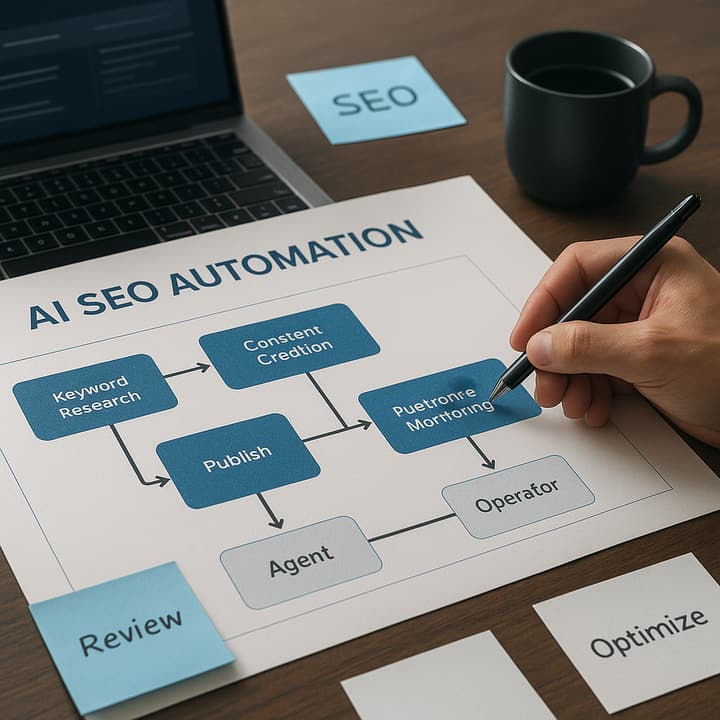
AI SEO automation is an operating-layer problem, not a list of tips. Technical founders evaluating automation architecture need a defensible playbook that ties AI agents for SEO to owners, observability, and revenue signaling. This post treats AI SEO automation as a system — an Autonomous Operations Infrastructure — that must include orchestration, governance, and clear exception paths so you can scale programmatic SEO without creating long-term ranking, compliance, or attribution debt.
This guide is practical and decision-stage: it shows where agents should act autonomously, where operators must retain control, what QA gates to implement, the failure modes to watch for, and how Meshline converts those rules into infrastructure. If you want a tailored architectural review, Book a strategy call.
Why AI SEO automation matters — and what’s at stake
AI agents for SEO open new operating models: programmatic category pages, automated content-refresh pipelines, and real-time Search Console response workflows. Those capabilities deliver scale and velocity, but they also raise acute risks:
- Algorithmic devaluation from low-quality automated output.
- Manual actions or policy flags from structural or legal errors.
- Crawl-budget waste and index bloat from ungoverned mass publishing.
- Attribution gaps that break lead-to-revenue measurement and decision-making.
For founders this is a product+marketing+ops problem: the automation you design impacts acquisition, product integrity, and revenue. The right architecture converts experiments into reproducible outcomes; the wrong one multiplies mistakes.
This post assumes you are responsible for architecture decisions and will assign owners. If you need templates and sprint plans, see the Meshline SEO Automation Playbook.
Operating framework for AI SEO automation
Treat automation as infrastructure with three layers:
- Orchestration: the scheduler and retry/transactional layer that coordinates agents and publishing pipelines.
- Governance: QA gates, human-in-the-loop rules, rollback policies, and policy enforcement.
- Operator workflows & observability: task ownership, alerting, diffs, and attribution integration.
Meshline maps each layer to concrete owners and runbooks so that agents operate under observable, auditable rules. See how Meshline frames orchestration in Meshline Product: Meshline Ops.
Core components (H3)
- Orchestrator: an idempotent engine that queues tasks, retries safely, and sequences staging→QA→publish steps.
- Agents: specialized models or chains that perform outline generation, meta production, structured-data assembly, or draft copy.
- Canonical data layer: PIM, product feeds, and canonical content sources the agents must read from (read-only in most cases).
- Governance layer: automated linters, human approval gates, and publish policies.
- Observability & attribution: logs, diffs, Search Console syncs, and lead-to-revenue mapping.
Design principle: canonical data and idempotency (H3)
Never let agents invent structured numeric or legal data. Agents should read canonical fields (e.g., price, SKU, date) and only write derived text. All publishing operations must be idempotent: re-running tasks should not create duplicates or inconsistent canonical URLs.
Data flows and sync patterns
Data contracts are the backbone of safe AI SEO automation. Define strict contracts between source systems and the automation pipeline:
- Source-of-truth feeds: PIMs, product APIs, pricing endpoints.
- Signal sources: Search Console, analytics, and rank tracking.
- CMS staging API: accepts drafts and supports a QA status lifecycle.
Sync patterns to prefer:
- Incremental, timestamped syncs to prevent race conditions.
- Event-driven triggers for signal-driven actions (Search Console anomaly → triage task).
- Batched staging writes with sample validations and explicit publish commands.
For standardization, enforce schema validation (Schema.org for structured data) before any item moves from staging to production.
Governance gates — where humans must stay in the loop
Not every automated task needs the same level of human oversight. Classify automation tasks into at least three governance tiers and codify the gate behavior.
Tiering model (H3)
- Tier 1 — Low risk, reversible: meta tags, internal link rewrites, canonical tag corrections. Allow automated deployment with deferred human audit and periodic sampling.
- Tier 2 — Medium risk: content refreshes, structured-data additions, headline or excerpt generation. Require sample-based human QA and automated rollback triggers tied to performance signals.
- Tier 3 — High risk: mass page generation, changes to pricing/legal copy, or indexation decisions. Require explicit operator approval and staged canary rollouts.
Each tier should map to concrete rules: approval SLAs, rollback thresholds, and test cohorts.
Examples of guardrail implementations (H3)
- Staging-by-default: agents write drafts in CMS staging with a locked publish flag.
- Canary release: publish to a small cohort (1–5%) and monitor impressions, CTR, and positions for X days.
- Automatic quarantine: orchestrator toggles noindex on suspicious cohorts if short-term signals drop beyond thresholds.
Practical examples and where agents help vs. operators control
Concrete workflows show where automation is high-value and where operators must intervene.
Programmatic category pages at scale (H3)
How agents help:
- Generate category descriptions from product feed attributes and user intent signals.
- Produce structured data (product/schema markup) from canonical fields.
- Create staging drafts and automated linting reports.
Operator controls:
- Human sample review for initial tranche (first 500 pages), then A/B rollout for the next 5k.
- Rollback policy tied to impressions/CTR drops or manual action notices.
- Enforce canonical URL service to avoid duplicate page creation.
Meshline maps this pattern into a sprint template in the Meshline SEO Automation Playbook.
Search Console anomaly response workflow (H3)
How agents help:
- Monitor Search Console API, classify anomalies (indexation, structured data, mobile usability), and draft remediation tasks.
- Propose low-risk fixes (e.g., robots header, meta tag tweaks) and pre-fill ticket templates with diffs.
Operator controls:
- Require operator sign-off before agent-initiated appeals, permanent index toggles, or sitemap changes.
- Escalation rules for manual-action flags; operators determine remediation messaging.
This pattern should feed into your ticketing system with SLA tracking for triage and remediation.
Content-refresh pipelines for evergreen pages (H3)
How agents help:
- Prioritize pages based on engagement decline and content decay signals.
- Suggest sections, FAQs, and updated stats from canonical sources.
Operator controls:
- Human spot checks for factual accuracy and similarity checks to prevent inadvertent duplication.
- A/B test refreshed variants and measure MQL and position movements before mass rollout.
Implementation steps — build vs. buy, integrations, rollout
This is a decision-stage checklist for founders choosing between quick build, custom integration, or adopting an operating layer like Meshline.
Step 0: Define success metrics (H3)
- Business KPIs: organic sessions from new/updated pages, MQLs per page, and lead-to-revenue velocity.
- Safety KPIs: Search Console warnings, manual actions, CTR and position degradation thresholds.
Map each KPI to an owner and an SLA. Templates are in the Meshline SEO Automation Playbook.
Step 1: Inventory and classification (H3)
List all candidate tasks (meta updates, content generation, structured data additions, index control), then classify them into your governance tiers. Capture owners, SLAs, and rollback actions for each task.
Step 2: Choose integration patterns (H3)
- Event-driven: Search Console event → orchestrator → agent → staging.
- Scheduled: periodic evergreen refresh cycles with sampling and canary cohorts.
- CI-style deploys: use CI pipelines for policy checks and automated linting prior to publish.
Decide whether to expose agent outputs as drafts for human editors or to enable automated publishing with deferred audit depending on tier.
Step 3: QA gates, linters, and test harness (H3)
Implement automated checks:
- Structured-data validators (Schema.org conformity).
- Duplicate detection and similarity thresholds against your corpus.
- Readability, toxicity, and hallucination checks; enforce canonical data read-only rules.
- Performance and Core Web Vitals pre-publish checks.
Human sampling must be systematic: 1% weekly for Tier 1, 5% for Tier 2, 100% for Tier 3 prior to production.
Step 4: Phased rollout and decision review (H3)
- Canary cohort (1–5%) monitored daily.
- Ramp to 25% with rollback triggers automated.
- Full roll only after KPIs are stable for N weeks and a decision review signs off.
If you choose to partner on implementation, Meshline runs alignment sprints to map Search Console workflows and lead-to-revenue attribution into a single system. See our integration approach in Meshline Solution: Organic Growth Automation and consider an implementation review to fast-track compliance: Book a strategy call.
QA, ownership, failure modes, and exception paths
High-throughput automation must be safe, observable, and auditable. Below are operational rules and concrete responses when automation fails.
Ownership rules (H3)
- SEO Owner: sets quality thresholds, approves Tier 3 actions, and owns rollback SLAs.
- Data Owner: guarantees unique IDs, canonical URLs, and data contracts.
- Automation Engineer: maintains orchestrator, retries, and idempotency guarantees.
- Content QA: signs off on semantic quality and factual checks.
- Revenue/Analytics Owner: ensures attribution maps to CRM and lead-to-revenue pipelines.
Document these roles in a runbook and publish to team wiki; see role templates in Meshline Glossary: AI Agents.
Common failure modes and mitigations (H3)
- Hallucinated data (pricing, specs): mitigation — force-read-only canonical sources for numeric/legal fields; disallow generation of such fields.
- Duplicate pages/cannibalization: mitigation — canonical URL service, automated duplicate detection pre-publish.
- Crawl-budget waste/index bloat: mitigation — staged indexation, sample-based publish, cohort noindex default.
- Manual action/policy violation: mitigation — Tier 3 pre-signoff, continuous Search Console monitoring, immediate quarantine and rollback.
Exception path (H3)
- Detect: monitoring alerts (manual-action, sudden CTR drop, or mass deindex).
- Quarantine: orchestrator toggles noindex and reverts the latest publish where possible.
- Triage: automated triage provides suggested remediation; operator reviews within SLA.
- Remediate: agent or human performs corrective edits; re-run linters.
- Postmortem: full RCA published within 72 hours with remediation and policy updates.
A template exception runbook and audit checklist are available in Meshline Solution: Organic Growth Automation.
Implementation checklist — day 1 to day 90
- Day 1–7: Inventory tasks and assign owners for SEO, data, automation, and QA.
- Day 7–21: Build canonical data contracts and a minimum viable orchestrator; add structured-data linting.
- Day 21–45: Pilot Tier 1 agents with automated QA and Search Console integration.
- Day 45–75: Expand to Tier 2 with human-in-the-loop sampling and Core Web Vitals validation.
- Day 75–90: Run a decision review for Tier 3 automation, finalize rollback SLAs, and map attribution to CRM for lead-to-revenue analysis.
Map these steps to Meshline sprint templates in the Meshline SEO Automation Playbook.
Governance SVG workflow (alt text and embedded)
Alt text: Meshline orchestration diagram connecting source data (PIM/feeds), AI agents (generate/outline), staging CMS and QA gates, observability and Search Console sync, and an operator exception path for quarantine and rollback.
Next steps and decision-stage options
For technical founders there are three pragmatic options, listed with trade-offs:
- Build in-house minimal orchestration and manual guardrails — fastest to start, highest maintenance and fragility.
- Integrate model APIs and home-grown automation tooling with custom governance — flexible but requires sustained engineering ops investment.
- Adopt Meshline as the operating layer — maps agents to owners, guardrails, and QA gates; recommended when programmatic scale and lead-to-revenue attribution are business critical.
Meshline supports standard engineering stacks and marketing systems. We run implementation sprints to map your Search Console workflows, programmatic SEO pipelines, and attribution into a resilient system. See implementation templates in Meshline Solution: Organic Growth Automation and starter playbooks in the Meshline SEO Automation Playbook.
Ready to move from experiments to production-grade automation architecture? Book a strategy call.
Appendix: editorial notes and outreach opportunities
- Outreach/backlink opportunity: prepare an editorial collaboration or case study request to PIM vendors, CMS partners, and analytics vendors to illustrate joint workflows (use Meshline customer stories and partner templates).
- Partner link opportunities include authoring a guest post for major SEO industry blogs or exchanging a product-playbook with platform partners.
For AI SEO Automation: Architects' Guide to Agents vs. Operators, ## Implementation Evidence and Reliability Checks
Use these references to validate the AI SEO automation implementation model, reliability assumptions, integration controls, and incident-response expectations before rollout.
- For AI SEO Automation: Architects' Guide to Agents vs. Operators, Google Cloud Architecture Framework
- For AI SEO Automation: Architects' Guide to Agents vs. Operators, AWS Well-Architected Framework
- For AI SEO Automation: Architects' Guide to Agents vs. Operators, Microsoft Azure Well-Architected Framework
- For AI SEO Automation: Architects' Guide to Agents vs. Operators, CNCF Platform Engineering Maturity Model
- For AI SEO Automation: Architects' Guide to Agents vs. Operators, Martin Fowler on distributed systems patterns
- For AI SEO Automation: Architects' Guide to Agents vs. Operators, Atlassian incident management guide
- For AI SEO Automation: Architects' Guide to Agents vs. Operators, HubSpot API documentation
- For AI SEO Automation: Architects' Guide to Agents vs. Operators, Salesforce integration patterns
AI SEO automation Implementation Checklist
Use this AI SEO automation checklist to keep the AI SEO automation workflow specific enough for operators and buyers. Name the owner, source system, destination system, exception route, QA checkpoint, and reporting field before automation goes live.
For AI SEO automation, Meshline should confirm the trigger, review path, audit trail, fallback owner, and demo-ready outcome. That keeps AI SEO automation from becoming another disconnected workflow and gives teams a practical implementation path.
The operating language should stay consistent: AI SEO automation, AI SEO automation automation, AI SEO automation workflow, AI SEO automation operating model, AI SEO automation implementation, AI SEO automation checklist, AI SEO automation QA, AI SEO automation governance, exception routing, automation governance, operational visibility, and Meshline's operating layer. AI agents for SEO should appear where it clarifies search intent and buyer relevance. SEO workflow governance should appear where it clarifies search intent and buyer relevance. AI content operations should appear where it clarifies search intent and buyer relevance. automation guardrails for SEO should appear where it clarifies search intent and buyer relevance.