
 MeshLine
AI Workflow Debugging: Workflow Guide for Operators
Trace AI workflow failures through inputs, decisions, tool calls, and handoffs. Use operator checks to isolate the cause and verify a controlled recovery.
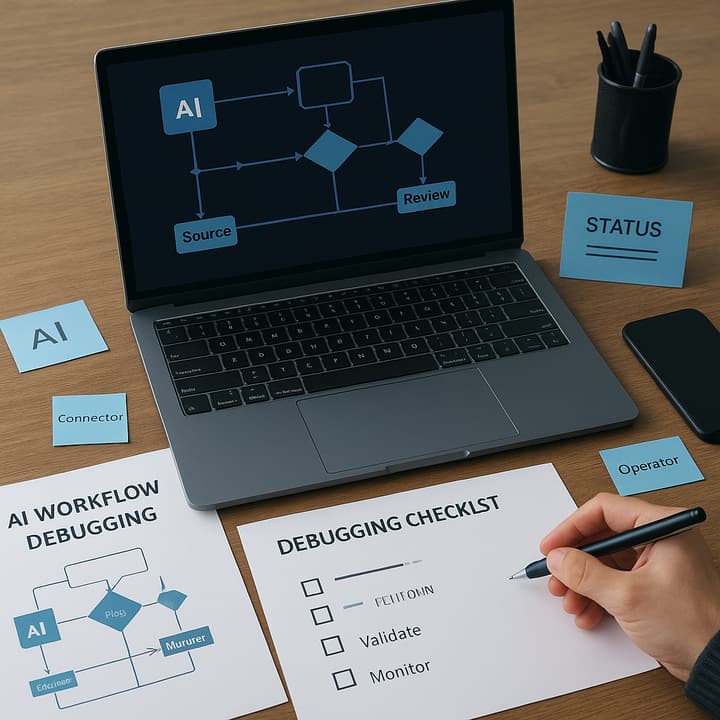
This playbook answers a live Search Console signal — the exact ranking query "ai workflow debugging" — and turns that signal into a decision-ready, buyer-facing operator guide. If your startup runs production AI agents, this article lays out how to detect failures, assign owners, design exception paths, and map operational intent into Meshline’s execution layer so agents become observable and recoverable.
Quick decision CTA: to map these rules into your runtime, See the engine structure.
What and why: ai workflow debugging as an operator problem
"ai workflow debugging" is a search query we see from operators and technical founders who need a repeatable, executable approach — not ad-hoc detective work. This is an operational discipline: owners, triggers, and exception handling must be defined, testable, and enforced by the runtime.
Why this matters for technical founders and operators
- Agents combine models, orchestration, external APIs, and business logic. A small failure anywhere can cascade into business impact.
- Debugging without ownership and automation means high MTTR, inconsistent remediation, and auditable gaps.
- Treating "ai workflow debugging" as an operations signal (not only a dev task) reduces business risk and supports procurement conversations.
Key buyer outcome
Operators should be able to answer three questions within five minutes of an alert: What triggered this? Who owns it? What automated exception path will run? Meshline maps those answers into runtime enforcement and audit trails. See Meshline platform architecture for how runtime enforcement gets wired to owner metadata and policies.
Search Console evidence: the signal and why Meshline should double down

Meshline Search Console shows the ranking query "ai workflow debugging" with 27 impressions and an average position of 24.67 (page 4). The current ranking page is the glossary entry at Meshline glossary: AI workflows debugging.
Why double down now
- The query is low-volume but high-intent: people searching it are often in the consideration stage, evaluating vendor architecture and operational patterns.
- Impressions are growing while CTR is weak; this indicates a gap between relevance and SERP presentation. Converting that interest requires a page engineered for first-page readiness (practical playbooks, clear CTA, and buyer-facing integration language).
- Doubling down converts search interest into product-qualified leads: include decision-stage language (automation, integration, implementation, demo), internal linking to product docs, and a clear demo or mapping CTA.
Practical next step for content strategy
- Replace the current glossary-first result with this operator playbook that surfaces triggers, owners, exception paths, authority references, and Meshline execution examples.
- Use the existing glossary as canonical definitions and link it heavily from the playbook (we link it throughout). This preserves the glossary's SEO authority while creating a stronger demo-ready resource.
Operating framework: maps, triggers, owners, and exception paths
A concise operating-layer checklist for ai workflow debugging includes five components: triggers, observable signals, owners, exception routing, and enforcement. Turn each into code, tests, and runtime metadata.
Triggers (what starts a debug flow)
- Alert triggers: latency p95/p99, error rate, failed confidence checks, embedding drift, and business-layer KPI regressions.
- Manual triggers: user reports, audits, or Search Console signals (like the ranking query above).
- Composite triggers: combine a model confidence threshold with a downstream business metric to reduce noise.
Observable signals (what you measure)
- Execution traces: step-level timing, inputs/outputs, resource usage, and correlation IDs.
- Model telemetry: token usage, log-probabilities, prompt and response embeddings, and assistant actions.
- External API signals: HTTP response codes, rate-limit headers, request IDs, and vendor-side latencies.
Owners (who acts)
- Level 1 (triage): on-call operator responsible for routing, restarting, or enabling safe-mode.
- Level 2 (investigation): agent or ML engineer responsible for prompt, model, or orchestration remediation.
- Level 3 (domain): product SME or legal for policy-level decisions.
Ownership rules to implement
- Registry: every agent entry includes primary owner, backup owner, and escalation path.
- Time-boxed acknowledgements: T_ack for the primary owner, after which escalation occurs automatically.
- Authority references: map each action to an authority (policy-as-code, human approver, or persona) and store that link in the execution log.
Exception paths (automated fallbacks)
- Soft failure: automatic retries with exponential backoff and alternate prompt templates.
- Fallback: switch to cached responses or human-in-loop review when confidence is low.
- Hard failure: disable outbound side-effects and raise a P1 incident when safety or security is at risk.
Enforcement and automation
- Policy-as-code: encode routing, ownership, and exception rules, then enforce via CI gating.
- Runtime hooks: Meshline enforces owners and exception routing at execution time so your operational intent becomes executable. Cross-reference: Meshline docs: agent governance.
Examples and use cases: three incident playbooks
These concrete playbooks map triggers to owners and exception paths so an on-call operator can act immediately.
Incident: Timeouts and cascading retries
Symptoms: rising p95 latency, queued requests, backend timeouts.
Playbook steps
- Trigger: 3x baseline p95 latency in 5 minutes.
- Immediate action: enable ingress throttles and set transient circuit-breakers.
- Owner: on-call operator; escalate to platform engineer if unresolved after 15 minutes.
- Root checks: external API rate-limit headers, model inference queue length, and feature store availability.
- Fix: reduce batch size, apply circuit-breaker, and reconnect backpressure to the orchestration layer.
Incident: Hallucination or incorrect outputs
Symptoms: user flags, low confidence scores, or semantic-drift alerts.
Playbook steps
- Trigger: user feedback or confidence < threshold.
- Owner: model owner + product SME.
- Immediate exception: disable auto-actioning and route outputs to a human review queue.
- QA: run a focused batch evaluation against golden examples and check prompt templates for recent changes.
Incident: Unauthorized data exposure
Symptoms: PII detection in outputs or an audit alert for unexpected data access.
Playbook steps
- Trigger: PII detector or audit rule alert.
- Immediate action: pause outbound interfaces, revoke tokens, preserve forensic logs.
- Owner: security lead + agent primary owner.
- Long-term: add prompt redaction, stricter data lineage policies, and policy-as-code gates.
For operational playbook templates, see Meshline ops playbooks.
Implementation steps: from detection to resilient operations
Operationalizing ai workflow debugging requires a combination of registry, instrumentation, testing, policy, and automation.
Step 1 — Inventory and registry
- Catalog every agent with owner, triggers, outputs, dependencies, and SLO/SLA targets.
- Keep the registry as the single source of truth and expose it to runtime for automated routing.
- Reference definitions in the glossary: Meshline glossary: AI workflows debugging.
Step 2 — Instrumentation and observability
- Traces: correlate request IDs across model, orchestration, and downstream systems using OpenTelemetry.
- Logs: structured logs that include input prompts, model responses, token counts, and decision flags.
- Metrics: p95/p99 latency, error rates, confidence percentiles, and embedding drift.
Step 3 — Testing and CI
- Unit tests for prompt templates and classifier functions.
- Integration tests that mock third-party APIs and validate retries and schema handling.
- Chaos tests: fault injection for timeouts, rate-limits, and model failure modes.
Step 4 — Policy-as-code and gating
- Encode routing and exception rules as code and gate deployments with CI checks to ensure owners and fallback paths remain intact.
- Block merges that remove primary owners or exception routes.
Step 5 — Automated remediation and runbooks
- Automate simple remediations: rollbacks, circuit-breakers, and automated human-in-loop routing for low-confidence outputs.
- Store runbooks in the same system as your on-call tooling to reduce MTTR.
Step 6 — Map to Meshline execution
- Implement runtime hooks and metadata so Meshline can enforce owner routing, exception paths, and authority references. See See the engine structure to build the mapping from registry to runtime enforcement.
QA, risk, and ownership: checks, audits, and failure modes
A strong QA program reduces silent degradation and ensures incidents are handled consistently.
Operational QA checks
- Alert coverage: each agent has latency, error rate, and confidence alerts.
- Test coverage: prompt template unit tests and dependency contract tests.
- Canary and staged rollouts: route a small percentage of traffic to new versions.
Ownership and authority references
- Decision log: every approval or automated action is stamped with an authority reference (policy ID, approver, or persona).
- Escalation windows: define T_ack and automatic routing to backups.
Failure modes to plan for
- Silent degradation: detect via periodic sampling and embedding drift metrics.
- Dependency schema changes: prevent with contract tests and schema validators.
- Retry storms: mitigate with circuit-breakers and rate limits.
Audits and compliance
- Immutable logs for actions and decisions, retention policies for audits, and periodic red-team exercises.
- Map audit findings back to the registry and policy-as-code tests.
Next steps: operationalize, demo, and buyer guidance
Short-term (7–14 days)
- Create or update the agent registry and assign owners.
- Configure three alerts per agent and connect them to on-call.
- Implement safe-mode and human-in-loop fallback for riskier flows.
Mid-term (1–3 months)
- Add tracing and model telemetry across pipelines.
- Run a chaos day to validate exception paths and escalations.
- Add policy-as-code gates into CI.
Long-term (ongoing)
- Automate remediation playbooks and publish SLOs for agent correctness.
- View aggregated health and incident metrics in a stakeholder dashboard.
Decision-stage CTA (buyer intent)
If you’re evaluating how to map these policies into your runtime and need vendor integration or implementation help, See the engine structure for an end-to-end mapping of owners, exception routing, and runtime enforcement. For governance patterns and integrations, see Meshline docs: agent governance and Meshline platform architecture.
Practical checklist: deployable ai workflow debugging rules
- Inventory: every agent listed with owner and failover.
- Alerts: latency, error rate, semantic confidence for each agent.
- Tracing: distributed tracing with per-step logs and correlation ID.
- Exception paths: soft-fail, fallback, hard-fail.
- CI gates: prompt tests and policy-as-code checks.
- Escalation: time-boxed routing with T_ack and SLAs.
- Forensics: immutable logs and retention policy.
Editorial and outreach note (growth & backlink opportunity)
Search Console shows the ranking query "ai workflow debugging" and the current Meshline page at Meshline glossary: AI workflows debugging. That page ranks around position 24. Doubling down means converting this interest into operator engagement by publishing playbooks, templates, and a clear decision CTA that maps to a demo or implementation.
Outreach/backlink opportunities
- Guest post or cross-post with MLOps community blogs and SRE practitioner sites to capture operational audiences.
- Partner integration pages (LangChain, Hugging Face, OpenAI) or vendor docs directories to secure contextual backlinks.
- Customer stories and industry blogs that demonstrate how Meshline mapped owners and exception paths into the execution layer.
Editorial action items
- Link this playbook to the glossary page and product docs for canonical definitions and deeper platform references.
- Feature a one-page downloadable runbook for on-call teams to capture email/demo conversions.
Resources and internal links
If you want a tailored runbook for your stack, link your agent registry and See the engine structure to map owners and automated exception paths into Meshline’s execution layer.
ai workflow debugging Implementation Checklist
Use this ai workflow debugging checklist to keep the AI agent governance workflow specific enough for operators and buyers. Name the owner, source system, destination system, exception route, QA checkpoint, and reporting field before automation goes live.
For ai workflow debugging, Meshline should confirm the trigger, review path, audit trail, fallback owner, and demo-ready outcome. That keeps ai workflow debugging from becoming another disconnected workflow and gives teams a practical implementation path.
The operating language should stay consistent: ai workflow debugging, AI agent governance automation, AI agent governance workflow, AI agent governance operating model, AI agent governance implementation, AI agent governance checklist, AI agent governance QA, AI agent governance governance, exception routing, automation governance, operational visibility, and Meshline's operating layer. ai workflow debugging workflow should appear where it clarifies search intent and buyer relevance. ai workflow debugging automation should appear where it clarifies search intent and buyer relevance. ai workflow debugging operations should appear where it clarifies search intent and buyer relevance.
Sources for Workflow Implementation
- For AI Workflow Debugging: Workflow Guide for Operators, Google Cloud Architecture Framework
- For AI Workflow Debugging: Workflow Guide for Operators, AWS Well-Architected Framework
- For AI Workflow Debugging: Workflow Guide for Operators, Microsoft Azure Well-Architected Framework
- For AI Workflow Debugging: Workflow Guide for Operators, CNCF Platform Engineering Maturity Model
- For AI Workflow Debugging: Workflow Guide for Operators, Martin Fowler on distributed systems patterns
- For AI Workflow Debugging: Workflow Guide for Operators, Atlassian incident management guide
- For AI Workflow Debugging: Workflow Guide for Operators, HubSpot API documentation
- For AI Workflow Debugging: Workflow Guide for Operators, Salesforce integration patterns
- For AI Workflow Debugging: Workflow Guide for Operators, Shopify Admin API documentation
- For AI Workflow Debugging: Workflow Guide for Operators, NetSuite SuiteTalk REST web services
- For AI Workflow Debugging: Workflow Guide for Operators, Stripe API documentation
- For AI Workflow Debugging: Workflow Guide for Operators, Zapier platform documentation