
 MeshLine
Blog Publishing Workflow Guide for Revenue Operations
Connect briefs, review gates, publishing ownership, distribution, and reporting so blog releases move without hidden coordination debt.
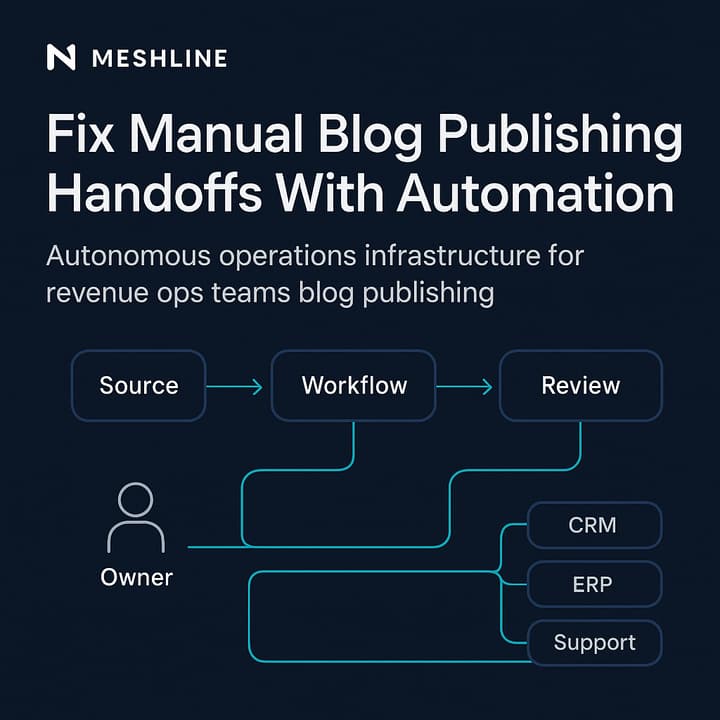
Revenue operations teams inherit complexity when they take ownership of blog publishing: fragmented templates, inconsistent metadata, late engineering work, and legal/regulatory exceptions. Those gaps accumulate as coordination debt "” missed deadlines, speed regressions, and unpredictable organic performance.
This case-style operating story shows how an autonomous operations infrastructure for revenue ops teams blog publishing converts ad-hoc human choreography into policy-driven automation, making publishing repeatable, auditable, and measurable. You'll get a before/after operating story, the Meshline design for blog publishing, concrete implementation patterns, review checkpoints, ownership rules, and a clear decision-stage path: Book a strategy call to scope a pilot and implementation timeline.
See our foundational guidance in the Meshline Operating Principles and a practical reference in the Meshline Blog Publishing Playbook.
What and why: the problem, symptoms, and measurable outcomes
Revenue ops teams operate at the intersection of marketing, product, and analytics. When blog publishing is shoehorned into that intersection without an operating system, the team spends disproportionate time on coordination instead of optimization.
Symptoms of coordination debt
- Multiple manual handoffs (PM → content → SEO → design → engineering) with no single source of truth.
- Rework when metadata, canonical tags, or redirects aren't applied consistently across posts.
- Post-publish regressions from platform changes that break tag injection or canonical patterns.
- Low CTR from weak SERP snippets despite high editorial quality "” often a governance or template issue, not a writing problem.
Measurable success outcomes
- Higher publishing velocity with lower coordination overhead (example: weekly cadence vs. ad-hoc releases).
- Fewer coordination tickets and fewer emergency hotfixes after platform releases.
- Predictable organic lift and improved CTR as templates, meta rules, and review checkpoints standardize search-facing output.
The core thesis: convert repetitive coordination into an autonomous operations infrastructure for revenue ops teams blog publishing that enforces policies, automates routine syncs, and surfaces exceptions when human judgment is required.
Before and after: a short operating story

Before
A mid-market B2B company had a 7-person revenue ops + content squad. Roughly 40% of team time went to coordination tickets and quick HTML fixes. Platform updates intermittently caused SEO regressions, and the editorial team had no standardized launch QA.
After (90-day pilot)
Meshline implemented an autonomous operations layer: metadata templates, automated redirect generation, synthetic launch checks, and exception routing to legal. The result: a sustained weekly three-post cadence, 60% fewer coordination tickets, and measurable organic traffic improvement within 90 days.
The operating story includes both social proof (ticket reduction, cadence) and technical proof (automated QA, redirect integrity), which makes the case credible for revenue ops leaders responsible for outcomes.
Meshline operating framework for blog publishing
Meshline collapses process into three executable layers: Policies, Pipelines, and Autonomous Actors. Together they form a repeatable operating pattern for content that matters to revenue.
Policies (declarative rules)
Policies are the single source of truth for what "good" looks like. Examples:
- Title rules (length, keyword placement, brand tokens).
- Slug and redirect policies (automated redirect on slug change; canonical rules).
- SEO thresholds (minimum score or custom checks) and when to require human review.
- Legal and compliance flags that create gated approval flows.
Each policy is owned by a named stakeholder and is executable by the pipelines that enforce it.
Pipelines (event-driven flows)
Pipelines move content through stages: draft → content QA → SEO check → design → staging → publish → post-publish audit. Pipelines are event-driven and idempotent, meaning they can re-run without causing duplication or inconsistent state.
Key pipeline behaviors:
- Template application and required-field validation on draft creation.
- Automated SEO and accessibility checks on staging.
- Redirect and canonical creation on publish.
- Post-publish audits and rollback triggers if regressions are detected.
Autonomous Actors (automation and human-in-the-loop triggers)
Autonomous actors are the actors that execute pipeline steps:
- Automation bots that apply templates, enforce slugs, and create redirects.
- QA actors that run synthetic audits and return prioritized fixes.
- Escalation actors that open tickets or route exceptions to legal or engineering.
Meshline orchestrates these actors and provides logging, dashboards, and runbooks so teams can measure and iterate.
For integration patterns and examples, consult our Meshline Integrations reference.
Why this autonomous operations infrastructure matters for revenue ops teams
The phrase "autonomous operations infrastructure for revenue ops teams blog publishing" is intentionally specific "” it signals three priorities:
- Autonomous: routine checks and transformations run without repeated manual steps.
- Operations infrastructure: a controlled execution layer that connects tools, enforces policies, and provides audit trails.
- For revenue ops teams blog publishing: outcomes focused on lead conversion, organic CTR, campaign sync, and operational SLAs.
When implemented correctly, teams can answer: who owns the title template? what happens if SEO score falls below threshold? how do we rollback a broken deployment? Those answers are stored as executable policy rather than tribal knowledge.
Policy examples (executable rules)
Concrete policies convert intent into enforcement. Sample policy definitions you can adopt immediately:
- Title policy: <= 70 characters; target keyword present in title and first paragraph; no more than three stop words from a banned list.
- Slug policy: hyphenated, <= 60 chars; any change to a published slug auto-creates a 301 redirect.
- SEO policy: minimum score >= 60 in the configured analyzer; below threshold, produce prioritized inline fixes and route to author.
- Legal policy: topics containing product claims, customer data, or regulated language trigger a legal approval workflow.
Each policy maps to a pipeline action. When a rule fails, the system generates a deterministic exception that is either auto-resolved or routed to the named owner.
Concrete use cases and implementation patterns
Below are focused examples that mirror common buyer needs and demonstrate how Meshline delivers value in practice.
Use case 1 "” Weekly cadence with fewer tickets
Problem: the editorial calendar missed deadlines due to last-minute engineering templates and missing metadata.
Meshline pattern: apply a metadata template at draft creation, validate required fields with an author-facing checklist, and run a synthetic publish in staging before the release window. Per-pilot outcomes: 60% fewer coordination tickets and consistent on-time releases.
Use case 2 "” Campaign sync and tagging
Problem: Landing pages, blogs, and campaign assets published out of sync, introducing attribution gaps.
Meshline pattern: automated campaign tagging and UTM validation; a release gate that blocks publish until campaign assets in the CRM or marketing automation tool are available and validated.
Integration/automation examples include synchronizing with marketing automation or CRM systems via standard connectors documented in Meshline Integrations.
Use case 3 "” Preventing SEO regressions
Problem: platform changes broke tag injection and canonical patterns, resulting in rank drops.
Meshline pattern: synthetic launch audits that replicate key SEO and indexability checks. If an audit detects a regression, the system can either automatically rollback, open a high-priority ticket, or flag the post for emergency engineering review.
Use case 4 "” Migrations and consistency at scale
Problem: migrating hundreds of posts to a new CMS introduced inconsistent slugs and missing metadata.
Meshline pattern: a migration pipeline that detects missing fields, applies canonical templates, creates 301 redirects for changed slugs, and populates a review queue for edge cases.
Each pattern pairs a policy with a pipeline that is owned, monitored, and auditable.
Implementation runbook: 6"“12 weeks (mid-market baseline)
Expect 6"“12 weeks for a mid-market revenue ops group. Enterprise timelines expand with legacy integrations or complex legal workflows.
Week 0"“1: Discovery and canonical intent
- Map stakeholders: revenue ops, SEO, content, legal, engineering.
- Define the content streams and the audience intent you own.
- Draft KPIs: publish cadence, coordination ticket volume, organic CTR, and leads per post.
Week 1"“2: Policies and ownership
- Create a policy catalog (title rules, redirect rules, legal triggers).
- Assign named owners and SLAs for each policy. Use the Meshline ownership model in the Meshline Operating Principles.
Week 2"“6: Pipelines and integrations
- Integrate the CMS, analytics, and CRM.
- Implement automated steps: metadata templates, SEO checks, redirect generation, and campaign tagging.
- Configure exception routing to ticketing systems and Slack channels.
Week 5"“7: QA and sandbox testing
- Run synthetic publishes in staging with automated audits.
- Test rollback and redirect integrity.
Week 7"“10: Pilot
- Start with 2"“4 authors and a single content stream.
- Measure ticket volume, cycle time, SEO score, and CTR.
Week 10"“12: Scale and formalize
- Expand to the full editorial calendar and additional pipelines (migrations, gated assets, republishing).
- Document processes in the Meshline Blog Publishing Playbook and publish operational dashboards.
For implementation services and scoping, see Meshline Services and Implementation or Book a strategy call to request a tailored demo.
review checkpoints, ownership, and failure modes
Operational resilience requires clear review checkpoints and ownership.
Ownership rules
- Policy owners: every policy has a named owner with an SLA for responses (e.g., 24 hours).
- Pipeline owners: an engineer or automation owner with runbooks and an on-call rotation.
- Editorial owners: content lead with responsibility for canonical intent and final approval when no exceptions exist.
Tie owners to KPIs or OKRs to ensure follow-through rather than passive assignment.
before launch and post-publish QA
launch checks:
- Required fields validated: title, slug, meta, campaign tags.
- SEO score threshold enforced with prioritized fixes surfaced inline.
- Link checks and UTM validation.
- Legal flag gating.
Post-publish checks (24"“72 hours):
- Indexing verification and canonical checks.
- Analytics sanity: expected traffic pattern and UTM arrival.
- Redirect verification for changed slugs.
Automate these jobs and surface results on a single dashboard to monitor exception volume and SLA compliance.
Exception paths and escalation
- Soft exception: author fixes within SLA and the pipeline re-queues automatically.
- Hard exception: legal holds or regulator concerns escalate to a legal queue and block publish.
- Platform regression: feature-flagged rollback and incident ticketing with priority alerts.
Failure modes and mitigations
- False positive QA failures: allow a logged "skip with justification" action for senior editors, with weekly reviews of skipped cases.
- Automation misconfiguration: stage all changes and run migration-level tests before production.
- Ownership gaps: monitor SLAs and escalate to revenue ops leadership after repeated misses.
Practical ready-to-run checklist
- Stakeholder map completed and owners assigned.
- Policy catalog authored and published.
- CMS integration configured and tested in staging.
- SEO checker integrated and thresholds set.
- Redirect automation tested for slug changes.
- Legal triggers set and approved by counsel.
- before launch and post-publish automated QA jobs scheduled.
- Dashboards established: ticket volume, cycle time, organic CTR, leads-per-post.
- On-call runbooks for pipeline owners.
Store the checklist and runbooks in your operational docs and reference the Meshline QA Checklist for templates.
Decision-stage next steps and CTA
If you lead revenue ops and are accountable for content outcomes, take these decision-stage actions:
- Run a 1-page discovery exercise (stakeholder map + three KPIs).
- Book a strategy call to review integrations, timeline, and ROI for a scoped pilot.
- Pilot Meshline on one content stream for 8"“10 weeks and measure ticket reduction, cycle time, and CTR improvement.
Book a strategy call to get a tailored scope, integration plan, and ROI estimate: Book a strategy call.
Editorial notes and outreach/backlink opportunity
- Outreach targets (for backlink and co-marketing opportunities): content operations and revenue ops industry blogs, product marketing communities, and SaaS directories. Suggested editorial partners include industry publications and vendor blogs that cover content operations, SEO tooling, and revenue ops workflows.
- Customer story opportunity: ask top-performing customers for measurable before/after metrics (ticket reduction, publish cadence, CTR gains) for case studies and joint outreach.
- Partner outreach angle: craft guest pieces that cover operationalizing SEO and content pipelines for revenue ops teams and pitch to product marketing and operations communities.
Appendix: Meshline links and internal reference pages
- For Blog Publishing Workflow Guide for RevOps, Meshline Integrations
If you're ready to convert coordination debt into repeatable value, Book a strategy call and we'll scope a pilot aligned to your tech stack and KPIs.
autonomous operations infrastructure for revenue ops teams blog publishing Implementation Checklist
Use this autonomous operations infrastructure for revenue ops teams blog publishing checklist to keep the blog publishing workflow specific enough for operators and buyers. Name the owner, source system, destination system, exception route, QA checkpoint, and reporting field before automation goes live.
For autonomous operations infrastructure for revenue ops teams blog publishing, Meshline should confirm the trigger, review path, audit trail, fallback owner, and demo-ready outcome. That keeps autonomous operations infrastructure for revenue ops teams blog publishing from becoming another disconnected workflow and gives teams a practical implementation path.
The operating language should stay consistent: autonomous operations infrastructure for revenue ops teams blog publishing, blog publishing automation, blog publishing workflow, blog publishing operating model, blog publishing implementation, blog publishing checklist, blog publishing QA, blog publishing governance, exception routing, automation governance, operational visibility, and Meshline's operating layer. Meshline for blog publishing should appear where it clarifies search intent and buyer relevance. blog publishing system design should appear where it clarifies search intent and buyer relevance. operating system for blog publishing should appear where it clarifies search intent and buyer relevance.
Sources for Workflow Implementation
- For Blog Publishing Workflow Guide for RevOps, Google Cloud Architecture Framework
- For Blog Publishing Workflow Guide for RevOps, AWS Well-Architected Framework
- For Blog Publishing Workflow Guide for RevOps, Microsoft Azure Well-Architected Framework
- For Blog Publishing Workflow Guide for RevOps, CNCF Platform Engineering Maturity Model
- For Blog Publishing Workflow Guide for RevOps, Martin Fowler on distributed systems patterns
- For Blog Publishing Workflow Guide for RevOps, Atlassian incident management guide
- For Blog Publishing Workflow Guide for RevOps, HubSpot API documentation
- For Blog Publishing Workflow Guide for RevOps, Salesforce integration patterns
- For Blog Publishing Workflow Guide for RevOps, Shopify Admin API documentation
- For Blog Publishing Workflow Guide for RevOps, NetSuite SuiteTalk REST web services
- For Blog Publishing Workflow Guide for RevOps, Stripe API documentation
- For Blog Publishing Workflow Guide for RevOps, Zapier platform documentation
Practical operating checks
In Blog Publishing Workflow Guide for RevOps, use this section to turn the blog publishing idea into a visible operating decision. The goal is to make the next handoff obvious before volume increases.
Monday morning diagnostic
For Blog Publishing Workflow Guide for RevOps, start by checking the last five examples where the workflow stalled. Write down the trigger, the source system, the owner, the next action, and the moment the customer or lead received a response. If one of those fields is missing, the workflow is relying on memory.
First workflow to tighten
For Blog Publishing Workflow Guide for RevOps, step 1 is to choose one handoff and make it measurable. For example, define what should happen when a qualified lead arrives, when a content brief is approved, when a CRM record changes, or when a reconciliation exception appears. The smaller the first rule, the easier it is to prove.
Checklist before you scale
- For Blog Publishing Workflow Guide for RevOps, Confirm the page or workflow has one owner.
- For Blog Publishing Workflow Guide for RevOps, Confirm the source system and destination system agree on the key fields.
- For Blog Publishing Workflow Guide for RevOps, Add one quality check that catches bad data before it reaches a reader, lead, or customer.
- For Blog Publishing Workflow Guide for RevOps, Add one relevant Meshline resource link that helps the reader take the next step.
- For Blog Publishing Workflow Guide for RevOps, Review the result after seven days and improve the rule before adding more volume.