
 MeshLine
Lead Qualification Workflow Guide for Revenue Operations
Turn fragmented lead review into a governed flow with enrichment, scoring evidence, owner routing, exceptions, and measurable follow-up.
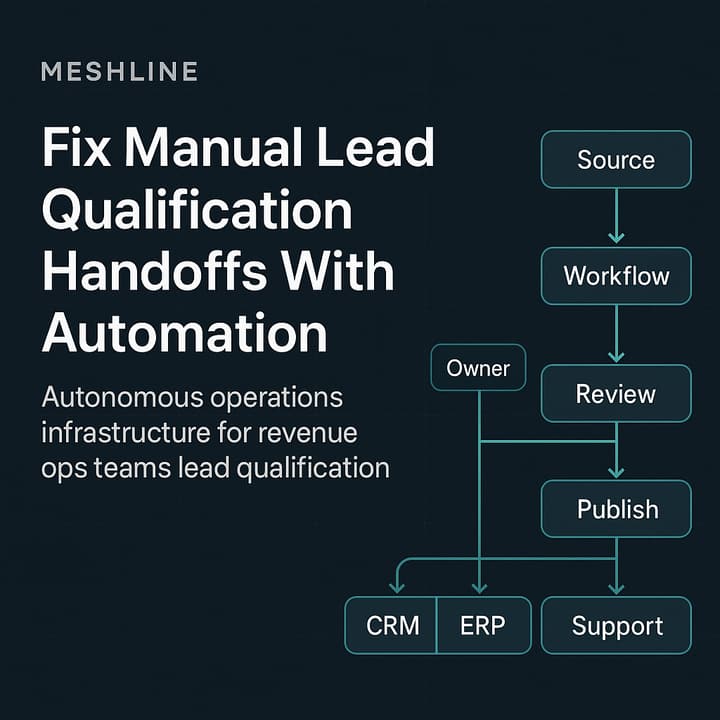
Revenue operations teams are judged on predictable funnel flow: clean intake, fair routing, fast response, and reliable attribution. When lead qualification is fragmented across forms, ad platforms, chat, spreadsheets, and a patchwork of point tools, the result is inconsistent execution, missed SLAs, and poor forecasting. This operating story demonstrates how an autonomous operations infrastructure for revenue ops teams lead qualification turns brittle plumbing into deterministic, auditable execution.
This playbook is written for revenue ops teams owning intake, scoring, routing, and funnel hygiene. It contains before/after operating stories, concrete implementation patterns, routing and sync rules, QA checks, ownership conventions, exception paths, and a 14-week decision-stage pilot you can use to pilot Meshline for lead qualification. If you want integration, automation, and implementation support, Book a strategy call to get a tailored plan.
Executive outcomes and commercial intent
- Predictable lead-to-opportunity conversion with signed audit logs and SLA enforcement.
- Faster triage for dirty or duplicate leads with built-in exception brokers and human-in-loop checkpoints.
- Fewer manual syncs and fewer 'lost leads' across CRM, MAP, and enrichment providers.
- Clear ownership and SLA definitions that restore rep trust and improve forecasting.
Meshline offers implementation services for connector wiring, rule design, and SLA configuration"”this guide shows what a pilot and rollout look like and how to measure success.
What breaks: why fragmented qualification costs pipeline

Most teams think lead quality problems are a scoring or model issue. In practice the failure mode is operational: signals fall through gaps because the operating plumbing is brittle.
Signal fragmentation
- Forms, ad platforms, chat widgets, event streams, and CSV imports emit data with different schemas and latency.
- Each source often has its own validation, enrichment, or tag logic.
Rules scattered everywhere
- Scoring, territory rules, and routing exist across spreadsheets, MAP automation flows, and one-off code.
- Versioning, testing, and rollback are non-existent.
Fragile handoffs
- SDRs and AEs rely on manual checks, Slack pings, and email threads to resolve duplicates and bad data"”introducing delay and inconsistency.
Common consequences: wrong queue assignments, missed call SLAs, duplicate records, and no single source of truth for 'qualified' status. The net effect: forecasting noise and lower win rates.
Why an autonomous operations infrastructure beats point solutions
An operating layer "” the autonomous operations infrastructure for revenue ops teams lead qualification "” treats the problem as an end-to-end system: ingestion, validation, deterministic scoring, routing, execution actions, exception handling, observability, and audit. Compared with stitching point tools, this approach delivers deterministic SLAs, auditable state transitions, and clear ownership boundaries.
Key benefits
- Deterministic rules with versioning and rollback.
- Event-first sync to avoid batch lag and inconsistent state.
- Human-in-loop design for edge cases with measurable SLAs.
- Signed audit trails for each state transition to support compliance and forecasting.
Operating framework: rules, state, owner, and automation
Below is a compact operating model you can adapt in your org as part of a Meshline pilot.
Principles
- Single source of truth for lead state: new → enriched → scored → qualified → routed → exception.
- Deterministic, versioned rules with test coverage.
- Human-in-loop for the 20% of complex cases; automation for the 80%.
- Observability: funnels, SLA telemetry, and reconciliation jobs.
Core components
- Ingest connectors (webhooks, streaming).
- Validation & enrichment and deterministic identity matching.
- Scoring engine (deterministic first; optional ML layer later).
- Routing engine (territory, product, workload).
- Execution layer (CRM/MAP sync, create tasks, start cadences).
- Exception broker (poison queue + triage console).
Ownership model (non-overlapping)
- Marketing Ops: lead source health, forms, UTM hygiene, enrichment thresholds.
- RevOps (Qualification Engine Owner): scoring rules, routing maps, SLA definitions.
- SDR Managers: exception triage SLAs, resolution training.
- Data/Engineering: telemetry, reconciliation jobs, dedupe logic.
Integration and sync patterns
- Event-first architecture (webhooks + streaming) to minimize lag.
- Change-first CRM sync with idempotent writes and conflict resolution.
- Durable queues with retries and poison-message handling for resilience.
Meshline-specific patterns include pre-signed audit logs on CRM writes and a replayable event store so you can reconcile state deterministically.
Meshline for lead qualification: before and after operating story
This before/after example is realistic for mid-market SaaS teams.
Before (fragmented)
- Marketing forms post to Marketo; ads land in a CSV pipeline.
- Scoring lives in a spreadsheet; tags are added manually in Salesforce.
- Duplicates and enrichment failures are handled by SDRs via email.
- SLA: 'call within 48 hours'"”rarely met.
After (Meshline operating layer)
- Events stream to Meshline in real time.
- Meshline validates, enriches, and deterministically scores each lead; low-confidence leads are queued for SDR triage.
- Routing rules assign leads by territory and workload; CRM records are created with audit metadata.
- Exceptions route to a triage console with a 4-hour SLA and built-in action templates.
Impact after a 90-day pilot (example KPIs)
- 32% faster first contact time.
- 18% lift in qualified-to-opportunity conversion.
- Duplicate rate reduced by 60%.
- Forecast accuracy improved for inbound-sourced pipeline.
These numbers are illustrative"”your pilot will produce tailored KPIs based on source mix and baseline performance.
Lead qualification system design patterns
Here are repeatable patterns we use when designing an operating system for lead qualification.
Deterministic baseline first
Start with deterministic validation and scoring. Get the plumbing right before you add ML. This reduces regression risk and makes debugging simpler.
Progressive enrichment and TTLs
Prioritize quick, cheap validators (email format, domain check) to route leads within SLA; run enrichment asynchronously with TTLs and fallbacks to prevent rate-limit failures.
Account-aware routing
For ABM or enterprise, score at the account level and reconcile contact-level signals to prevent duplicate outreach or territory conflicts.
Partner and channel flows
Tag partner-sourced leads at ingestion, preserve partner attribution through every sync, and route to partner workflows with special SLAs and reporting.
Implementation steps: 14-week pilot to scale
This implementation cadence is prescriptive and decision-stage oriented.
Week 0"“2: Discovery and canonical intent
- Map every lead source, schema, and owner.
- Define the canonical 'qualified' state and acceptance criteria with Rev and Sales leadership.
- Deliverable: lead-source inventory and SLA matrix.
Week 3"“5: Build connectors and ingestion
- Implement event streaming/webhook connectors.
- Add deterministic validation (email, domain, phone).
- Configure enrichment thresholds and fallbacks.
Week 6"“8: Scoring rules and routing
- Implement deterministic scoring and routing maps (territory, product).
- Test idempotent CRM writes and signed audit logging.
Week 9"“11: Exception flows and human-in-loop
- Build exception broker and triage console.
- Train SDRs and run DR (disaster recovery) and replay tests.
Week 12"“14: Observability, reconciliation, and go/no-go
- Deploy telemetry dashboards for ingest success, SLA compliance, and duplicate rates.
- Run reconciliation jobs comparing Meshline state vs CRM.
- Make go/no-go decision based on KPIs and rep feedback.
Integration specifics
- CRM sync: prefer change-first with idempotent operations; log rule versions and actor metadata.
- MAP sync: preserve UTM/campaign attribution on create and updates.
- Enrichment: cache results, set TTLs, and implement priority lanes to protect SLAs.
Decision-stage service language: Meshline provides implementation services for connector wiring, rule design, and SLA setup. If you need integration, automation, and an implementation roadmap, Book a strategy call to review a tailored pilot plan.
For Lead Qualification Workflow Guide for RevOps, ## QA, risk, ownership, and failure modes
Solid governance prevents operational regressions.
Operational ownership rules
- Single RevOps owner for the qualification engine and rule versions.
- Marketing Ops owns source health and enrichment thresholds.
- SDR managers own triage SLAs and training.
QA checks and cadence
- Daily: ingest success rate, top 5 sources by fail count, exception queue health.
- Weekly: duplicate rate, reconciliation delta with CRM, impact of rule changes.
- Monthly: funnel conversion delta and scoring drift detection.
Failure modes and mitigations
- Connector outage: durable queue + replay + on-call alert to connector owner.
- Enrichment rate limits: prioritized enrichment, cached fallbacks, adaptive TTLs.
- Rule regression: versioning, canary testing, and fast rollback.
Exception templates and audit
Use structured exception templates with fields for lead ID, source, failure code, enrichment snapshot, assigned-to, and resolution notes. All state changes are signed and include actor, timestamp, and rule version.
Practical checklists: launch, run, and scale
Pre-launch
- Complete lead-source inventory and owner sign-off.
- Canonical 'qualified' definition approved.
- Pilot routing and exception SLAs defined.
Launch
- Connectors validated with replay tests.
- Scoring rules smoke-tested on historical data.
- SDR triage console staffed and trained.
Runbook (ops)
- Daily ingest and exception checks.
- Weekly reconciliation and duplicate audits.
- Monthly rule reviews and drift analysis.
Scale
- Add back-pressure controls and rate-limited enrichment lanes.
- Expand rule coverage by region and product line.
- Add ML signals only after deterministic baseline is stable.
Examples and use cases: patterns for common org types
High-volume inbound SaaS
Pattern: strict validation + progressive profiling; early quarantine for low-confidence leads. Result: quarantined spam removed automatically; clean leads routed in under 5 minutes.
ABM and enterprise
Pattern: account scoring plus contact-level decays and ABM vendor cross-checks. Result: coordinated account-level plays and fewer duplicate outreaches.
Channel and partner leads
Pattern: partner tagging, partner-rep assignment, and partner-specific SLAs. Result: accurate attribution and partner dashboards.
Meshline resources and internal links
- Explore Meshline's lead qualification patterns and implementation templates: Lead qualification patterns and examples.
- Review Meshline product connectors and integration patterns: Product connectors & integration patterns.
- See use-case playbooks for revenue ops: Revenue ops use-case collection.
- Use the Meshline QA checklist and runbook templates during pilot: QA checklist and runbook templates.
- Check Meshline's public product pages for pricing and implementation options: Pricing and implementation options.
(Each link contains templates, exportable rule-sets, and runbooks you can reuse during a pilot.)
Next steps: pilot scope and decision criteria
Recommended pilot scope
- 8"“12 week pilot covering 1"“3 high-volume lead sources.
- Objectives: reduce duplicate rate, cut time-to-first-contact by 25"“30%, and demonstrate SLA compliance.
- KPIs: ingest success rate, exception queue SLA, qualified-to-opportunity conversion lift.
Decision criteria for rollout
- Achieved target reductions in duplicates and SLA misses.
- Positive rep feedback on quality and reduced reconciliation work.
- Observability and signed audit trails in place for compliance and forecasting integrity.
Book a strategy call
If you want a tailored pilot design that maps to your CRM and MAP, integrates with enrichment and intent partners, and includes implementation services, Book a strategy call and we'll map your sources to a 14-week implementation plan and provide a commercial estimate.
Editorial backlink and outreach opportunity
We recommend outreach to CRM consultancies, enrichment vendors (Clearbit, ZoomInfo), and ABM vendors for co-authored case studies. A joint case study with a customer and an ABM or enrichment partner is a high-impact backlink opportunity that amplifies credibility for the operating story.
Appendix: sample SLA table and exception template
SLA examples
- Ingest validation: 99% success daily.
- Routing: 95% of qualified leads routed within 15 minutes.
- Exception triage: initial action within 4 hours; resolution within 48 hours.
Exception template fields
- Lead ID, Source, Failure code, Enrichment snapshot, Time received, Assigned to, Resolution notes, SLA timestamp.
Closing thought
Lead qualification is a hybrid problem: it requires both clean data and an operational system to enforce behavior and ownership. An autonomous operations infrastructure for revenue ops teams lead qualification turns ad-hoc processes into predictable, auditable execution. If you want a concrete pilot plan and to walk through integration specifics, Book a strategy call and we'll map your sources to a 14-week implementation that converts cleaner and scales reliably.
Related Meshline Resources
- For Lead Qualification Workflow Guide for RevOps, Meshline workflow automation products
- For Lead Qualification Workflow Guide for RevOps, Meshline pricing and implementation options
autonomous operations infrastructure for revenue ops teams lead qualification Implementation Checklist
Use this autonomous operations infrastructure for revenue ops teams lead qualification checklist to keep the lead qualification workflow specific enough for operators and buyers. Name the owner, source system, destination system, exception route, QA checkpoint, and reporting field before automation goes live.
For autonomous operations infrastructure for revenue ops teams lead qualification, Meshline should confirm the trigger, review path, audit trail, fallback owner, and demo-ready outcome. That keeps autonomous operations infrastructure for revenue ops teams lead qualification from becoming another disconnected workflow and gives teams a practical implementation path.
The operating language should stay consistent: autonomous operations infrastructure for revenue ops teams lead qualification, lead qualification automation, lead qualification workflow, lead qualification operating model, lead qualification implementation, lead qualification checklist, lead qualification QA, lead qualification governance, exception routing, automation governance, operational visibility, and Meshline's operating layer. Meshline for lead qualification should appear where it clarifies search intent and buyer relevance. lead qualification system design should appear where it clarifies search intent and buyer relevance. operating system for lead qualification should appear where it clarifies search intent and buyer relevance.
Sources for Workflow Implementation
- For Lead Qualification Workflow Guide for RevOps, Google Cloud Architecture Framework
- For Lead Qualification Workflow Guide for RevOps, AWS Well-Architected Framework
- For Lead Qualification Workflow Guide for RevOps, Microsoft Azure Well-Architected Framework
- For Lead Qualification Workflow Guide for RevOps, CNCF Platform Engineering Maturity Model
- For Lead Qualification Workflow Guide for RevOps, Martin Fowler on distributed systems patterns
- For Lead Qualification Workflow Guide for RevOps, Atlassian incident management guide
- For Lead Qualification Workflow Guide for RevOps, HubSpot API documentation
- For Lead Qualification Workflow Guide for RevOps, Salesforce integration patterns
- For Lead Qualification Workflow Guide for RevOps, Shopify Admin API documentation
- For Lead Qualification Workflow Guide for RevOps, NetSuite SuiteTalk REST web services
- For Lead Qualification Workflow Guide for RevOps, Stripe API documentation
- For Lead Qualification Workflow Guide for RevOps, Zapier platform documentation
Practical operating checks
In Lead Qualification Workflow Guide for RevOps, use this section to turn the lead qualification idea into a visible operating decision. The goal is to make the next handoff obvious before volume increases.
Monday morning diagnostic
For Lead Qualification Workflow Guide for RevOps, start by checking the last five examples where the workflow stalled. Write down the trigger, the source system, the owner, the next action, and the moment the customer or lead received a response. If one of those fields is missing, the workflow is relying on memory.
First workflow to tighten
For Lead Qualification Workflow Guide for RevOps, step 1 is to choose one handoff and make it measurable. For example, define what should happen when a qualified lead arrives, when a content brief is approved, when a CRM record changes, or when a reconciliation exception appears. The smaller the first rule, the easier it is to prove.
Checklist before you scale
- For Lead Qualification Workflow Guide for RevOps, Confirm the page or workflow has one owner.
- For Lead Qualification Workflow Guide for RevOps, Confirm the source system and destination system agree on the key fields.
- For Lead Qualification Workflow Guide for RevOps, Add one quality check that catches bad data before it reaches a reader, lead, or customer.
- For Lead Qualification Workflow Guide for RevOps, Add one relevant Meshline resource link that helps the reader take the next step.
- For Lead Qualification Workflow Guide for RevOps, Review the result after seven days and improve the rule before adding more volume.