
 MeshLine
CRM-to-ERP Sync Workflow Guide for Revenue Operations
Map canonical records, field validation, sync ownership, retries, and reconciliation so CRM-to-ERP handoffs remain reliable.
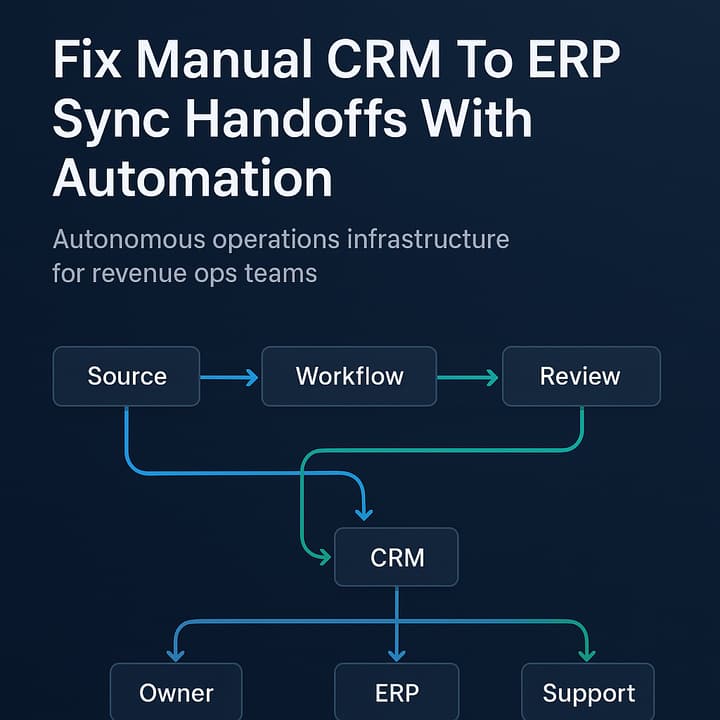
CRM-to-ERP Sync for RevOps breaks when customer, order, invoice, or account records drift between systems. For revenue teams, the painful part is the manual recovery that follows: teams spend the week reconciling records instead of serving customers, ownership is unclear, and the team has to rebuild context while the customer, lead, campaign, or report is already waiting.
This article uses before/after operating stories, implementation patterns, and proof themes so revenue ops can diagnose common failure modes, select implementation patterns, and run a safe pilot. It includes practical runbooks, KPIs, and a decision-stage next step to Book a strategy call.
What changed and why it matters
Before: a tangle of point-to-point connectors. Sales reps update opportunities in the CRM, nightly exports or brittle webhooks deliver those changes to ERP, and exceptions are handled manually via spreadsheets, emails, and chat. Missed line items, duplicate invoices, and stale forecasts are symptoms of brittle routing, poor observability, and unclear ownership.
After: Meshline inserts an autonomous operations infrastructure for revenue ops teams CRM to ERP sync. It accepts CRM events, enforces canonical business events and schema, validates payloads, deterministically routes, and automates exception handling with human-in-the-loop queues owned by revenue ops.
Why this matters now
- Revenue cycles compress: finance needs near-real-time order visibility to accelerate billing and collections.
- Modern CRMs expose event APIs, but without an operating layer they still cause silent drift and ad-hoc fixes that compound over time.
- Auditors and controllers require explainable, replayable flows for booking, billing, and revenue recognition.
Key outcome: reduce invoice exceptions, shorten days sales outstanding (DSO), and improve forecast accuracy by codifying CRM to ERP sync as an autonomous, observable workflow that revenue ops owns.
Operating framework: the autonomous operations infrastructure for CRM to ERP sync

Meshline reframes CRM to ERP sync as an operational surface, not just an integration problem. The operating framework is built around five capabilities that revenue ops teams must control:
- Canonical events and schema "” a single source of truth for order, subscription, and amendment events.
- Deterministic orchestration "” idempotency, ordered delivery, and replay for every business event.
- Business-rule layer "” pricing, discount, and recognition rules executed under revenue ops governance.
- Observability and alerting "” per-event logs, SLA dashboards, and exception queues with ownership metadata.
- Human-in-the-loop routing "” structured exception workflows with recovery templates and escalation rules.
Meshline's operating layer is intentionally described as an autonomous operations infrastructure for revenue ops teams CRM to ERP sync because it behaves like an operator: it performs routine fixes, heals certain failure modes automatically, surfaces exceptions with context, and provides audit-grade evidence for each decision.
Core technical responsibilities
- Schema validation and enrichment at the event boundary.
- Transformation pipeline from CRM objects (opportunity, quote, amendment) into canonical ERP-ready events.
- Deterministic routing, dead-letter queues, and replay capabilities.
- Retry/backoff policies with circuit-breakers for downstream outages.
- Immutable audit logs and replay tooling for forensic and audit use.
Ownership and SLA definitions
- Revenue Ops: owns canonical models, business rules, exception triage, and operator runbooks.
- Integrations/Platform Team: owns connectors, credential rotation, platform uptime, and infra-level SLAs.
- Finance: owns revenue recognition rules, invoice thresholds, and sign-off for accounting-impacting changes.
Codify these responsibilities in runbooks and role-based routing. See Meshline Platform controls and role examples in the Meshline Platform documentation.
Examples and use cases: before / after operating stories
Below are concrete vignettes showing the difference between brittle integrations and an autonomous operations infrastructure for revenue ops teams CRM to ERP sync.
Use case 1 "” Missed orders (CRM → ERP)
Before: Sales closes a $150k deal that includes a non-standard product add-on. The nightly export to ERP maps the product incorrectly and finance discovers an incomplete invoice two days later. Collections are delayed and the account team scrambles.
After: Meshline enforces schema checks at the CRM event boundary and enriches missing product attributes from a canonical product catalog. The malformed event is rejected with a clear owner and instructions. Revenue ops triages the exception and resolves the issue within 90 minutes. The invoice posts same-day and DSO impact is avoided.
Outcome metrics: exception triage P95 reduced from 24 hours to under 2 hours; invoices affected per month reduced by 65%.
Use case 2 "” Duplicate invoices from rapid amendments
Before: A subscription amendment triggers two near-simultaneous webhook events. The ERP creates two invoices; reconciliation becomes a manual write-off.
After: Meshline applies idempotency keys and deduplication windows in the orchestration layer. The second event is recognized and either merged or routed for manual review with a detailed audit trail. Finance avoids the duplicate posting.
Outcome metrics: duplicates per 1,000 invoices fell by 98%; reconciliation time for duplicates collapsed from hours to minutes.
Use case 3 "” Revenue recognition audit
Before: Reconciliation of booking dates to recognition schedules requires cross-checking spreadsheets and tickets.
After: Meshline stores a canonical event history and produces exportable audit trails for each booking-to-recognition step. Finance can replay the flow to verify recognition and produce audit evidence.
Outcome metrics: audit preparation time for revenue recognition reduced by 40%; audit exceptions reduced materially.
Implementation steps: design, pilot, and roll out
The implementation is staged and gated. Each stage has review checkpoints, owner sign-offs, and rollback criteria.
Stage 0 "” Discovery and canonical model
- Inventory systems: list all CRM instances, ERP instances, middleware, custom connectors, and the teams that own them.
- Map events: opportunity creation, quote accepted, amendment, cancellation, billing event, payment, refund.
- Define a canonical schema and field-level validation rules; identify required vs optional attributes.
- Deliverable: canonical event schema (versioned) and an owners contact matrix.
Stage 1 "” Pilot the canonical pipeline (shadow run)
- Select a low-risk product line or business unit with modest transaction volume.
- Implement Meshline connectors for CRM and ERP in sandbox environments.
- Configure schema validation, a dead-letter queue, and human-in-the-loop routing.
- Run a shadow sync for 2"“4 weeks, compare results to the current pipeline, and measure reconciliation drift.
Pilot success criteria
- Shadow-run delivery parity ≥ 99.5% vs. the source of truth.
- Exception triage P95 under target (e.g., 2 hours).
- No production writes for the pilot until sign-off.
Stage 2 "” Automate and enforce business rules
- Migrate pricing, discounting, and recognition checks into Meshline's business-rule layer under revenue ops control.
- Configure exception queues with SLA timers and escalation rules.
- Create resolution templates (e.g., 'request product code update', 'manual invoice hold') to reduce cognitive load on operators.
Stage 3 "” Scale and go-live
- Expand the pipeline to all product lines and business units.
- Enable replay and automatic reconciliation jobs.
- Publish runbooks and train revenue ops teams on triage, replay, and SLA management.
Implementation patterns and integration tips
- API-first connectors: prefer event-driven webhooks for near-real-time sync where ERP and CRM support them.
- Batch fallback: implement nightly batch parity checks for legacy endpoints to avoid out-of-order writes.
- Idempotency & deduplication: required for all put/post operations.
- Security & compliance: credential rotation, encrypted audit logs, and role-based access.
For connector and pattern details, review Meshline's implementation blueprints at Meshline Integrations.
QA, risk, and ownership: rules and failure-mode playbooks
Revenue ops must own the operating surface and exception paths. Below are ownership rules, QA checks, common failure modes, and remediation playbooks.
Ownership rules (who does what)
- Revenue Ops: maintain canonical schema, triage business-rule exceptions, approve replay runs, run operator shifts.
- Integrations Team: maintain connector code, monitor infra SLAs, rotate credentials, and handle platform incidents.
- Finance: validate recognition outputs and sign-off on accounting-impacting rule changes.
QA checks before and after release
Operational QA checklist for every release or new connector:
- Schema backward-compatibility tests and version gates.
- Idempotency and deduplication test vectors.
- Canary run in sandbox for 48"“72 hours with production-like data.
- Reconciliation test against source-of-truth reports.
- Audit log and replay validation.
Common failure modes and remediation
- Missing or malformed product attributes: route to an ops queue with actionable fields and contact context; offer automated enrichment when safe.
- Out-of-order events (amendment before create): hold in staging and trigger replay when dependencies arrive.
- Connector outage: fail-open to batch queue with SLA alerting and temporary manual review.
- Silent schema drift (CRM changes): detect with schema diffing, block incompatible versions, and notify stakeholders.
QA: measurable KPIs and SLA targets
- Canonical event delivery success rate ≥ 99.5%.
- Exception triage time (P95) ≤ 2 hours.
- Reconciliation drift ≤ 0.1% per week.
- MTTR for invoice-stopping exceptions ≤ 4 hours.
Operational tooling and compliance
- Immutable audit logs accessible by Finance for audits and reconciliations.
- Role-based access control for rule changes and operator actions.
- Cryptographic evidence for replay runs and reconciliations.
See Meshline QA runbooks and operator templates in Meshline QA docs.
Practical checklist: migration and day-2 operations
Use this operational checklist for a rollout and steady-state operation.
Pre-rollout
- [ ] Inventory and map all CRM event producers and ERP consumers.
- [ ] Define canonical events and a versioning policy.
- [ ] Build sample payloads and negative test cases.
- [ ] Configure Meshline sandbox and connect test credentials.
- [ ] Approve SLAs and escalation paths with Finance and Legal.
Pilot
- [ ] Shadow-run for 2"“4 weeks and log reconciliation drift daily.
- [ ] Validate reconciliation reports and adjust transforms.
- [ ] Tune dedup and idempotency windows.
- [ ] Train a 2"“4 person ops squad for exception triage.
Go-live
- [ ] Enable automatic reconciliation and replay alerts.
- [ ] Run full reconciliation at day 1, day 7, and day 30.
- [ ] Monitor KPIs and publish weekly status.
Day-2 operations
- [ ] Weekly schema drift report.
- [ ] Monthly audit of rule changes and approvals.
- [ ] Quarterly security review.
Exception decision trees (examples)
- Validation error → Ops queue → 2-hour triage → Fix in CRM or enrich in Meshline → retry.
- Out-of-order dependency → Hold → auto-replay when dependency arrives.
- Connector outage → Batch fallback + notify stakeholders.
Ownership escalation rules
- P1 (invoice-stopping): Pager to Integrations + Revenue Ops, 15-minute SLA.
- P2 (data drift): Email + Ops queue, 2-hour SLA.
- P3 (visual mismatch): Weekly ticket, 48-hour SLA.
Comparison and procurement guidance
When evaluating approaches, consider three architecture patterns for CRM to ERP sync system design:
- Point-to-point connectors: quick to ship, but brittle and hard to audit.
- iPaaS platforms: flexible but often lack operator tooling for human-in-the-loop workflows and business-rule governance.
- Autonomous operations infrastructure (Meshline): combines orchestration, rule enforcement, observability, and operator workflows"”designed for revenue ops to own.
Procurement checklist
- Confirm support for canonical event schema and versioning.
- Verify deterministic replay and immutable audit logs.
- Evaluate operator experience (queues, escalation, templates) and integration test tooling.
- Ask for pilot success metrics (reconciliation parity, exception triage time, duplicate rate reduction).
For transformation blueprints and case examples, review Meshline Case Studies and our integration patterns at Meshline Integrations.
ROI and measurable impact
A conservative ROI model for transforming CRM to ERP sync with an autonomous operations infrastructure for revenue ops teams CRM to ERP sync:
- Reduced invoice exceptions: lower manual adjustments and fewer write-offs.
- Faster collections (reduced DSO): faster invoice delivery, fewer disputes, and clear remediation paths.
- Lower operational overhead: fewer ad-hoc tickets and smaller ops headcount required for the same transaction volume.
Example (sample company):
- Baseline: 1,000 invoices/month, 5% exception rate, average remediation cost $250 per exception.
- Post-Meshline: exceptions drop to 1.25% (75% reduction). Monthly savings = (50 → 12.5 exceptions) × $250 ≈ $9
- - Combined with improved DSO and reduced revenue leakage, the project often pays back in months for mid-market customers and faster for enterprise accounts.
Next steps and decision-stage CTA
If recurring CRM to ERP sync failures are eroding revenue confidence, adopt an autonomous operations infrastructure approach to gain predictability, faster exception resolution, and audit-ready trails.
Start with a short strategy engagement where we will:
- Map your current failure modes and owners.
- Produce a canonical event model for a pilot product line.
- Run a safe shadow pilot and produce success metrics.
To schedule that, Book a strategy call. Meshline provides integration blueprints, managed pilots, and an operations-onboarding program that includes rule migration, operator training, and QA playbooks. Learn about our platform controls at Meshline Platform.
For CRM-to-ERP Sync Workflow Guide for RevOps, ## Editorial notes and outreach opportunities
This article is optimized for the ranking query "autonomous operations infrastructure for revenue ops teams CRM to ERP sync" and related decision-stage queries such as "CRM to ERP sync system design" and "operating system for CRM to ERP sync." Outreach opportunities include:
- Implementation partners and consultancies that publish joint case studies.
- SaaS directories and technical integrator guides that accept contributed solution briefs.
- Customer stories and finance-transformation blogs for backlinking and social proof.
Potential partner targets for outreach include implementation partners listed on major CRM and ERP partner directories and finance transformation consultancies with public thought leadership. Pitch joint-case studies emphasizing measurable outcomes (exceptions reduced, DSO shortened, pilot timeline and cost).
Appendix: failure-mode playbooks (quick reference)
1) Validation error: reject → create Ops ticket → auto-fill fields from CRM history → notify owner → retry.
2) Duplicate invoice: detect using idempotency keys → log duplicate event → merge or ignore per rule → alert finance if duplicate invoice already posted.
3) Partial write to ERP: mark event as "partial" → push to reconciliation job → compare ledger entries → auto-correct or escalate.
If you'd like a tailored migration plan for your stack (CRM, ERP, billing), Book a strategy call and we'll prepare a 4-week pilot blueprint.
autonomous operations infrastructure for revenue ops teams CRM to ERP sync Implementation Checklist
Use this autonomous operations infrastructure for revenue ops teams CRM to ERP sync checklist to keep the CRM to ERP sync workflow specific enough for operators and buyers. Name the owner, source system, destination system, exception route, QA checkpoint, and reporting field before automation goes live.
For autonomous operations infrastructure for revenue ops teams CRM to ERP sync, Meshline should confirm the trigger, review path, audit trail, fallback owner, and demo-ready outcome. That keeps autonomous operations infrastructure for revenue ops teams CRM to ERP sync from becoming another disconnected workflow and gives teams a practical implementation path.
The operating language should stay consistent: autonomous operations infrastructure for revenue ops teams CRM to ERP sync, CRM to ERP sync automation, CRM to ERP sync workflow, CRM to ERP sync operating model, CRM to ERP sync implementation, CRM to ERP sync checklist, CRM to ERP sync QA, CRM to ERP sync governance, exception routing, automation governance, operational visibility, and Meshline's operating layer. Meshline for CRM to ERP sync should appear where it clarifies search intent and buyer relevance. CRM to ERP sync system design should appear where it clarifies search intent and buyer relevance. operating system for CRM to ERP sync should appear where it clarifies search intent and buyer relevance.
Sources for Workflow Implementation
- For CRM-to-ERP Sync Workflow Guide for RevOps, Google Cloud Architecture Framework
- For CRM-to-ERP Sync Workflow Guide for RevOps, AWS Well-Architected Framework
- For CRM-to-ERP Sync Workflow Guide for RevOps, Microsoft Azure Well-Architected Framework
- For CRM-to-ERP Sync Workflow Guide for RevOps, CNCF Platform Engineering Maturity Model
- For CRM-to-ERP Sync Workflow Guide for RevOps, Martin Fowler on distributed systems patterns
- For CRM-to-ERP Sync Workflow Guide for RevOps, Atlassian incident management guide
- For CRM-to-ERP Sync Workflow Guide for RevOps, HubSpot API documentation
- For CRM-to-ERP Sync Workflow Guide for RevOps, Salesforce integration patterns
- For CRM-to-ERP Sync Workflow Guide for RevOps, Shopify Admin API documentation
- For CRM-to-ERP Sync Workflow Guide for RevOps, NetSuite SuiteTalk REST web services
- For CRM-to-ERP Sync Workflow Guide for RevOps, Stripe API documentation
- For CRM-to-ERP Sync Workflow Guide for RevOps, Zapier platform documentation
Practical operating checks
In CRM-to-ERP Sync Workflow Guide for RevOps, use this section to turn the crm-to-erp sync idea into a visible operating decision. The goal is to make the next handoff obvious before volume increases.
Monday morning diagnostic
For CRM-to-ERP Sync Workflow Guide for RevOps, start by checking the last five examples where the workflow stalled. Write down the trigger, the source system, the owner, the next action, and the moment the customer or lead received a response. If one of those fields is missing, the workflow is relying on memory.
First workflow to tighten
For CRM-to-ERP Sync Workflow Guide for RevOps, step 1 is to choose one handoff and make it measurable. For example, define what should happen when a qualified lead arrives, when a content brief is approved, when a CRM record changes, or when a reconciliation exception appears. The smaller the first rule, the easier it is to prove.
Checklist before you scale
- For CRM-to-ERP Sync Workflow Guide for RevOps, Confirm the page or workflow has one owner.
- For CRM-to-ERP Sync Workflow Guide for RevOps, Confirm the source system and destination system agree on the key fields.
- For CRM-to-ERP Sync Workflow Guide for RevOps, Add one quality check that catches bad data before it reaches a reader, lead, or customer.
- For CRM-to-ERP Sync Workflow Guide for RevOps, Add one relevant Meshline resource link that helps the reader take the next step.
- For CRM-to-ERP Sync Workflow Guide for RevOps, Review the result after seven days and improve the rule before adding more volume.