
 MeshLine
Marketo vs n8n: Proposal Follow-Up Governance
Compare Marketo and n8n for governed proposal follow-up, including approval logic, ownership, retries, and exception visibility.
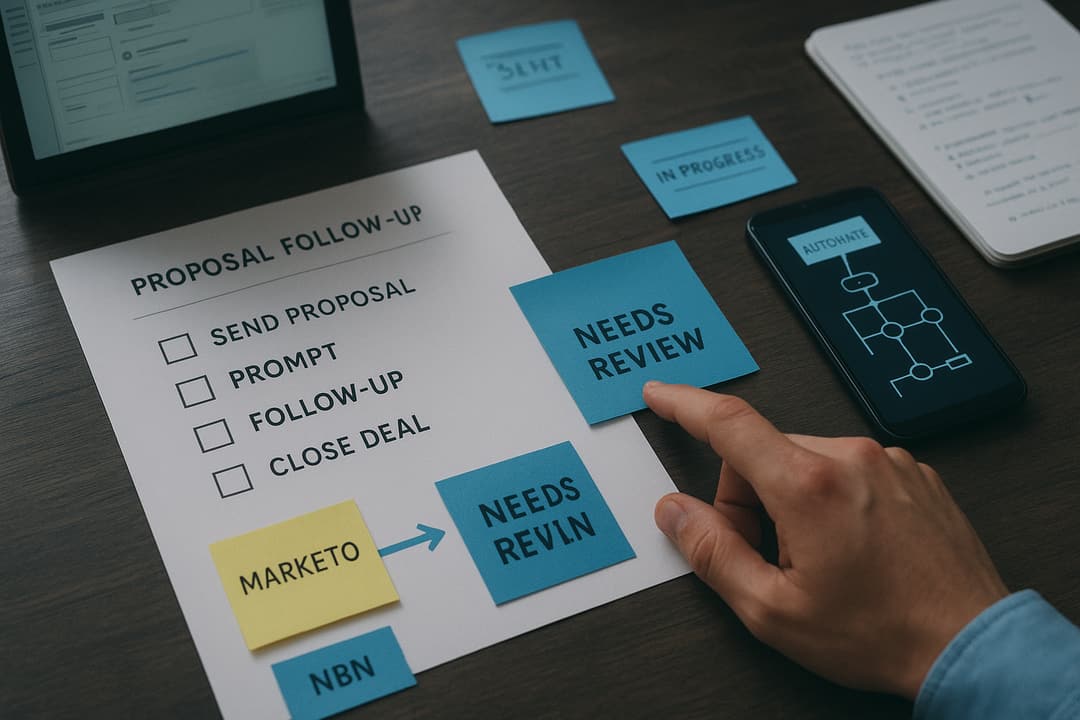
Marketo vs n8n for proposal follow-up: Founders’ execution guide to orchestration & recoverability
Every founder, revenue ops lead, or deal desk engineer who searches for "marketo vs n8n for proposal follow-up" is trying to solve one business outcome: stop deals going cold because automation silently failed. This is not a feature checklist. This is an operational playbook that shows who must own triggers, retries, observability, and recovery paths so follow-ups actually happen.
Why this matters: marketing automation and workflow engines look similar on a spec sheet, but failure modes are where revenue is lost. This article reframes the vendor comparison (marketo n8n comparison) around execution surface, lists concrete triggers and QA gates, and gives a two-week spike test you can run now.
Executive thesis: execution surfaces beat feature lists
The right tool for proposal follow-up is the one that guarantees end-to-end ingestion, idempotent processing, clear escalation, and measurable SLA compliance. That means comparing execution guarantees, not checkboxes. For example, both Marketo and n8n can send emails — the difference is whether transient webhook failures produce a dead-letter entry or silent loss.
Founders should treat this as a decision about orchestration responsibilities: who owns ingestion reliability, who enforces idempotency, who routes exceptions to humans, and how the system proves it met the SLA.
How operators lose execution on proposal follow-up (recurring failure pattern)
When proposal follow-up fails at scale it follows a pattern operators will immediately recognize and can measure:
- Trigger gap: the proposal system webhook doesn’t reach the orchestration endpoint (timeouts, 429s, or silent 204s).
- Data divergence: contact identity or timezone differs between proposal tool, CRM, and the marketing system.
- Timing mismatch: cadence rules ignore local windows or lifecycle constraints, sending the right message at the wrong time.
- Silent retry failure: transient API or SMTP errors are dropped because retries aren't visible or configured.
- Ownership fog: no single team owns the workflow state, so dead-letter items sit unresolved.
These are execution failures, not product feature gaps.
Typical webhook trigger gaps
Most follow-ups start with a webhook such as proposal.sent. Webhooks must land in a guaranteed ingestion layer (a message queue or event store). If you assume webhooks "just arrive," an intermittent 502 or route flapping will silently drop events and nobody notices until a rep misses a follow-up.
- Detect: track webhook delivery latency and non-2xx rates.
- Fix: front webhooks with a queue (e.g., Amazon SQS or a managed streaming layer) and implement dead-letter routing.
Data divergence and identity problems
If a proposal tool lists "[email protected]" while Salesforce holds "[email protected]," personalization and owner routing break. Enforce explicit enrichment and match logic with a fallback human queue.
- Detect: record match confidence and the top suggested CRM matches.
- Fix: add a schema-validation gate and an enrichment step that pushes low-confidence matches to a human review ticket (e.g., Zendesk).
Timing and timezone mismatches
Sending T+48 in UTC vs T+48 in prospect local time misses prime windows. Convert timestamps into contact local time based on CRM timezone or IP-derived guess, and normalize before scheduling.
Silent retries and dead-lettering
Transient SMTP or API 500 responses must be retried with exponential backoff and then dead-lettered for manual resolution — not dropped. Implement observability for retry counts and failure reasons (SMTP bounce, 4xx auth, 5xx server error).
Feature map vs execution surface: Marketo and n8n compared
This is a practical marketo n8n comparison for founders proposal follow-up tools: map vendor capabilities to the execution surfaces you care about.
- Marketo (Adobe) is an enterprise-grade marketing automation platform with campaign orchestration, templating, deliverability tooling, and built-in reporting. See Adobe's Marketo overview for product details. Marketo product page.
- n8n is an open-source workflow automation engine focused on custom orchestration, API-first connectors, and explicit node-level retry visibility. n8n docs and product.
Both can execute a follow-up sequence, but they emphasize different tradeoffs: Marketo bundles deliverability and campaign governance; n8n gives you raw orchestration control and direct API access.
Marketo strengths (execution-focused)
- Campaign versioning, permissioning, and approved template governance — useful for marketing-controlled touchpoints.
- Built-in reporting for opens, clicks, and program attribution, which ties follow-up outcomes back to marketing spend. See Marketo integrations with CRM platforms like Salesforce for reference.
- Deliverability features and vendor relationships with major ESPs.
Limitations: Marketo campaigns typically assume event delivery is reliable; you still need an ingestion layer that guarantees webhooks.
n8n strengths (execution-focused)
- Transparent node-level execution history, retry configuration, and conditional branching — you control recovery flows explicitly.
- Direct API connectors for legacy or custom proposal tools, avoiding waiting for a vendor connector.
- Easier to implement dead‑letter flows and one-click replays for failed events.
Limitations: n8n gives you control but requires you to build governance: idempotency stores, multi-environment promotion pipelines, and centralized observability.
Where checklists mislead
A long connector list does not guarantee reliability. Reliability requires SLAs: guaranteed ingestion, idempotency, exponential retries with dead-lettering, and meaningful alerts.
Concrete RFP follow-up scenario (operator-ready)
Systems in play:
- Proposal tool: Proposable (proposal.sent event)
- CRM: Salesforce
- Email provider: SendGrid or Amazon SES
- Orchestration: Marketo flow or n8n workflow
- Human queue & tickets: Zendesk + Slack alerts
Fields and SLA (operator checklist)
- Source payload: proposal_id, contact_email, contact_source_id, sent_timestamp_utc.
- Required enrichments: sf_contact_id (nullable), sf_owner_id, timezone.
- Timing SLA: first follow-up T+48 local hours; reminder T+7 days; last-chance T+14 days.
- Failure policy: retry webhook delivery 5 times with exponential backoff; move to dead-letter queue after 5 failures.
Failure sequence example
- Proposable sends proposal.sent; orchestration endpoint times out (502).
- No retry on the reception layer → event dropped.
- CRM owner expects follow-up; automation never schedules it; deal goes stale.
Recovery path (operator actions)
- Dead-letter queue with daily alert showing number and top failed endpoints.
- Automatically create a Zendesk ticket for events in dead-letter and assign to sf_owner.
- One-click replay from the ticket UI that replays the original payload after manual QA.
(If you use email/SMS channels, consult provider docs: Twilio for SMS behavior and Gmail API for send quotas.)
Operational rules that stop this class of failure
Translate SLA into four enforceable rules to eliminate silent loss:
- Guaranteed ingestion: every external event must land in a durable queue with unique IDs and replay capability (e.g., SQS, Kafka, or managed event store).
- Idempotent processing: replaying an event must not create duplicate emails — use idempotency keys based on proposal_id + action_type.
- Observable retries: retry counts and cause codes must be stored and surfaced on dashboards; never silently drop.
- Human-in-loop escalation: define triggers that create tickets (e.g., retries≥3 and owner mapped).
Owner mapping and responsibility
Define a single owner for the orchestration pipeline (often Revenue Operations or Deal Desk). This owner is accountable for SLA, dead-letter resolution, and weekly reconciliations with CRM.
QA gates and retry logic (H3)
- Gate 1 — Schema validation: reject and route to schema-error queue when missing required fields.
- Gate 2 — Contact-match verification: route low-confidence matches to a human match queue with suggested SF matches.
- Gate 3 — Delivery verification: for transient delivery errors, increase retry cadence; on permanent bounce, set contact suppression flag and notify owner.
Reporting signals and dashboards
Essential signals for a daily ops dashboard:
- Events received vs processed (success rate %)
- Dead-letter queue size and age distribution
- Number of idempotency conflicts prevented
- SLA deviations (e.g., mean follow-up latency vs promised T+48)
- Owner MTTR for dead-letter items
Surface these via your observability stack or a BI tool that pulls from your orchestration event store. See Meshline's Orchestration Patterns for Revenue Systems for dashboard templates.
Integration & recovery patterns: which tool when
There is no universal winner — choose based on the execution surface you need.
When to pick Marketo
Pick Marketo when your follow-up is campaign-driven, needs marketing governance, and benefits from built-in attribution and deliverability tooling. But add an ingestion layer (queue + retry + dead-letter) in front of Marketo to guarantee delivery.
When to pick n8n
Pick n8n when your flows require custom branching, bespoke API integrations, or transparent node-level retries. n8n is ideal when you need to own orchestration semantics and exception flows.
Hybrid pattern (recommended for many founders)
A winning pattern: orchestration engine (n8n or a managed orchestrator) → normalized event → Marketo program.
- n8n (or engine) receives proposal.sent, validates schema, enriches from Salesforce, applies timezone logic, writes a normalized event to a queue.
- Marketo subscribes to the normalized event and performs templated sends and reporting.
This gives you the best of both worlds: guaranteed ingestion and governance. Plan for a tiny state store that records event IDs and delivery states for reconciliation.
Implementation checklist (field-level SLA specifics)
- Ingest & queue
- Schema: proposal_id, contact_email, contact_source_id, sf_contact_id (nullable), sent_timestamp_utc.
- Queue: replayable, exposes message age, supports dead-lettering.
- Identity & enrichment
- Primary lookup: sf_contact_id if present, else fuzzy email match with owner suggestion.
- Enrichment SLA: <3s for sync flows; if >3s, use async enrichment and callback.
- Timing rules
- Convert sent_timestamp_utc to contact local time using CRM timezone.
- Follow-up windows: T+48 local hours, T+7 days, T+14 days.
- Delivery & idempotency
- Idempotency key: proposal_id + action_type.
- Retry pattern: 1m, 5m, 15m, 1h, then dead-letter.
- Escalation
- Dead-letter: open ticket in Zendesk and Slack alert to owner.
- Provide manual replay from ticket with preserved audit trail.
- Observability
- Dashboard: events received, processed, SLA breaches, dead-letter age, owner MTTR.
- Security/compliance
- Ensure templates and dynamic fields pass GDPR/CCPA checks and consent flags.
Failure modes and exact recovery paths
- Silent-drop (no retries): add guaranteed queue + alert when drop rate >0.5%.
- Duplicate sends (no idempotency): add idempotency store and nightly duplicate reconciliation; optionally apply conversion tolerance rules.
- Wrong owner (stale mapping): weekly sync from CRM to orchestration and a hard fail when owner ID missing.
- Bounce storm (bad enrichment): pause automation for that owner when bounce rate >2x baseline within 24h and open remediations ticket.
Decision checklist: what founders should choose now
- You need governed campaigns and rarely call nonstandard APIs: choose Marketo and add an ingestion engine for guaranteed delivery.
- You have bespoke flows or legacy APIs: choose n8n and plan governance for idempotency and observability.
- You cannot tolerate outages: implement hybrid orchestration → normalized event → marketing program.
Concrete next step: run a 2-week ingestion spike. Produce 1,000 synthetic proposal.sent events, inject intermittent endpoint failures, and measure dead-letter vs processed. Treat >0.5% silent loss as a blocker.
Meshline commercial next step (earned CTA)
If you need help converting your chosen tool into an SLA-backed engine with dead-lettering, idempotency, and observability, request a short design review to map the minimal orchestration layer to your stack. See the engine structure and book a design spike: See the engine structure. For a deeper playbook, consult Meshline resources: Orchestration Patterns for Revenue Systems, Proposal Follow-up Playbook, Meshline QA Gates and Alerts, and Integrations & Connectors Guide.
Where proposal follow-up usually breaks in practice
The useful test for marketo vs n8n for proposal follow-up is not whether the team can draw a clean workflow. It is whether the workflow still behaves when a record arrives late, a required field is missing, or two systems disagree about who owns the next action.
Start by writing down the first signal, the field that proves it is trustworthy, the person who can override the route, and the timestamp that shows whether the handoff happened on time. Those details make proposal follow-up automation reviewable instead of merely automated.
For buyers comparing marketo vs n8n for proposal follow-up, the decision should center on proposal follow-up automation, proposal follow-up reporting, proposal follow-up exception handling, proposal follow-up ownership, and whether the team can inspect the audit trail without asking engineering to reconstruct the incident. marketo n8n comparison belongs in the article only where it clarifies a real operator decision, not as a stray keyword. proposal follow-up platform comparison belongs in the article only where it clarifies a real operator decision, not as a stray keyword. founders proposal follow-up tools belongs in the article only where it clarifies a real operator decision, not as a stray keyword.
When proposal follow-up needs an operating layer
Meshline fits when proposal follow-up is no longer a single automation but a recurring operational commitment. The warning sign is usually simple: people trust the tool when everything is normal, then leave Slack messages, spreadsheet notes, and manual fixes behind as soon as the edge case appears.
For Marketo vs n8n: Proposal Follow Up Workflow Comparison, define the authoritative data, routing rule, review checkpoint, retry policy, and evidence trail before launch. This lets the operating team adjust exceptions without turning each failure into an engineering investigation.
The decision behind Marketo vs n8n: Proposal Follow Up Workflow Comparison is whether a connector is enough or the workflow needs a maintained execution layer. When revenue, customer handoffs, reporting, billing, or CRM ownership are involved, scope auditability and recovery alongside launch speed.
- For Marketo vs n8n: Proposal Follow-Up Governance, document which system wins when two records disagree.
- For Marketo vs n8n: Proposal Follow-Up Governance, name who can pause or override execution without creating a hidden side process.
- For Marketo vs n8n: Proposal Follow-Up Governance, specify what evidence remains after a failed handoff is recovered.