
 MeshLine
NetSuite vs Close for Agency Delivery Operations
Compare NetSuite and Close for agency revenue and delivery, including orchestration boundaries, SLA gates, QA checks, and failure ownership.
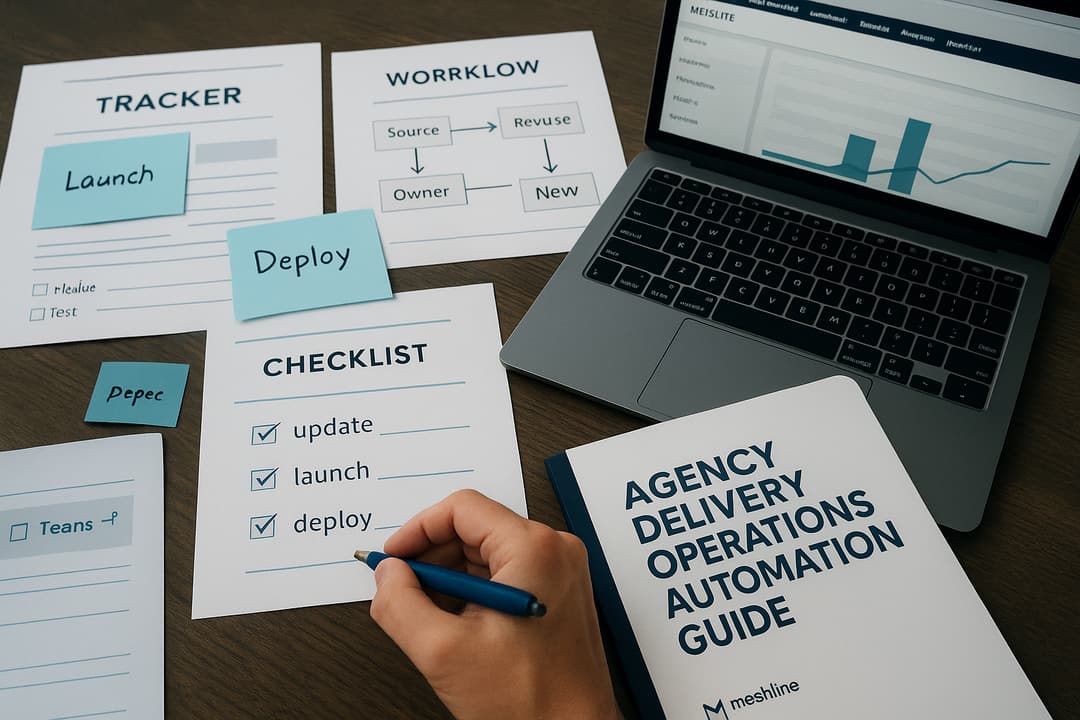
Agencies search "netsuite vs close for agency delivery operations" because the buying decision is rarely about UI or features alone. It’s about who owns execution when a closed deal must become a staffed, scoped, scheduled, and billable project under real SLAs. This guide reframes the product comparison around orchestration quality and operational ownership, showing concrete triggers, owners, QA gates, failure modes, exception paths, and the monitoring signals that prevent a closed-won from becoming a recurring firefight.
Thesis: tools are necessary but insufficient — orchestration is the product you ship
NetSuite (PSA/ERP) and Close (sales CRM) each solve a subset of the bid-to-bill problem. The recurring failure isn’t a missing feature — it’s a missing orchestration policy. Treat the Close ↔ NetSuite integration as product work: define canonical fields, SLAs for each handoff, idempotency and retry logic, and an exceptions remediation path. If you do that, either platform can scale; if you don’t, you’ll pay in meetings, manual fixes, delayed invoices, and unhappy clients.
What each platform is built to do — and why that matters
NetSuite (what it actually anchors)
NetSuite is engineered as a bid-to-bill suite: CRM surface, PSA and project accounting, resource planning, and finance consolidation. When your primary failure modes are financial (complex billing, revenue recognition, consolidated reporting), NetSuite is the natural anchor. See NetSuite product materials for SuiteProjects and SRP for PSA-focused use cases: NetSuite SuiteProjects.
Close (what it actually anchors)
Close is a sales execution CRM: call and email capture, SMS, tasks, and pipeline hygiene to accelerate rep velocity. It's optimized for opportunity conversion and rep adoption, not for project accounting. Teams commonly use Close as the sales-first source of truth and push structured metadata into a downstream PSA via API triggers. Developer resources: Close API overview.
Why the difference matters for content leaders
Feature checklists will tell you who does what; they won’t tell you who will own the mapping table at 2 AM when a project posts the wrong billing type. The operating decision is rarely platform-only: it’s which system you treat as canonical for which fields, and who enforces that contract.
Why agencies still lose execution when they pick a tool
Common failure symptoms (30–90 days post-launch)
- Duplicate or missing client records between sales and delivery. Sales marks the deal live; delivery never receives the scope or UTM/source fields.
- Projects created with no resourcing or no budget code, causing scope drift and surprise write-downs.
- Late invoices because timesheets were started in the wrong system or billable events never reached finance.
- Daily firefighting meetings to reconcile outcomes after the client is already escalated.
Root causes (operating model, not features)
- No orchestration owner who actively runs SLAs and exception queues.
- Missing field validation gates at ingestion; transforms silently drop required fields.
- Point-to-point integrations without idempotency or canonical keys that produce duplicate projects on retry.
- No monitoring signals that tie engineering errors to business KPIs (invoice aging, days-to-first-timesheet).
Why point-to-point fixes are fragile
A webhook that creates a NetSuite project when Close marks a deal won will work at low volume — until an edge-case fields mismatch creates an unbillable project. Without validation, retries duplicate projects; without canonical keys, finance invoices a phantom budget. The reliability cost compounds as volume grows.
A concrete operator scenario (fields, SLAs, failure sequence)
Scenario: A content agency sells a 6-month SEO + content retainer through Close and bills through NetSuite SuiteProjects.
- Source (Close): contact_id, opportunity_id, opportunity.status, opportunity.amount, opportunity.start_date, custom_field:utm_campaign, closing_note.
- Destination (NetSuite SuiteProjects): customer.entity_id, project.project_code, project.start_date, budget_code, billing_type (retainer/fixed/T&M), initial_resource_allocation, revenue_recognition_schedule.
- Orchestration layer: Workato or MuleSoft recipe that does: create customer if missing → validate required fields → create project with budget_code mapping → create initial task list → post project_id back to Close → create Slack PM alert.
Operational SLA (example rules to enforce):
- Within 10 minutes of Close.opportunity.status = "won" the orchestration must create or confirm the NetSuite customer and create the project; project_id must be returned to Close. Failure after 1 hour opens an incident ticket and pings the PM on Slack.
- PM confirmation of initial resource assignment must occur within 8 working hours of project creation; otherwise project enters an "unassigned" risk bucket and billing is blocked after 48 hours.
- Consultants must submit week-1 timesheets into NetSuite within 7 calendar days of project.start_date; missing timesheets auto-remind and escalate to the PM.
Failure sequence most agencies see: Close marks opportunity won; the integration creates a minimal project but drops utm_campaign and scope lines because Close custom_field mapping is broken; NetSuite invoices the wrong billing_type because budget_code nulls default; finance reverses the invoice; client billed late and leadership scrambles. Root cause: no field validation at ingestion and no SLA that escalates mapping errors.
Integration patterns: what breaks and what to adopt instead
Point-to-point webhooks and low-code apps
Pros: quick POC, fast time-to-value. Cons: fragile multi-step transactions, poor observability, and no transactional rollback. Use for low-risk notifications (Slack alerts, simple status tags), not for bid-to-bill flows.
iPaaS orchestration (recommended for most agencies)
Use Workato, MuleSoft, or an equivalent iPaaS to centralize transformations, enforce SLA gates, provide retry and queue logic, and hold an exceptions dashboard. Orchestration should:
- Enforce canonical field mapping and mandatory fields.
- Use idempotency keys (Close.opportunity_id + company_id) to prevent duplicates.
- Route exceptions into a triage queue with SLAs for acknowledgement and resolution.
Embedded/native connectors
NetSuite-native adapters reduce latency and simplify finance mapping, but they can lock you into a vendor path and still require orchestration policies for non-1:1 fields.
Pattern decision checklist:
- If billing and revenue recognition are primary, NetSuite-first with orchestration focused on accounting fields.
- If pipeline hygiene and faster sales conversion are primary, Close-first with orchestration that ensures high-quality downstream records.
- If both are critical, run both and build a canonical mapping layer in the orchestration tier with a clear ownership contract.
For integration patterns and orchestration diagrams, see Meshline’s reference resources: Integration Orchestration Patterns and our Agency Delivery Playbook.
Decision rules: choose NetSuite, Close, or both (operator lens)
1) Choose NetSuite when:
- You must unify project accounting, revenue recognition, and finance consolidation.
- You have complex billing rules (percent-complete, milestone invoices, multi-entity consolidation).
- You need the PSA to be the system of record for billing and compliance.
2) Choose Close when:
- Your immediate priority is rep velocity, pipeline hygiene, and reliable opportunity metadata.
- You accept a separate PSA for billing and want a fast CRM frontend.
3) Run both when:
- You need sales velocity and tight financial controls; the orchestration contract becomes the product you ship. Set up canonical fields, map ownership, SLA escalation, and an exceptions remediation workflow.
Practical operating rules and QA gates (exact, implementable)
Owners and explicit responsibilities
- Sales owner: responsible for ensuring every won opportunity contains mandatory canonical fields. If validation fails, opportunity automatically returns to sales labeled "Missing Metadata" and downstream project creation is paused.
- Orchestration owner (ops/platform): owns iPaaS recipes, retry queues, mapping tables, and daily exception triage. This role is active ops work, not a one-off IT ticket.
- PM owner (post-sale): confirms resource assignment within 8 working hours and signs off initial scoping task. Absent signoff, auto-escalate to delivery leadership.
QA gates to implement this week
- Field validation at ingestion: reject project creation when required fields are null and post a detailed error back into Close with the missing fields list.
- Idempotency keys: use a stable business key (Close.opportunity_id + account_id) so retries never create duplicates.
- Exception queue policy: SLA for acknowledgement = 30 minutes, SLA for resolution = 4 hours; after 4 hours the incident triggers PagerDuty and notifies the delivery director.
Monitoring signals (minimum useful telemetry)
- Project creation latency (mean and p95) from Close won to NetSuite project_id returned.
- Percent of projects created with full mandatory metadata (target ≥ 98%). Call this your "handoff hygiene" metric.
- Days between project start and first approved timesheet (target ≤ 7 days).
- Invoice aging caused by integration errors (target: zero invoices aged solely because of integration errors).
These metrics convert soft complaints into quantifiable remediation work and allow ops to prioritize fixes by business impact. For instrumentation guidance, see Meshline: Instrumentation & Signals.
First 30 days after selection: a pragmatic checklist (operator playbook)
- Convene a 2-week mapping workshop (sales + ops + finance). Output: canonical field map (Close → Orchestration → NetSuite) and agreed release artifact.
- Publish SLAs per handoff and add them to your ops handbook. Make the orchestration owner accountable.
- Build a minimal orchestration POC: it must validate fields, enforce idempotency, and surface errors (Zapier for alerting, Workato/MuleSoft for transactional flows if needed).
- Instrument the four monitoring signals and make them visible in weekly ops review.
- Run a 30-day remediation sprint for the top 3 exceptions and automate resolution paths. Track reduction in manual reconciliations as your sprint KPI.
Starter recipe idea: trigger on Close.opportunity.won → orchestration validates fields → create NetSuite customer if missing → create SuiteProjects project with project_code = "CL#{opportunity_id}" → return project_code to Close → create Slack PM alert. Enforce exponential backoff on retries and route unresolved items to an exceptions dashboard. Close and NetSuite developer docs support these API calls: Close developer docs and NetSuite integration resources.
How Meshline frames the orchestration problem (short, earned CTA)
Meshline treats the orchestration layer as the engine structure of delivery operations: an owned, monitored, and versioned runtime that enforces SLAs, canonical mapping, and exception remediation. If you want the engine structure, runbook, and a templated Workato recipe for Close → NetSuite orchestration, please: See the engine structure. That link is the decision-step CTA for teams ready to convert analysis into an operational POC.
Vendor pros/cons and real-world signals (operator lens)
- NetSuite (PSA): pro — unified project accounting and revenue recognition; con — heavier implementation, admin load, and a steeper learning curve that increases ops cost. Monitor early adoption by tracking admin tickets and time-to-first-approved-invoice.
- Close (CRM): pro — fast rep adoption and built-in communication capture; con — not a PSA — you will need a reliable downstream PSA and orchestration layer. Monitor lost metadata rates and mapping exceptions during the POC.
- Orchestration choices: Zapier for low-risk one-way flows; Workato or MuleSoft when you require transactional guarantees, SLA gates, and centralized monitoring.
Hard stop signals — when to pause feature work and fix reliability
If after 90 days you still have any of:
- >5% of projects created with missing mandatory metadata,
- >2 manual reconciliations per week for closed deals, or
- invoices delayed >7 days because of integration issues,
then stop adding features and fix the operating system first. Put engineering and ops on a remediation sprint: add field validation, idempotency, and an exceptions dashboard. See Meshline’s remediation runbook: Remediation Runbooks.
Outreach and backlink opportunity (editorial note)
For backlink and partner outreach, pitch three editorial hooks:
- A co-authored case study with an integration partner (Workato, MuleSoft, or a NetSuite implementation partner) demonstrating a Close → NetSuite orchestration cut error rate from X% to Y%.
- A guest post in the NetSuite or Close partner ecosystem about canonical mapping best practices for agencies.
- A data-driven piece comparing invoice aging pre/post orchestration from customers who implemented an orchestration layer.
These outreach angles make the article linkable and establish Meshline as the practical authority on agency delivery orchestration.
Further reading and operator references
- NetSuite SuiteProjects and SRP materials: NetSuite
- Close CRM + Developer API: Close
- Orchestration patterns and architecture: MuleSoft orchestration patterns
- Zapier pragmatic patterns: Zapier blog on integration
- Meshline resources: Agency Delivery Playbook, Integration Orchestration Patterns, Instrumentation & Signals, Engine Structure, Remediation Runbooks
After reading this, your immediate actions are:
- Convene the mapping workshop and publish a canonical field map.
- Build a 2-week orchestration POC that includes validation and SLA gates.
- Instrument the four monitoring signals and hold the first ops review within 14 days.
If you want the Meshline Engine Structure diagram, runbook, and a templated Workato recipe for Close → NetSuite orchestration, click the CTA above: See the engine structure.
Implementation Evidence and Reliability Checks
Use these references to validate the agency delivery operations implementation model, reliability assumptions, integration controls, and incident-response expectations before rollout.
Where agency delivery operations usually breaks in practice
The useful test for netsuite vs close for agency delivery operations is not whether the team can draw a clean workflow. It is whether the workflow still behaves when a record arrives late, a required field is missing, or two systems disagree about who owns the next action.
Start by writing down the first signal, the field that proves it is trustworthy, the person who can override the route, and the timestamp that shows whether the handoff happened on time. Those details make agency delivery operations automation reviewable instead of merely automated.
For buyers comparing netsuite vs close for agency delivery operations, the decision should center on agency delivery operations automation, agency delivery operations reporting, agency delivery operations exception handling, agency delivery operations ownership, and whether the team can inspect the audit trail without asking engineering to reconstruct the incident. netsuite close comparison belongs in the article only where it clarifies a real operator decision, not as a stray keyword. agency delivery operations platform comparison belongs in the article only where it clarifies a real operator decision, not as a stray keyword. content leaders agency delivery operations tools belongs in the article only where it clarifies a real operator decision, not as a stray keyword.
When agency delivery operations needs an operating layer
Meshline fits when agency delivery operations is no longer a single automation but a recurring operational commitment. The warning sign is usually simple: people trust the tool when everything is normal, then leave Slack messages, spreadsheet notes, and manual fixes behind as soon as the edge case appears.
For agency delivery operations, the operating layer should define the client record, routing owner, project handoff, exception review, retry behavior, and evidence trail before launch. That gives delivery leads a way to adjust the workflow without rebuilding every client escalation by hand.
The commercial question is whether the team needs another connector or a maintained delivery layer. If the workflow touches client onboarding, CRM ownership, fulfillment status, reporting, billing, or follow-up, the implementation should be scoped around recovery and auditability as much as speed.
- Ask which delivery system wins when client records disagree.
- Ask who can pause or override a handoff without creating a side process.
- Ask what evidence remains after a delivery exception is recovered.