
 MeshLine
NetSuite vs Slack: Lead Routing Workflow Comparison
NetSuite vs Slack for lead routing: compare routing, ownership, exception handling, and implementation tradeoffs before choosing a workflow.
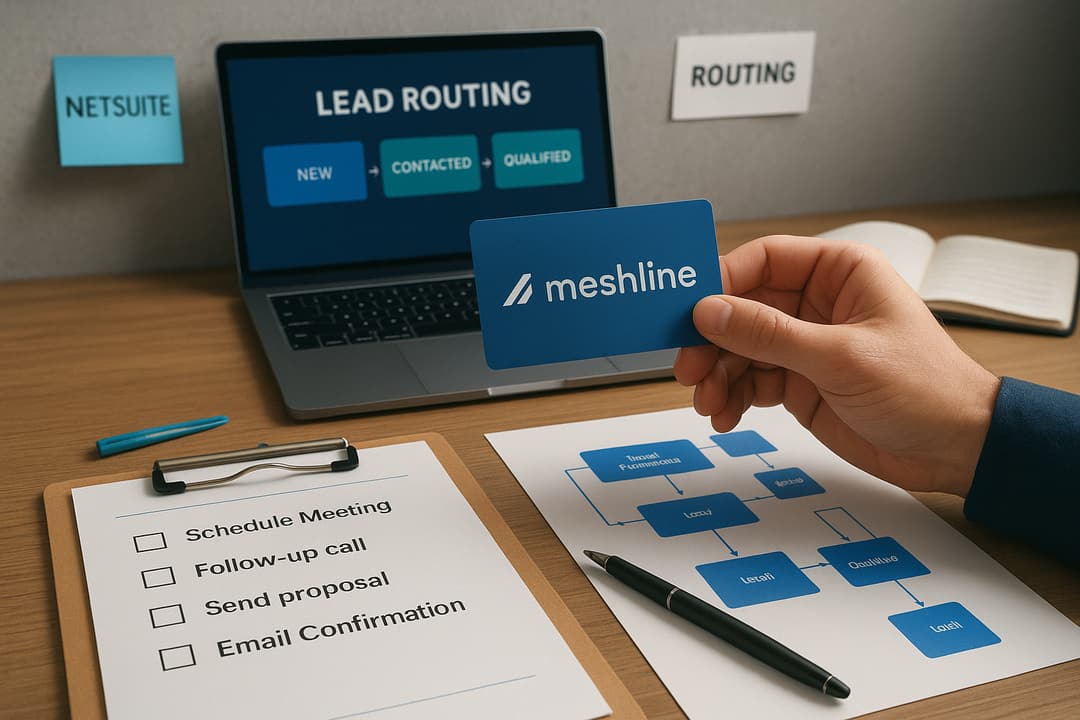
Netsuite vs Slack for Lead Routing: Agency Operators’ Guide to Fixing Execution Failures
Agency operators running paid channels and high-touch sales flows ask a single practical question: will the stack reliably deliver the right lead to the right rep within the SLA your sales motion depends on? This article reframes the netsuite vs slack for lead routing debate away from a feature checklist and toward execution quality and orchestration. You’ll get concrete failure modes, operator-tested patterns, integration options, and a decision-stage next step: See the engine structure.
This is a comparison for operators, RevOps, and agency leads who need to choose an architecture that prevents silent failures and protects commission and conversion outcomes. The Meshline angle: it's not about which product has more buttons—it's about whether your architecture enforces ownership, SLAs, and recoverability.
Why tooling is the wrong first question
The default question—"NetSuite or Slack?"—puts the cart before the horse. The right first operational questions are:
- Where does a lead become a piece of owned work?
- How fast must a human respond to meet your conversion targets?
- Who is accountable when assignment or enrichment fails?
Speed-to-lead research shows why these matter: contact within minutes (not hours) materially increases qualification and conversion. If your SLA is minutes, you cannot depend on ephemeral notifications alone. This is the core reason netsuite vs slack for lead routing is a bad starting conversation: the correct architecture depends on SLA and ownership guarantees, not just tooling features.
Related reading: the canonical speed-to-lead audits and studies provide the empirical basis for SLA-driven design. See Harvard Business Review’s research and the Lead Response Management (LRM) study for why immediate contact matters.
How operators actually lose execution
Most failures are operational patterns repeated across stacks. Understanding these patterns lets you diagnose and fix routes instead of swapping tools.
Notification-only routing
A Slack message is sent but no durable owner exists in the CRM or a queue. If the channel is noisy or muted, the lead sits unowned. This is the classic netsuite slack comparison failure: attention without ownership.
Precedence and overwrite races
Two systems (CRM rules and a marketing stack) both try to set owner and overwrite one another silently. Ownership flips destroy rep trust and commission accuracy.
Field-mapping and timing races
Alerts fire before enrichment completes. Assignment rules that depend on enriched fields assign to default queues; later enrichment triggers a reassignment and owner history becomes inconsistent.
Missing SLA telemetry
Teams get Slack pings but can’t answer "How long between form submit and first contact?" Without telemetry you never detect silent degradation until revenue is lost.
Common symptoms to watch for:
- Leads unassigned in NetSuite while Slack shows an alert.
- Ownership changes after enrichment or sync.
- Reps report buried notifications and noisy channels.
- No reliable "time to first contact" metric.
NetSuite’s routing model: strengths and blind spots
NetSuite is built as a canonical owner-of-record with deterministic, rule-driven assignment (territories, geo, custom fields). For agencies that require commission integrity and centralized reporting, NetSuite’s model is valuable—but it has operational blind spots for minute-level SLAs.
Strengths
- Durable owner-of-record and financial reporting for commissions and pipeline.
- Powerful rule engines for territory and complex assignment logic.
- Centralized logging and data lineage when implemented correctly.
Blind spots for agency lead routing
- Attention UX: NetSuite is not optimized for real-time mobile-first triage. If your SLA requires near-instant acknowledgement, relying on CRM visibility alone may be slow.
- Integration surface: there is no zero-config native bridge that reliably synchronizes NetSuite with attention channels; most teams add middleware or iPaaS, which introduces latency and more failure modes.
- Silent precedence conflicts: external systems writing owners or fields can overwrite NetSuite rules without an obvious alert unless you design explicit precedence and audit logs.
NetSuite docs are useful for configuration, but operators must design for orchestration, not just rules. See NetSuite for CRM references.
Slack’s value and why it fails as a routing platform
Slack is optimized for attention and rapid team context. It's excellent for surfacing intent and enabling human triage. However, Slack is not a CRM, and designing routing with Slack as the canonical source carries risk.
Where Slack helps
- Immediate visibility and human-readable context for front-line triage.
- Lightweight capture flows and the ability to create quick, distributed responses.
- Low friction for ops testing and early-stage triage workflows.
Where Slack breaks down for routing
- Ephemeral attention: channels are noisy, pings are muted, messages lose prominence.
- Limited assignment logic: Slack workflows can't replace territory logic, commission attribution, and durable reporting.
- Sync risk: Slack-first flows require reliable write-back to CRM; if write-back fails, the CRM and reporting diverge.
Slack can be a perfect attention layer—if you pair it with a CRM-owned orchestration layer and guarantee atomic assignment and SLA telemetry. See Slack’s lead capture features for context.
Orchestration, not notification: the tradeoff that decides outcomes
Notifications are fast but ephemeral. Orchestration is slower to design but enforces ownership, rollback, and auditable history. The operational tradeoff for agency operators is to combine NetSuite and Slack via an explicit orchestration layer that:
- Makes CRM the canonical owner-of-record when commission or reporting integrity matters.
- Uses Slack as the attention and triage conduit.
- Guarantees atomic assignment and SLA-enforced escalation.
Key orchestration primitives
- Atomic assignment: create the lead and set owner in the CRM in a single idempotent transaction before notifying Slack.
- Acknowledgement and escalation: Slack requires a response window (e.g., 2 minutes); if no ack, escalate to fallback queue via SMS/phone/CRM task.
- Idempotent retries: middleware must handle API retries and field lag without creating duplicates or ownership flip-flops.
- SLA telemetry and audit trails: log creation→first-touch→owner-history in a single event stream or analytics table.
If SLA = minutes, design for sub-minute routing with enforced acknowledgements or automated fallback. If SLA = hours, a Slack-first pattern may be acceptable if auditability and reconciliation exist.
Concrete failure scenario and recovery (operator-tested)
Below is a real-world pattern we see in agencies and how to repair it.
Failure scenario
- Form submit at 12:00 triggers a webhook.
- iPaaS writes a lead to NetSuite at 12:00:01; enrichment job (region_code) runs asynchronously and is not yet populated.
- iPaaS posts a Slack alert at 12:00:03. A rep claims the lead at 12:03 and manually updates owner in NetSuite.
- Enrichment completes at 12:05; NetSuite assignment rules reassign based on region_code and overwrite the manual claim. Ownership flips and commission attribution is inconsistent.
Why it matters: the Slack notification created attention but not a durable, precedent-safe assignment. There was no SLA enforcement or atomic assignment, and owner history lacked auditable events.
Recovery path (recommended)
- Pause-and-enrich: Create the lead in a paused state in NetSuite, run enrichment synchronously or in a deterministic micro-batch, then set owner and notify Slack only after assignment is final.
- Ack-and-fallback: Post to Slack with a required acknowledgement window (e.g., 2 minutes). If no ack, auto-assign to a live fallback queue and notify a supervisor.
- Audit every owner change: Log each ownership change as an auditable event and surface a daily "ownership flips" report for RevOps.
These steps convert a notification pipeline into an orchestrated flow with measurable SLA guarantees.
Practical decision checklist: NetSuite vs Slack vs Orchestration layer
Use this checklist to map your SLA, ownership, and tooling to a recommended architecture.
Choose NetSuite-first when:
- You need canonical ownership, commission integrity, or complex territory rules.
- Reporting and finance require CRM-of-record with auditable owner history.
Choose Slack-first when:
- Your primary goal is immediate awareness and triage, and you have a reliable reconciliation process to CRM.
- Qualification is low-friction, front-line judged, and can tolerate brief manual handoffs.
Always add orchestration when:
- SLA is measured in minutes.
- You ingest leads from multiple sources that may race to assign owner.
- You require guaranteed ownership, rollback-safe retries, and auditability.
Examples of orchestration tools and patterns:
- iPaaS (Zapier, LeadsBridge) for simple mappings—OK for hours-level SLAs but must be hardened with retries and logging.
- Custom middleware built on serverless functions to guarantee atomic writes for minute-level SLAs.
- Routing engines (Twilio Flex style) for advanced channel escalation and programmatic fallbacks.
Patterns that work (field-proven)
Operators that consistently hit SLAs use repeatable patterns:
Assign-then-notify
Write ownership into NetSuite (idempotent) and then notify Slack with a single CTA: "Acknowledge or escalate." This prevents race conditions.
SLA-enforced escalation
If Slack acknowledgement isn’t received in X minutes, escalate automatically to multiple channels (SMS + phone + CRM task) to guarantee contact attempts in the golden window.
Ownership guardrails
Block downstream systems from overwriting owner without checking a precedence flag; attempted overwrites create alerts for RevOps.
Dead-man detection
Report leads with "no acknowledgment within SLA" and inspect integration logs daily. When the metric spikes, initiate a rapid incident review.
Implementation notes and integration options
Your implementation choice should be driven by SLA and team bandwidth.
iPaaS (Zapier, LeadsBridge)
Good for rapid prototyping and teams without platform engineers. Pros: speed to market. Cons: added third-party layer, often eventual-consistent behavior, limited retry sophistication.
Custom orchestration (serverless or microservices)
Best for minute-level SLAs. Build atomic write patterns: create-with-status → enrich → finalize-and-notify. Include idempotence keys and robust retry logic.
Routing engines and contact platforms
Tools like Twilio Flex demonstrate channel-optimized escalation. They’re useful when you need multi-channel fallback and advanced routing primitives.
Native CRM rules
Use NetSuite’s assignment and territory rules for canonical ownership, but pair them with middleware that enforces precedence and logs owner-history events.
For operator-ready references and patterns, see these Meshline resources:
Each of these covers mapping orchestration primitives to specific stacks and includes diagrams and checklist templates.
When to bring help—and the right deliverables to ask for
Ask for vendor or consultant help when:
- Your SLA is minutes and you rely on point-to-point Zapier flows without retries or telemetry.
- Ownership flips are occurring after enrichment or sync windows.
- You cannot produce creation→first-contact reliably from logs.
When you engage, ask them to demonstrate three deliverables:
- Atomic assignment example in your stack (end-to-end demo).
- SLA-enforced escalation with proof of end-to-end latency under production load.
- Owner-history auditability and a remediation playbook for ownership flips.
If you prefer a ready-made reference implementation and diagram, request Meshline’s engine artifact: See the engine structure.
Decision-stage next step (earned CTA)
If you want a concrete orchestration implementation that preserves NetSuite ownership, pushes attention to Slack without creating race conditions, and produces SLA telemetry with auditable owner history, request our engine diagram and checklist: See the engine structure. We include a sample serverless atomic-write pattern, fallback sequences for Slack acknowledgements, and a daily ownership-flip report template.
Quick takeaways for agency operators
- The question "netsuite vs slack for lead routing" is incomplete without SLA and ownership constraints. Pick tools to meet operational guarantees, not feature lists.
- Use NetSuite as owner-of-record when you need durable reporting and commission integrity; use Slack for attention and triage—but never as the only source of assignment.
- Add an orchestration layer for minute-level SLAs: atomic assignment, SLA-enforced escalation, idempotent retries, and owner-history auditability are non-negotiable.
- Instrument creation→first-contact and alert on SLA breaches. This single metric explains most lost opportunities.
Related Meshline resources (internal):
- Decision-stage implementation: See the engine structure
External references (examples and research):
- NetSuite (CRM/system of record): netsuite.com
- Slack lead capture and workflows: slack.com
- Harvard Business Review: hbr.org 03 / the-short-life-of-online-sales-leads
- Lead Response Management (LRM) study: leadresponsemanagement.org lrm_study
- Zapier NetSuite ↔ Slack integrations: zapier.com integrations / slack
- Twilio Flex routing concepts: twilio.com core-concepts / routing
Implementation Evidence and Reliability Checks
Use these references to validate the lead routing implementation model, reliability assumptions, integration controls, and incident-response expectations before rollout.
Where lead routing usually breaks in practice
The useful test for netsuite vs slack for lead routing is not whether the team can draw a clean workflow. It is whether the workflow still behaves when a record arrives late, a required field is missing, or two systems disagree about who owns the next action.
Start by writing down the first signal, the field that proves it is trustworthy, the person who can override the route, and the timestamp that shows whether the handoff happened on time. Those details make lead routing automation reviewable instead of merely automated.
For buyers comparing netsuite vs slack for lead routing, the decision should center on lead routing automation, lead routing reporting, lead routing exception handling, lead routing ownership, and whether the team can inspect the audit trail without asking engineering to reconstruct the incident. netsuite slack comparison belongs in the article only where it clarifies a real operator decision, not as a stray keyword. lead routing platform comparison belongs in the article only where it clarifies a real operator decision, not as a stray keyword. agency operators lead routing tools belongs in the article only where it clarifies a real operator decision, not as a stray keyword.