
 MeshLine
Marketo vs Stripe for Sales Follow-Up Workflows
Compare Marketo and Stripe across buyer signals, payment events, follow-up ownership, and the orchestration needed between both systems.
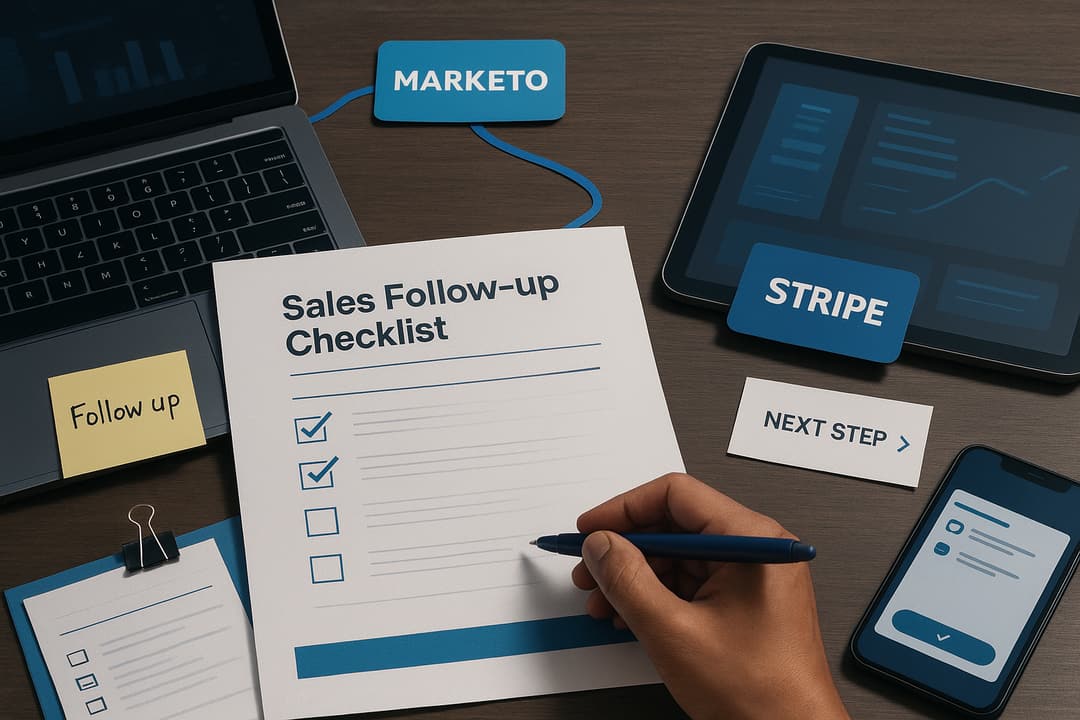
Thesis (short): Searching "Marketo vs Stripe for sales follow-up" usually frames the debate as a feature checklist. Revenue ops teams should reframe it: the real question is whether your orchestration, routing rules, and execution guardrails prevent race conditions, duplicate touches, and ownership gaps. This article reframes the marketo vs stripe for sales follow-up comparison around execution quality and orchestration—not feature checklists—and gives concrete failure modes, recovery patterns, runbook snippets, and a decision checklist you can use immediately.
Why this matters for revenue ops teams: predictable pipeline velocity and clear handoffs are KPIs for RevOps. If follow-ups are noisy or out-of-order, conversion drops, rep trust erodes, and escalation cycles waste budget. This guide is written for revenue ops teams, workflow owners, and operators who are deciding whether to route follow-up through Marketo workflows, Stripe-triggered actions, or a central orchestration layer.
Where operators actually lose execution: repeatable failure archetypes
Before you debate vendor features, understand the recurring patterns that cause failures. Name the pattern and you’ll identify the right fix quickly.
H3 — Data latency & race conditions
A form submit and a payment event can arrive in any order. Without a canonical event bus or idempotent handling, automated nurtures and transactional messages race and prospects receive contradictory signals. This is the most common reason teams ask "Marketo vs Stripe for sales follow-up"—they're seeing the symptoms, not the root cause.
H3 — Ownership and routing gaps
When both marketing automation (Marketo) and payments (Stripe) touch the same contact, neither system should unilaterally decide to pause or resume outreach. Lack of a single owner for the routing decision leads to duplicate outreach and confused reps.
H3 — Integration brittleness and hidden duplicates
Point-to-point integrations (Zapier/Make, direct webhooks) are fast to ship but fragile. They can produce duplicate triggers, uncoordinated enrollments, and maintenance debt when API shapes change.
H3 — Alert fatigue masking actual regressions
Operators often set broad alerts ("webhook failure") that create noise. That noise hides the high-signal regressions—e.g., a contact receiving both transactional and nurture emails in a tight window.
Where "Marketo vs Stripe for sales follow-up" shows up in practice
When teams ask this comparison, they're usually deciding one of two things:
- Can marketing own end-to-end follow-up (Marketo workflows → sales tasks)?
- Should payment events in Stripe drive distinct follow-up (invoicing, onboarding, account management)?
Short answer: both tools are useful, but neither should be the single orchestration brain. A canonical event bus and a central orchestration layer that enforces pause/resume and idempotency resolves the conflict. For playbook-level patterns, see Meshline's Sales Orchestration Playbook.
Concrete failure scenario operators will recognize
Scenario name: "Form submit, then payment, but nurture fires first"
Systems: Marketo Engage (Marketo (Adobe Marketo Engage)), Segment (CDP/event bus), Salesforce Sales Cloud, Stripe Billing (Stripe). Each system is a node in the follow-up flow; the glue is the orchestration.
H3 — Flow specification (source → destination, fields, SLA)
- Source: Website form posts to Marketo with fields: email, first_name, company, utm_source, lead_id. Marketo writes a record and emits a webhook. SLA: process and route the webhook within 15 seconds.
- Payment: Prospect completes checkout; Stripe emits invoice.payment_succeeded with fields: customer_email, stripe_customer_id, payment_intent_id. SLA: webhook delivered within 5 seconds.
- Destination: Segment receives both events and forwards to Marketo, Salesforce, and a central orchestration engine.
H3 — Failure sequence (how execution breaks)
- Form submit → Marketo fires a "thanks" email and enrolls the contact into a 7-day nurture.
- Stripe payment webhook arrives seconds later via a Zapier flow that updates Salesforce and pushes a second Marketo update. Because the integration path is point-to-point and unordered, the payment does not pause the nurture quickly enough.
- Prospect receives both a nurture email promising a rep will reach out and a billing confirmation; sales sees both a task and automated outreach and delays action.
Root causes: no canonical event ordering, point-to-point middleware lacking idempotency/ordering guarantees, and no defined pause/resume rule tied to payment state.
H3 — Immediate recovery steps operators can run
- Disable the affected Marketo program and export contacts who received both nurture and billing emails in the last 24 hours.
- Add a canonical event sink (Segment or RudderStack) that records server-received timestamps and enforces idempotency keys (e.g., webhook id, payment_intent_id).
- Implement a simple orchestration rule: if purchase_completed occurs within N seconds of lead_submitted, pause marketing cadence and create a sales task instead of enrolling in nurture.
- Add monitoring: alert when a contact receives both transaction + nurture within 30 minutes.
Integration patterns that stop race conditions
Operators should pick one of these canonical patterns and make it standard across flows.
H3 — Event bus / CDP as canonical truth
Route every event (forms, pageviews, Stripe webhooks) into a CDP like Segment; use it to activate Marketo and Salesforce. Central ingestion reduces ordering ambiguity and centralizes enrichment. See Segment's patterns for ingestion and activation.
H3 — Orchestration engine with pause/resume semantics
Use an orchestration engine that supports declarative rules like "pause marketing if payment.pending or payment.succeeded within N minutes." This separates orchestration from simple integration middleware. For an example topology, see Meshline's Orchestration Engine Overview.
H3 — Idempotency stores and reliable webhook handling
Store processed webhook_event_id and payment_intent_id in a short-lived persistence layer (Redis / DB) to avoid duplicate handling. Follow Stripe's webhook best practices documented on Stripe.com for retries and idempotency.
H3 — Clean object modeling: custom objects vs contact properties
Keep transactional records (payments, invoices) as custom objects, not transient contact-level flags. Marketo supports programmatic custom objects—use them to prevent transient state from causing enrollments.
Tool-fit: Marketo, Stripe, and the orchestration layer
Below is a concise comparison focused on fit-for-purpose, not an exhaustive feature matrix.
H3 — Marketo (marketing automation and nurture)
Best for long-running nurtures, lead scoring, and campaign workflows. Use Marketo to manage cadences and nurture content, but gate enrollments with an orchestration_state contact property that the central engine controls. See Adobe Marketo Engage for product and API docs: Marketo (Adobe Marketo Engage).
H3 — Stripe (payments and lifecycle events)
Stripe is the source of truth for billing and subscription lifecycle events. Emit reliable webhooks and include metadata for lead IDs or contact emails. Do not use Stripe by itself for lead routing unless you have robust sync into your CRM. See Stripe Billing & Payments docs.
H3 — Orchestration engine / CDP (the glue)
This is where decisions are reconciled: apply pause/resume logic, enforce idempotency, and order events. Whether you use Segment, RudderStack, or a dedicated orchestration engine, make it the place that writes the final commands to Marketo and Salesforce. Meshline's recommended topology is available at See the engine structure.
When Zapier / Make are appropriate (and when they're not)
Zapier and Make are excellent for quick automations—notifications, lightweight syncs, and prototypes. But they are brittle for sequencing-critical flows. If a Zap or Make flow is part of a critical path, treat it as production code: add unit tests, explicit owners, and CI checks.
Operational rules, QA checks, and monitoring to implement now
These are actionable rules you can add to your runbook this week.
- Rule 1 — SLA on event processing: median and P95 processing times for inbound webhooks must be measured and alerted if they exceed thresholds (e.g., median < 5s, P95 < 30s).
- Rule 2 — Pause-first policy: events with payment_in_progress or payment_succeeded set contact.orchestration_state = paused for a defined window; orchestration layer decides duration.
- Rule 3 — Idempotency store: persist webhook_event_id and payment_intent_id for 48 hours and reject duplicates.
- Rule 4 — Overlap detection: daily report for contacts receiving both a transactional and a nurture email within a 1-hour window; threshold-based paging if > 5.
- Rule 5 — Ownership mapping: one living document that maps actions to owning systems (Marketo = nurture, Salesforce = outbound tasks, Orchestration = pause/route decisions). Review monthly.
H3 — Synthetic tests and failure injection
- End-to-end synthetic test: create a test contact, submit the form, simulate a Stripe payment, and assert that nurture enrollment does not occur and a sales task appears in < 2 minutes.
- Failure injection: simulate delayed ingestion (Segment/queue) and confirm orchestration pauses follow-up appropriately.
Decision checklist for revenue ops teams (practical)
- If your primary problem is "timing/duplicate touches," buy or build a central orchestration layer before adding more point integrations.
- If your problem is "tracking payments and billing state," use Stripe Billing APIs and integrate them into your CDP/CRM—don’t rely on email triggers alone.
- If you already have Segment or RudderStack, enforce ordering and use them as canonical event buses.
- If Zapier/Make are in the critical path, accept the operational cost: add tests, version control, and documented owners.
- For high-value transactions, add a human-in-the-loop: create manual verification tasks for payments above a threshold before resuming automated sales cadences.
Example runbook snippet (copy/paste)
- Trigger: Stripe webhook invoice.payment_succeeded with metadata.lead_id
- Check: Has this webhook_event_id been processed? If yes → exit.
- Enrich: Match to contact by metadata.lead_id or customer_email via CDP lookup (P95 lookup < 200ms).
- Decision: If contact.orchestration_state == "in_nurture" and purchase_amount > 0 then set orchestration_state = "post_purchase" and create sales task; else resume default behavior.
- Logging: Write an audit entry with event_id, decision, timestamp, and operator.
Vendor questions and implementation checklist (what to ask Marketo / Stripe / CDP vendors)
- Can we ingest webhooks into your platform with server-side timestamps preserved?
- Does your API support idempotent writes (or can we store processed webhook IDs)?
- What is the recommended model for custom objects vs contact properties for transactional records?
- Can you support an orchestration_state property that external systems can write and Marketo programs can read to gate enrollments?
For Marketo docs and API details see Marketo (Adobe Marketo Engage). For Stripe webhook and idempotency patterns see Stripe.
Migration plan (3-week sprint to move sequencing out of zaps)
Week 1: Audit flows, export overlapping-contact list, and identify core zaps.
Week 2: Implement canonical event sink (Segment or RudderStack) and a simple orchestration rule engine for the highest-risk flows.
Week 3: Replace direct zaps for those flows with orchestration outputs; run end-to-end and failure-injection tests; roll forward to production.
Closing: What to decide now (practical next steps)
- Run the overlap detection query in production this week. If > 20 unique contacts in 7 days, treat as a P1 and apply the recovery path.
- Move sequencing logic out of point-to-point zaps and into an orchestration pipeline (event bus → orchestration → action).
- Add two synthetic E2E tests (form→payment and payment→form) to CI and nightly smoke tests.
If you want to see the recommended topology and rules we run in production, See the engine structure — it shows canonical event buses, orchestration rules, and retry/idempotency patterns.
Related Meshline resources:
External references cited in this article (official docs and guides):
- Marketo (Adobe Marketo Engage)
- Stripe Billing & Payments
- Forrester predictions on automation and governance (2026) cited for strategic context.
Diagram alt text: Orchestration flow diagram showing Website form submit → Marketo (lead record & nurture), Stripe (payment webhooks) → Segment (event bus) → Orchestration engine → Salesforce (lead/tasks). The diagram highlights race conditions when webhooks arrive out of order and the orchestration engine as the canonical decision point.
Implementation Evidence and Reliability Checks
Use these references to validate the sales follow-up implementation model, reliability assumptions, integration controls, and incident-response expectations before rollout.
Where sales follow-up usually breaks in practice
The useful test for marketo vs stripe for sales follow-up is not whether the team can draw a clean workflow. It is whether the workflow still behaves when a record arrives late, a required field is missing, or two systems disagree about who owns the next action.
Start by writing down the first signal, the field that proves it is trustworthy, the person who can override the route, and the timestamp that shows whether the handoff happened on time. Those details make sales follow-up automation reviewable instead of merely automated.
For buyers comparing marketo vs stripe for sales follow-up, the decision should center on sales follow-up automation, sales follow-up reporting, sales follow-up exception handling, sales follow-up ownership, and whether the team can inspect the audit trail without asking engineering to reconstruct the incident. marketo stripe comparison belongs in the article only where it clarifies a real operator decision, not as a stray keyword. sales follow-up platform comparison belongs in the article only where it clarifies a real operator decision, not as a stray keyword. revenue ops teams sales follow-up tools belongs in the article only where it clarifies a real operator decision, not as a stray keyword.
When sales follow-up needs an operating layer
Meshline fits when sales follow-up is no longer a single automation but a recurring operational commitment. The warning sign is usually simple: people trust the tool when everything is normal, then leave Slack messages, spreadsheet notes, and manual fixes behind as soon as the edge case appears.
For Marketo vs Stripe: Sales Follow Up Workflow Comparison, define the authoritative data, routing rule, review checkpoint, retry policy, and evidence trail before launch. This lets the operating team adjust exceptions without turning each failure into an engineering investigation.
The decision behind Marketo vs Stripe: Sales Follow Up Workflow Comparison is whether a connector is enough or the workflow needs a maintained execution layer. When revenue, customer handoffs, reporting, billing, or CRM ownership are involved, scope auditability and recovery alongside launch speed.
- For Marketo vs Stripe: Sales Follow Up Workflow Comparison, document which system wins when two records disagree.
- For Marketo vs Stripe: Sales Follow Up Workflow Comparison, name who can pause or override execution without creating a hidden side process.
- For Marketo vs Stripe: Sales Follow Up Workflow Comparison, specify what evidence remains after a failed handoff is recovered.