
 MeshLine
Shopify vs Marketo for Client Onboarding: Fix Execution
Shopify vs Marketo for client onboarding: compare routing, ownership, exception handling, and implementation tradeoffs before choosing a workflow.
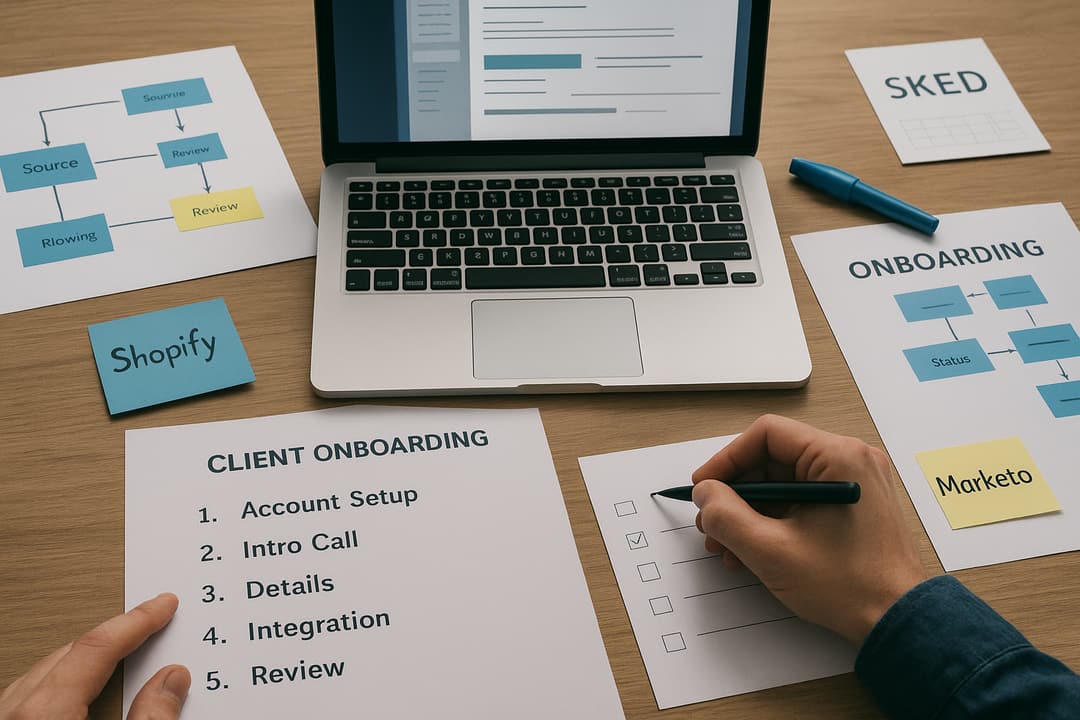
Shopify vs Marketo for Client Onboarding: Fix Execution
If you're searching for "shopify vs marketo for client onboarding," stop treating this as a feature checklist. Marketing ops teams and onboarding leads face one structural question: which toolset helps you enforce execution guarantees when humans, APIs, and SLAs interact? This article reframes the Shopify vs Marketo comparison around orchestration quality — the observable, testable controls that prevent deals from slipping between systems.
Editorial thesis: choose a platform based on the surface area for enforcing SLAs, automated error recovery, and clear ownership during each onboarding milestone. Both Shopify and Marketo can enable excellent onboarding, but both will also fail badly without a deliberate orchestration layer and operational runbooks.
This is written for marketing ops teams making a client onboarding platform comparison, operators running combined stacks (Shopify storefront + Marketo nurture + CRM), and leaders who must reduce time-to-first-value (TTFV) and onboarding fallout.
Executive thesis and decision checklist
- Prioritize orchestration surface and ownership over feature parity. The right tool is the one you can make operationally reliable.
- If onboarding is commerce-first (account setup, fulfillment, order provisioning), Shopify’s storefront-native automations and event model often make early execution easier. See Shopify docs: Shopify Flow.
- If onboarding is nurture-first (multi-touch campaigns, scoring, CRM-driven plays), Marketo’s campaign engine is stronger — but it assumes deterministic identity and reliable upstream syncs. See Marketo Engage: Marketo product page.
- Regardless of choice, require: a canonical ID, a state machine with SLAs, defensive payload validation, and observable incident routing. If you can’t answer "who owns the SLA when a sync fails?", execution will break.
Decide this week on three commitments: canonical identifier, state machine, and a payload-validation + escalation path. Then run one end-to-end smoke test. If you need a templated map, See the engine structure.
Where operators actually lose execution (the three failure zones)
When teams say "the tool failed us," it's rarely a missing feature. Operators lose execution in three repeatable zones:
Handoff ownership: who owns the customer now?
Onboarding often begins with a human signal (Closed-Won) and relies on system events (Shopify order, Marketo person create, Salesforce opportunity update). When the event ownership is unclear, tasks are duplicated and milestones are missed.
Symptoms:
- Sales marks closed-won but no onboarding ticket appears.
- Marketing executes a nurture campaign against incomplete identity data.
- Success teams assume provisioning is done because an order exists, but the CRM shows no onboarding state.
Fixes (quick): define a single handoff event (e.g., Shopify order tag onboarding_ready or Salesforce field Onboarding_Start_Date) and enforce it with automation that writes a canonical status into the CRM. If onboarding_status != started within 2 hours, escalate.
Data mapping and sync exceptions: the silent failure mode
APIs and field mappings cause the majority of silent failures. Marketo’s REST API provides robust capabilities and usage dashboards, but improper mappings and unmonitored errors produce dropped records.
Symptoms:
- Person creates failing with validation errors.
- Partial records (email without account_id) that can’t be reconciled.
- Integration middleware retries quietly and then stops without surfacing an incident.
Fixes (quick): treat API calls like production services. Validate payloads before write attempts, categorize failure modes (schema mismatch vs rate limit vs permission), and push failing payloads into a triage queue with the raw JSON attached.
Orchestration gaps between commerce and nurture engines
Shopify tracks orders, customers, and fulfillment. Marketo runs campaigns and scoring. Without a controlling orchestration layer, transactional and behavioral flows run on different clocks.
Symptoms:
- Transactional emails go out before a profile is enriched.
- Nurture programs fire on incomplete or duplicate identities.
- Customers get conflicting communications from sales, success, and marketing.
Fixes (quick): define which system owns which class of action: Shopify for immediate transactional responses, Marketo for any multi-touch nurture, and a middleware/orchestration layer to mediate identity and ensure sequencing.
A recognizable failure scenario (concrete systems, fields, SLAs)
Example stack: Shopify Plus storefront + Marketo Engage + Salesforce CRM + Segment CDP. This is a common shopify marketo comparison configuration for wholesale or B2B commerce.
Sequence that fails in many implementations:
- Sales sets Opportunity.Stage = Closed-Won and adds Account.Onboarding_Start_Date = today (SLA: start within 24 hours).
- Customer accepts terms; Shopify creates the account and tags it "wholesale_onboard." Shopify Flow sends a webhook to middleware but omits Salesforce Account ID. Shopify Flow docs.
- Middleware attempts to create a Marketo person via REST API. Field mapping errors (company_name vs company) cause a validation error; middleware retries and then drops without an alert. Marketo REST API guidance.
- Marketo nurture never starts because the person record was never created; the customer receives only a generic transaction from Shopify. Sales assumes onboarding is happening. 48 hours later the customer complains.
Immediate operational rules you can apply:
- On webhook receipt, require a canonical identifier (Salesforce Account ID or Segment profile id). If missing, return 400 and create an actionable alert. Don’t silently queue.
- Use a dry-run validation for Marketo pushes: verify schema compatibility before committing. If push fails, open an incident ticket with the failing payload.
- Track an onboarding state machine in Salesforce or orchestration layer with timestamps and named owners for each transition.
If you want a templated state machine and checklist, use Meshline’s resources: Meshline: Data Sync QA checklist and Meshline: Client Onboarding Playbook.
How the platforms differ when you focus on execution, not features
This is not a feature-by-feature matrix. It’s an execution surface analysis: what each platform lets you enforce, observe, and remediate in production.
Shopify: execution strengths and operator caveats
Strengths:
- Native event model (orders, customers, checkouts) makes it easy to attach a concrete commerce-first onboarding event.
- Shopify Flow is a low-code canvas for triggers and actions; it can call external HTTP endpoints, which is powerful for immediate orchestration. See Shopify docs: Shopify Flow.
Caveats:
- Flow capabilities differ by plan and have execution limits — critical flows must be tested on your plan tier.
- Shopify is not a campaign engine. Moving nurture into the storefront risks mixing transactional and marketing messaging and complicates consent management.
Marketo: execution strengths and operator caveats
Strengths:
- Powerful program orchestration, nurturing, and scoring for behavior-driven onboarding.
- Robust CRM sync options and activity push to Salesforce when configured correctly. Marketo product page
Caveats:
- Marketo assumes a deterministic identity upstream. If data arrives from multiple channels without canonical IDs, engagement programs fragment.
- API quotas and sync timings are operational constraints — monitor them and build retry/backoff policies.
Comparative operational tradeoffs (quick)
- If the onboarding workflow is dominated by commerce events and immediate provisioning, Shopify-first is operationally simpler.
- If onboarding requires multi-step nurture, cross-touch scoring, and programmatic plays, Marketo-first is more appropriate — but needs stronger middleware and identity controls.
- In many real-world cases you run both. The decision then becomes: who enforces sequencing and owns failures? That’s an orchestration problem, not a product one.
Orchestration patterns that prevent the common failures
Adopt these patterns as mandatory infrastructure for onboarding execution.
Pattern A — Canonical identity and single handoff event
Create and enforce a canonical ID (Salesforce Account ID or CDP profile id). Require reconciliation on every inbound payload. If the ID is missing, reject and create a ticket. This removes ambiguity about ownership and reduces duplicate records.
See Meshline’s QA checklist: Meshline: Data Sync QA checklist.
Pattern B — State machine as the source of truth
Implement an onboarding state machine with discrete, actionable states (e.g., signed → account_created → identity_validated → assets_uploaded → nurture_started → ready_for_success). Store timestamps and named owners for each transition. Escalate automatically when a state exceeds SLA thresholds.
Pattern C — Defensive integration and payload validation
Validate payloads against the target API schema before writes. Use dry-run patterns for Marketo and respect Shopify Flow limits. Surface failed payloads into a triage queue with automatic owner assignment and a standard incident title.
Pattern D — Observability and a visible incident path
Integrate integration metrics into a single dashboard: calls/sec, errors, schema mismatches, and median time in state. A high-quality onboarding dashboard shows incomplete onboards, time-to-first-value (TTFV), and most-failed payload fields. If you need playbook inspiration, see Gainsight and Intercom onboarding design notes (Gainsight onboarding playbook).
Quick implementation playbook (actions for this week)
- Identify and enforce the canonical owner-of-record (Salesforce Account ID or CDP profile id). Add middleware validation to reject missing IDs. (Owner: Integration Lead. SLA: 48 hours.)
- Add monitoring rules: (a) Marketo failed creates > 3 in 10 minutes → page Ops; (b) any onboarding state duration > SLA → email CSM. (Owner: Observability lead.)
- Move non-transactional messaging into Marketo programs; use Shopify Flow only for transactional handoffs. (Owner: Marketing Ops.)
- Run an end-to-end smoke test for a sample customer: Shopify tag → middleware validation → Marketo create → Marketo program enrollment → Salesforce state advancement. Time each step and record TTFV. Fix failures and rerun. (Owner: Onboarding PM.)
Templated artifacts: Meshline: Client Onboarding Playbook and See the engine structure.
Measuring success (metrics that matter to ops)
Track these KPIs weekly and publish to stakeholders:
- Time to first value (TTFV): median time from Closed-Won to first onboarding milestone completion.
- Onboarding completion rate within SLA (target ≥ 90%).
- API error rate and median MTTR for onboarding-critical failures (target MTTR < 2 hours).
- Manual interventions per 100 onboards (trend should decline).
Use these metrics to justify investment in orchestration. For market benchmarking, consult G2 and Forrester reports on onboarding tools and behavior change.
Team and governance nudges that reduce friction
- Appoint a named onboarding SLA owner for each account (not an ambiguous team). That person is accountable for resolving sync exceptions or escalating.
- Maintain a living runbook (mapping table, accepted payload sample, common errors, smoke test steps) in your team wiki and link it to onboarding tickets.
- Run a 30-minute monthly "onboarding postmortem" for any onboard that exceeds 48 hours to closure; capture root causes and update integrations.
Need a governance template? See Meshline's orchestration guidance: Meshline: Orchestration vs Automation.
When to buy, integrate, or build
- Buy (Shopify-native + Marketo): choose this if you need low-latency storefront reactions plus a commercial-grade nurture engine. Plan for middleware and SLA ownership. See Shopify and Marketo docs for platform limits and integration patterns.
- Integrate (CDP/middleware): if you have multiple data sources (web, mobile, POS), invest in a CDP (Segment) to canonicalize identity and route validated payloads to Marketo and Salesforce. Segment onboarding guide.
- Build (custom orchestration): if onboarding involves conditional approvals, KYC, or enterprise provisioning, build a dedicated orchestration layer that enforces state transitions and exposes observability.
Use Forrester or Forrester-style ROI analysis to get leadership buy-in for orchestration investment.
Closing: the operational decision to make now
Stop debating checkboxes. Decide how you will guarantee execution during the first 72 hours after close. Draft and commit to these three items and run one smoke test this week:
- Single canonical ID for onboarding (who enforces it?).
- Onboarding state machine and SLA (where is it visible?).
- Payload validation and incident path (who gets paged on failures?).
If you want an executable engine map that turns this decision into code and runbooks, See the engine structure. That map contains a templated state machine, validation schema, and escalation wiring you can adapt for Shopify + Marketo environments.
References and operator reading
- Shopify Flow documentation: help.shopify.com manual / shopify-flow
- Marketo REST API and developer guidance: experienceleague.adobe.com rest / rest-api
- Segment onboarding and CDP routing: segment.com user-onboarding / process
- Gainsight onboarding playbook: gainsight.com resource / saas-customer-onboarding-playbook
- Forrester research on onboarding as behavior change: forrester.com customer-onboarding-is-more-than-activation-its-behavior-change / RES194167
(Internal links used: /product/engine-structure, /glossary/data-sync-qa, /playbook/client-onboarding, /blog/orchestration-vs-automation)
Next Step
Use this workflow as an implementation map: choose the source signal, define the owner rules, add QA gates, and decide what should happen when the system cannot route safely. Meshline can then turn that map into a visible operating layer with audit trails and recovery paths.
Implementation Evidence and Reliability Checks
Use these references to validate the implementation model, reliability assumptions, integration controls, and incident-response expectations for Shopify vs Marketo for Client Onboarding: Fix Execution before rollout.
Where client onboarding usually breaks in practice
The useful test for shopify vs marketo for client onboarding is not whether the team can draw a clean workflow. It is whether the workflow still behaves when a record arrives late, a required field is missing, or two systems disagree about who owns the next action.
Start by writing down the first signal, the field that proves it is trustworthy, the person who can override the route, and the timestamp that shows whether the handoff happened on time. Those details make client onboarding automation reviewable instead of merely automated.
For buyers comparing shopify vs marketo for client onboarding, the decision should center on client onboarding automation, client onboarding reporting, client onboarding exception handling, client onboarding ownership, and whether the team can inspect the audit trail without asking engineering to reconstruct the incident. shopify marketo comparison belongs in the article only where it clarifies a real operator decision, not as a stray keyword. client onboarding platform comparison belongs in the article only where it clarifies a real operator decision, not as a stray keyword. marketing ops teams client onboarding tools belongs in the article only where it clarifies a real operator decision, not as a stray keyword.