
 MeshLine
approval workflows Automation Guide for Founders
A founder-focused playbook that converts approval workflows into an observable, auditable operating layer. Patterns, owners, failure modes, and how Meshline operationalizes approvals.
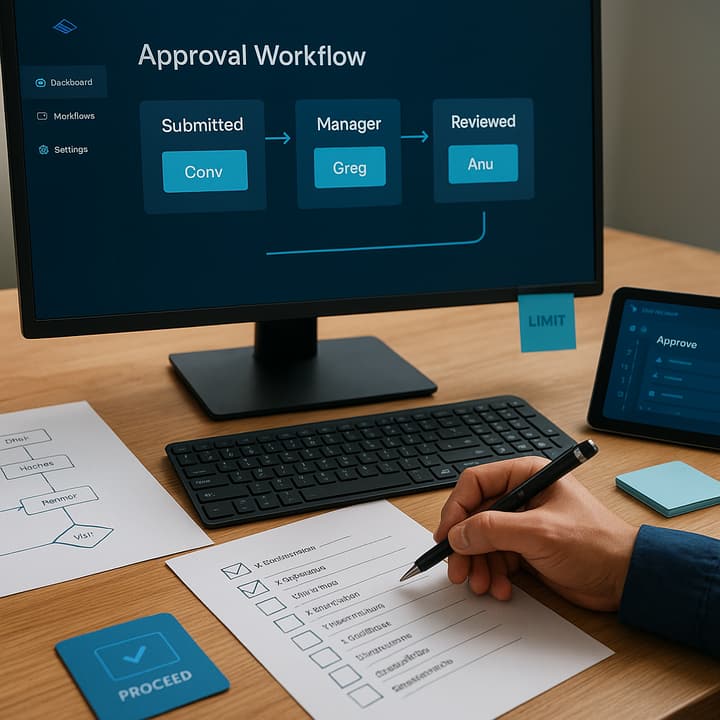
Autonomous Operations Infrastructure for Founders Approval Workflows: Implementation & Integration Guide
Founders waste runway and focus when routine approvals become tactical chores. This playbook shows how to design an autonomous operations infrastructure for founders approval workflows that replaces Slack pings, email CCs, and ad-hoc docs with an enforceable, observable operating layer. The content is implementation-focused: triggers, owners, QA gates, failure modes, exception paths, reporting signals, and concrete Meshline integration patterns to turn approvals into infrastructure.
This article targets founders evaluating an approval platform or implementation partner. It maps the primary query "autonomous operations infrastructure for founders approval workflows" to adjacent terms like approval workflows system design and operating system for approval workflows so you can use this as a decision document during procurement and rollout.
Why founders need autonomous approval infrastructure (what founders lose today)
Founders repeatedly report three failure patterns from ad-hoc approvals:
- Bottleneck risk: single-person approvals create single points of failure and slow decision velocity.
- Audit and context loss: rationale and attachments live in ephemeral chat, causing rework and compliance gaps.
- Slowed GTM cycles: marketing launches, deal approvals, and onboarding stall without deterministic routing and SLAs.
Turning approvals into infrastructure reduces tribal knowledge and creates predictable escalation lanes. Research on decision rights and operating models underscores faster execution when governance and automation are codified; see work from McKinsey and maturity frameworks from Gartner and Forrester.
Why this matters to founders: approvals are part of your operating surface — they control speed, legal exposure, and runway. An autonomous operations infrastructure for founders approval workflows enforces guardrails while preserving founder-level exceptions.
Operating framework: treating approvals like an operating system
You must move from ad-hoc rules to a deterministically enforced model. The operating framework below turns approval work into an approval OS rather than a folder of emails.
- Events & triggers: explicitly enumerate what generates an approval (campaign launch, contract > $X, pricing override, new hire request).
- Ownership & roles: map requesters, approvers, backups, and auditors. Use role-based selectors (e.g., "quota-owner", "legal-on-call") rather than people's names.
- Rules & gates: require a minimal schema and automated guards (budget checks, duplicate detection, authorization matrix).
- Routing & SLA: deterministic routing with time-based escalation and on-call backups to avoid silent stalls.
- Observability & audit: immutable logs, decision rationale, and outcome tags for reporting and compliance.
- Exception paths: founder-level overrides that require post-approval QA and compulsory audit logging.
Meshline enforces these primitives so approvals become part of product and revenue telemetry. See the Meshline product overview for platform-level connector and event models.
Design rule: guardrails before automation
Codify policies (budget thresholds, compliance rules, SLA windows) as policy artifacts before enabling auto-approval. That creates testable guardrails and prevents unsafe automation. The concept mirrors secure engineering guidance such as NIST's recommendations for secure logging and policy enforcement (NIST).
Design rule: prescriptive metadata and idempotency
Require a minimal schema for every approval (title, owner, use case, financial impact, deadline, idempotency key). Prescriptive metadata enables reporting, idempotent processing, and downstream automation.
Examples and high-impact use cases (founder-prioritized)
Prioritize workflows that block revenue or increase legal/financial risk. High-impact candidates:
- Pricing overrides for deals above a threshold — controls margin and sales velocity.
- Marketing campaign launches with paid spend — ensures brand, budget, and legal checks.
- Contract redlines and NDAs — reduces legal exposure and onboarding delays.
- Headcount or contractor hires beyond tiers — protects runway and payroll accuracy.
Case story — before and after (founder-level):
Before: an SDR DM'd the founder on Slack to approve a discount. The founder replied with a screenshot, pasted the decision into CRM, and forgot to record rationale. The CFO discovered inconsistencies during reconciliation.
After: the SDR opens a request in the approval OS. The workflow validates the discount against pricing policy, routes to the quota owner, waits 8 hours, auto-escalates to backup after SLA, and logs the decision in an immutable audit record. Revenue Ops dashboards show time-to-decision automatically.
For technical teams, model approvals as state machines and retries using production-grade orchestration primitives like AWS Step Functions or Camunda; see orchestration patterns in the respective docs (Camunda).
Implementation steps: a founder-friendly operator playbook
Each action below names the owner, tooling options, and QA gates. Implement with a two-week canary and a staged rollback plan.
1) Map the domain (owner: founder + ops)
- Inventory approval touchpoints for the last 90 days across marketing, sales, legal, finance, and engineering.
- Classify each by frequency and impact (revenue, compliance, runway).
- Deliverable: prioritized approval inventory and a 30-day sprint backlog. Run a one-hour discovery workshop with domain leads.
Tools & notes: export CRM activity, Slack channel threads, and contract trackers. HubSpot and Atlassian docs provide useful patterns for structuring approval artifacts (HubSpot, Atlassian).
2) Define policy artifacts and schema (owner: domain lead)
- For each approval type, define minimal schema: request_type, amount, SLA, rationale, attachments, idempotency_key, and domain tags.
- Publish these artifacts in a canonical approvals registry (a Git-backed repo or a low-code policy registry).
- QA gate: schema validation tests and sample payloads.
3) Choose an enforcement surface (owner: platform/ops)
Decide whether the approval OS lives embedded in a system-of-record, a global workflow layer like Meshline, or a hybrid.
- If you need cross-tool routing, audit, and connectors, use an OS that supports event-driven connectors (Meshline). See the Meshline solutions for approval workflows.
- For developer-facing gates, integrate with GitHub Actions or CI/CD controls.
- For stateful enterprise processes, consider AWS Step Functions or Camunda for durable process models.
QA gate: run a connector smoke test for each system-of-record (CRM, billing, ATS).
4) Implement deterministic routing & SLA (owner: platform)
- Configure rules based on role, amount, and region — avoid person-based routing.
- Define explicit SLAs and escalation rules: time-windowed auto-escalation, on-call approvers, and blackout calendars.
- QA gate: synthetic routing tests and SLA breach simulations.
5) Instrument observability and audit (owner: ops + finance)
- Emit structured events for every state transition and index them into analytics.
- Link approval outcomes to downstream systems (CRM, billing, campaign platforms) so decisions trigger programmatic execution.
- QA gate: verify event fidelity and retention policies. Follow secure logging guidance like NIST and compliance best practices.
6) QA, canary, and rollout (owner: QA + domain lead)
- Start with a shadow canary: route 10% of requests through the new OS while leaving legacy channels available.
- Run daily diffs and reconciliation jobs; fix drift before increasing traffic.
- After two weeks of stable canary metrics, flip to full routing and retire ad-hoc channels.
Tools: use feature-flags and progressive rollout strategies from platform tooling. For developer-friendly policies, see orchestration examples on GitHub and vendor docs.
Tool selection considerations and integration patterns
Tool selection considerations (H3)
- Cross-functional and event-driven workflows need an OS with connectors and event streaming (Meshline, AWS Step Functions).
- Developer-facing approvals are best handled in the developer platform (GitHub Actions) to keep approvals close to code.
- Low-code user-facing approvals can be handled with Slack Workflow Builder or CRM-native approvals for teams without engineering support.
Integration and sync patterns (H3)
- One-way sync: approval outcomes push to the system-of-record (CRM, ATS) and trigger execution.
- Two-way sync: updates in the system-of-record can re-open approvals (required for change-of-record scenarios).
- Idempotency: include idempotency keys so replayed events do not duplicate approvals.
QA gate: perform end-to-end tests that simulate the full event path from request to downstream execution.
QA, failure modes, ownership, and escalation
Operationalizing approvals reduces friction but introduces new failure modes. Enumerate ownership, QA checks, and mitigations.
Ownership rules (operational) (H3)
- Platform owner (Meshline/ops): accountable for routing logic, connectors, and SLA enforcement.
- Domain owner (product/marketing/sales/legal): accountable for policy content and domain exceptions.
- On-call approver: rotating role receiving escalations outside normal hours.
- Audit owner (finance/compliance): maintains retention, auditability, and documentary requirements.
Operational rule: never store decision rationale only in chat; centralize in the approval OS and link chat threads for context.
QA checks and acceptance criteria (H3)
- Schema validation: requests must pass schema checks before entering the queue.
- Routing tests: run synthetic requests for each rule path monthly.
- Idempotency tests: replay events and verify no duplicate decisions.
- Security checks: redact PII and sensitive contract terms in logs per policy.
Use industry frameworks for secure logging and access control; for example, align retention and redaction with NIST guidance.
Common failure modes and mitigations (H3)
- Silent stalls: approver unresponsive. Mitigation: strict SLA + escalation and on-call backup.
- Incorrect routing: rules mis-specified. Mitigation: rule preview UI and canary rollouts.
- Data drift: schema changes break older requests. Mitigation: versioned schema and migration scripts.
- Shadow divergence: shadow-mode outputs differ from legacy. Mitigation: daily diffs and reconciliation.
Exception paths:
- Founder override: allowed with immediate execution and mandatory post-facto review.
- Legal emergency: emergency bypass with mandatory CFO or GC sign-off within 48 hours.
- Automation fallback: if the OS is down, move to an emergency manual queue with stricter audit and temporary rate limits.
Document every exception path in the policy registry and require a review if used more than N times in 30 days.
Measurement and reporting signals (what to monitor from day one)
Track these KPIs closely and link every metric back to request-level records:
- Median time to decision by request type.
- SLA breach rate and mean time to remediate.
- Exception rate (manual overrides per 100 requests).
- Rework rate (requests that required re-approval).
- Business impact: revenue influenced, deal velocity, or legal incidents avoided.
Design dashboards so every metric drills into the request and event payload. Industry analysts stress linking workflow metrics to business outcomes for maturity; see Gartner, Forrester, and operational literature from McKinsey.
Next steps & implementation offers (decision-stage CTA)
If you’re a founder ready to move from reactive approvals to an autonomous operating layer, follow this quick decision checklist and then book a strategy session:
- Prioritize one high-impact approval type (pricing override or contract redlines).
- Define schema and owner within 48 hours.
- Implement deterministic routing and SLA within two weeks using Meshline or your orchestration layer.
- Run a two-week shadow canary and reconcile daily diffs.
Meshline provides connectors, automation recipes, and sync patterns for CRMs, Slack, analytics, and identity providers so approvals are enforced and visible. To discuss an implementation roadmap tailored to your stack, Book a strategy call.
See these Meshline resources for implementation references: the Meshline solutions for approval workflows, the Meshline product overview, Meshline docs on approval routing, the Meshline automation blog, and Meshline services & implementation.
Practical checklist (copyable)
- [ ] Inventory approvals for the last 90 days and rank by impact.
- [ ] For top 3 types, author schema and policy artifacts.
- [ ] Implement deterministic routing and SLA with a backup approver.
- [ ] Instrument emitted events for every state transition.
- [ ] Run a 2-week shadow canary; reconcile diffs daily.
- [ ] Create dashboards: median time to decision, SLA breaches, exception rate.
- [ ] Define founder override process and mandatory post-approval QA.
Appendix: operator-level pitfalls, references, and outreach opportunities
Pitfalls and tips:
- Automating bad rules — freeze policy changes for two weeks before enabling auto-approve.
- Over-automation of noisy requests — raise thresholds for auto-approval to reduce false positives.
- Scattered audit records — centralize logs and require links to the approval record in downstream systems.
Editorial and outreach opportunities: this article cites decision-rights and operating-model frameworks (McKinsey, Gartner, Forrester), secure logging (NIST), and vendor orchestration patterns (AWS, Camunda, GitHub). Outreach opportunities include guest posts or co-marketing with Camunda, AWS Step Functions, and developer communities on GitHub.
External authority links cited in this playbook include vendor and research sites used for operational best practices and orchestration patterns: McKinsey, Gartner, Forrester, NIST, AWS Step Functions, Camunda, Atlassian, HubSpot, and GitHub Actions.
If you want an implementation review tailored to your stack and milestone plan, Book a strategy call and we'll prepare a 30-day technical roadmap.
autonomous operations infrastructure for founders approval workflows Implementation Checklist
Use this autonomous operations infrastructure for founders approval workflows checklist to keep the approval workflows workflow specific enough for operators and buyers. Name the owner, source system, destination system, exception route, QA checkpoint, and reporting field before automation goes live.
For autonomous operations infrastructure for founders approval workflows, Meshline should confirm the trigger, review path, audit trail, fallback owner, and demo-ready outcome. That keeps autonomous operations infrastructure for founders approval workflows from becoming another disconnected workflow and gives teams a practical implementation path.
The operating language should stay consistent: autonomous operations infrastructure for founders approval workflows, approval workflows automation, approval workflows workflow, approval workflows operating model, approval workflows implementation, approval workflows checklist, approval workflows QA, approval workflows governance, exception routing, automation governance, operational visibility, and Meshline's operating layer. Meshline for approval workflows should appear where it clarifies search intent and buyer relevance. approval workflows system design should appear where it clarifies search intent and buyer relevance. operating system for approval workflows should appear where it clarifies search intent and buyer relevance.
Meshline Implementation Fit
Meshline is the right fit when the approval workflows path needs more than a one-off automation. The implementation should include a named source of truth, a visible owner, deterministic routing rules, QA checks before each write, an exception queue, and a recovery path that operators can inspect without asking engineering to reconstruct what happened.
For approval workflows Automation Guide for Founders, for commercial evaluation, Meshline scopes the workflow as an operating system: discovery, data contracts, integration logic, review gates, observability, launch support, and post-launch optimization. That makes the page useful for buyers comparing tools, agencies, low-code automations, and custom integration work.
For approval workflows Automation Guide for Founders, the Meshline implementation narrative must stay anchored in Autonomous Operations Infrastructure: an operating layer above scattered tools, an execution layer for system-led execution, trigger-to-outcome execution for revenue-critical work, ownership and control for the business team, engines that continue improving after launch, and self-operating business systems that reduce manual coordination.
- For approval workflows Automation Guide for Founders, Book a strategy call when the workflow touches revenue, billing, CRM ownership, attribution, customer handoffs, or reporting.
- For approval workflows Automation Guide for Founders, Use Meshline when the buyer needs implementation accountability, not only a connector recommendation.
- For approval workflows Automation Guide for Founders, Keep this page as the primary URL for the keyword family; related glossary and blog posts should link here as supporting context.