
 MeshLine
Zoho vs Gorgias: Client Onboarding Workflow Comparison
Zoho vs Gorgias for client onboarding: compare routing, ownership, exception handling, and implementation tradeoffs before choosing a workflow.
Zoho vs Gorgias for Client Onboarding: A Marketing Ops Guide to Fix Orchestration & Execution
Thesis (short): marketing ops teams searching "zoho vs gorgias for client onboarding" don’t need another feature checklist. They need an execution-first decision framework that exposes where handoffs fail, how automations create brittle dependencies, and what enforceable gates convert promises into predictable outcomes.
This piece reframes the Zoho vs Gorgias for client onboarding debate as an orchestration and execution problem. It centers operator workflows, shows concrete failure sequences with named systems (Zoho CRM, Gorgias, Zapier, Airtable), and delivers copyable fixes and a decision path to reduce time-to-value.
Quick verdict for marketing ops teams
- If your dominant flow is sales-led intake with multi-team handoffs and you need canonical records for billing and reporting, a Zoho-first architecture gives you the data model and CRM tools to own the customer lifecycle — if you enforce data contracts and instrument activation signals.
- If your dominant flow is support-led activation where conversational context and rapid agent action define value, a Gorgias-first architecture delivers an agent-optimized ticket surface and multichannel routing — but it will not replace an orchestration layer that guarantees cross-team timelines.
- In practice, the winner in any Zoho Gorgias comparison is the orchestration plan: required fields, idempotent syncs, dead-letter handling, SLA mapping, and a lightweight state engine. The platform choice matters less than whether you can enforce and observe execution.
Why operators still lose execution (core failure modes)
In hundreds of audits across marketing ops teams, failures trace back to predictable modes. Calling these out lets you design targeted fixes rather than swap products.
Handoff blindness — sales → onboarding → CS
Failure pattern: Sales marks closed-won in Zoho without required fields (primary_metric, POC_email). A Zapier webhook attempts to create a Gorgias onboarding ticket but the payload lacks the primary_metric key. Routing rules in Gorgias treat the ticket as generic support, not onboarding, so it gets delayed. Onboarding waits on detective work.
Why it matters: the gap between contract signing and first meaningful outcome is the highest churn risk. Operator time is the cost; lack of enforced fields turns every close into a detective ticket.
SLA and routing gaps — ticket surfaces vs activation signals
Failure pattern: Tickets that matter for onboarding are misclassified as support. Level 1 agents respond under a 24-hour support SLA while onboarding needs a 2-hour response and immediate escalation. The wrong SLA equals the wrong owner and timeline.
Why it matters: ticket classification is the lever that maps work to urgency and to the right owner. Gorgias supports SLA policies, but teams must design onboarding-specific workflows and enforce them upstream.
Data drift and duplicate canonical records
Failure pattern: Zoho account naming inconsistencies create duplicates; Gorgias imports email threads and creates separate contacts; automations can’t reconcile keys; messages get duplicated and ownership is murky.
Why it matters: orchestration engines require deterministic keys (company domain, external_id, email). Without error handling and reconciliation logic, automation amplifies inconsistency.
Template overreach: either too generic or too bespoke
Failure pattern: Onboarding templates either do not account for conditional branches (product tiers, add-on modules) or they’re so tailored every kickoff requires manual rewriting.
Why it matters: templates reduce variance only when paired with conditional logic and decision gates. Otherwise they provide a false sense of control and force manual exception handling.
A concrete failure scenario — how a 5‑day SLA becomes 15 days
Scenario summary (named systems and fields):
- Systems: Zoho CRM (deal_id = Z-12345); Zapier orchestration; Gorgias for tickets; Airtable as lightweight state engine.
- Required close fields: primary_metric (string), expected_go_live_date (ISO8601), POC_email (email), scope_doc_url (URL).
- SLA intent: onboarding tickets must be in "kickoff scheduled" state within 48 hours; default support SLA is 24h first response.
Failure sequence:
- Day 0: Sales marks closed-won in Zoho; required fields are incomplete.
- Day 0 + 02:00: Zapier fires; because primary_metric is missing, Gorgias receives a ticket with default tags and support SLA.
- Day 1: L1 agent responds under support workflows; no onboarding owner assigned.
- Day 3: Agent realizes this requires onboarding context and requests POC and scope.
- Day 6: Onboarding kickoff scheduled — a 5‑day SLA target has become 20 days to go-live.
Root causes in this sequence: missing validation at source, brittle orchestration script without dead-letter handling, and SLA logic in Gorgias dependent on absent fields.
Recovery path (copyable):
- Enforce close validation: block closed-won until required fields exist, or create an automated sales task preventing webhook emission.
- Dead-letter queue: have Zapier (or iPaaS) pause and create a high-priority Airtable task when validation fails; notify the salesperson by email and Slack until fixed.
- Pre-trigger mapping: configure Gorgias pre-triggers to tag incoming tickets based on fallback heuristics (company domain, deal_id) and notify CS Lead automatically if key fields are missing.
These steps convert detective work into enforceable gates and measurable SLA outcomes.
Technical tradeoffs: Zoho-first vs Gorgias-first architectures
Choosing a surface determines where you buy simplicity and where you take on complexity. Below are the tradeoffs for marketing ops teams deciding between CRM-first and ticket-first designs.
Zoho-first (CRM as system of record)
- Best where: sales-led onboarding with contractual obligations, multi-team handoffs, and a need for canonical records for billing and reporting.
- Strengths: structured data model, deal histories, native validation and reporting.
- Risk: if no state engine or lightweight tracker exists, tickets in Gorgias will appear detached and lack context; agents will need to manual-lookup deal data.
- Operator rule: make a minimal canonical field set required at close and back it with an orchestration engine that owns onboarding state.
Gorgias-first (ticket surface as system of action)
- Best where: support-led adoption, ecommerce post-sale engagement, and when conversational context creates activation events.
- Strengths: strong agent UX, multi-channel consolidation, macros for rapid responses.
- Risk: success metrics and activation signals often live in CRM; without disciplined two-way sync you get duplicate outreach and inconsistent state.
- Operator rule: build idempotent syncs that push activation events from tickets back into the CRM, and use unique external_ids to prevent re-triggers.
Hybrid pattern (recommended for most teams)
- Run a lightweight state engine (Airtable or internal table) as the canonical onboarding instance. Sync Zoho and Gorgias events to that engine. Use the state engine to drive SLAs, ownership, and escalation.
- Benefit: you decouple transient ticket events from canonical onboarding state and gain a single place to observe execution metrics.
Orchestration patterns that reliably fix execution
Below are operational patterns and templates marketing ops teams can copy. This is the core of the "client onboarding platform comparison" that actually matters: who owns execution.
Gate at source: required fields and blocking webhooks
- Require primary fields at close. If fields are missing, block the closed-won transition and create a sales task. Don't let a webhook send incomplete payloads to Gorgias.
- Implementation: Zoho validation rules or a lightweight serverless function that returns 400 if required fields are absent.
State engine: canonical onboarding instance
- Use Airtable (or an internal table) containing onboarding_status, owner, last_action_at, next_SLA, and external_ids (Zoho deal_id, Gorgias ticket_id).
- The orchestration engine (Zapier or iPaaS) writes events from Zoho and Gorgias to the state table and triggers escalations from there.
Dead-letter and reconciliation patterns
- If an automation fails to set a required key or the reconciliation key is ambiguous, send the payload to a dead-letter queue (DLQ) and create a human task in Airtable with clear remediation steps.
- Retries should be idempotent and bounded to avoid loops.
SLA mapping and pre-triggers in Gorgias
- Pre-map ticket tags using deal_id, company domain, and incoming channel heuristics. If key fields are absent, set temp_sla=onboarding and notify the CS Lead.
- Define escalation windows in Gorgias that align with onboarding SLAs (e.g., first response <= 2 hours, escalate to CS Lead after 4 hours).
Observability and metrics
Track these KPIs centrally in the state engine and in CRM reports:
- Time-to-kickoff (target <= 48 hours)
- % tickets reclassified (target <= 10%)
- Field completion rate at close (target 100%)
- Dead-letter queue volume and average remediation time
Testing, QA, and recovery plans (practical tasks you can run this week)
- Inspect 5 recent closed-won deals and confirm the canonical field set. For each missing field, measure delta between close and first onboarding action. If average delta > 12 hours, add source validation.
- Audit 10 onboarding tickets in Gorgias for mid-flow reclassification. If > 20% were reclassified, tighten tag mapping and pre-triggers.
- Run chaos tests: create a closed-won without primary_metric and verify Zapier pauses, creates a DLQ row in Airtable, and notifies the salesperson. If any step fails, review error handling and retries.
Recovery play — the 48-hour triage (step-by-step)
- Triage: assign a CS Lead immediately for any onboarding ticket lacking required fields (target assignment <= 2 hours).
- Remediate: sales supplies missing fields and uploads the scope document within 24 hours.
- Re-sync: orchestration engine replays the automation and sets Airtable state to "ready-kickoff."
This play compresses detective time and restores onboarding momentum.
Decision guide for marketing ops teams (practical comparator)
- Choose Zoho-first when your process is sales→implementation heavy, you need CRM reporting, and you can enforce required fields at close. Back it with an orchestration engine and acceptance gates. (See Zoho docs: zoho.com)
- Choose Gorgias-first when the post-sale conversation defines immediate value and you need an agent-first workflow. Ensure tickets can push activation signals back to CRM and that you maintain unique external_ids. (See Gorgias: gorgias.com)
- If undecided: run a hybrid with Airtable as your state engine and Zapier as the orchestration layer. This reduces risk while you measure which surface owns most activation events.
Implementation checklist (copyable, execution-focused)
- Zoho validation: enforce fields primary_metric, expected_go_live_date, POC_email, scope_doc_url on closed-won. Block webhook emission if missing. (help.zoho.com)
- Zapier flow: (1) listen Zoho closed-won → (2) validate required fields → (3a) create Gorgias ticket with ticket_tag=onboard; (3b) create Airtable onboarding row → (4) on validation failure create DLQ task.
- Gorgias rules: onboarding tickets automatically set sla_level=onboarding and assign to "Onboarding Team" queue; escalate after a defined window.
- Monitoring: dashboard for time-to-kickoff, ticket reclassification rate, and field completion rate at close.
Meshline framing and a single earned CTA
This isn't a product bake-off — it's a decision about who owns the activation signal and how you enforce execution. Use the platform that best maps to your dominant flow (CRM-first vs ticket-first), but build the orchestration layer that enforces gates, runs retries, and offers observable SLAs.
If you want a reference automation and state model to run as a starting point, see the Meshline Engine Structure for an example orchestration blueprint that maps Zoho deals into onboarding instances and back into Gorgias tickets. Also review the Meshline playbook on Onboarding Orchestration and the Intake to Activation guide for runbooks and measurable SLAs. For definitions and ownership patterns, consult the Execution Quality glossary.
Decision-stage CTA: implement the engine structure above and run the 48-hour triage test this week — if you want help mapping it to your stack, Meshline provides an assessment and templated automations. See the engine structure for the starter blueprint.
What I looked at (sources and why they matter)
- Zoho CRM docs and onboarding guides to validate required-field and validation patterns. (zoho.com)
- Gorgias help docs for team setup and SLA routing to confirm ticket-level controls. (gorgias.com)
- Zapier automation patterns for dead-letter queues and retries.
- Airtable guides for building a lightweight onboarding state engine.
- HubSpot, Intercom, Zendesk playbooks and Forrester research that frame onboarding as behavior change — not merely feature activation.
Closing: an action plan after reading
- Decide which surface (CRM vs ticket) owns your activation signal and make that owner responsible for canonical fields and SLA mapping.
- If you lack an orchestration engine, build one (Airtable + Zapier is a low-cost start) and add enforceable gates at close.
- Run the 48-hour triage test on five recent deals and measure delta-to-kickoff. If average > 48 hours, prioritize implementing source validation, DLQ handling, and SLA mapping.
External references used above: Zoho, Gorgias, Zapier, Airtable, HubSpot, Intercom, Zendesk, Forrester, G2. For vendor docs: see Zoho (zoho.com) and Gorgias (gorgias.com) linked at first mention.
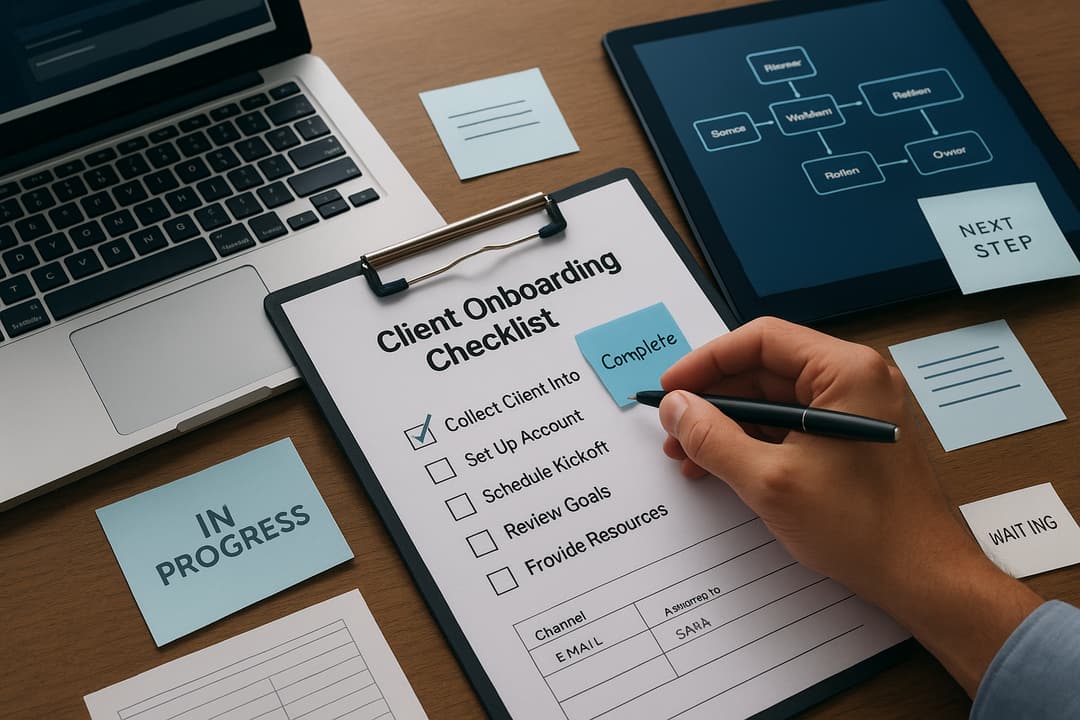
![Onboarding orchestration diagram showing Sales (Zoho), Orchestration Engine, Support (Gorgias), Zapier automations, and Airtable tracker in a client onboarding platform comparison.]
Implementation Evidence and Reliability Checks
Use these references to validate the implementation model, reliability assumptions, integration controls, and incident-response expectations for Zoho vs Gorgias: Client Onboarding Workflow Comparison before rollout.
Where client onboarding usually breaks in practice
The useful test for zoho vs gorgias for client onboarding is not whether the team can draw a clean workflow. It is whether the workflow still behaves when a record arrives late, a required field is missing, or two systems disagree about who owns the next action.
Start by writing down the first signal, the field that proves it is trustworthy, the person who can override the route, and the timestamp that shows whether the handoff happened on time. Those details make client onboarding automation reviewable instead of merely automated.
For buyers comparing zoho vs gorgias for client onboarding, the decision should center on client onboarding automation, client onboarding reporting, client onboarding exception handling, client onboarding ownership, and whether the team can inspect the audit trail without asking engineering to reconstruct the incident. zoho gorgias comparison belongs in the article only where it clarifies a real operator decision, not as a stray keyword. client onboarding platform comparison belongs in the article only where it clarifies a real operator decision, not as a stray keyword. marketing ops teams client onboarding tools belongs in the article only where it clarifies a real operator decision, not as a stray keyword.
When client onboarding needs an operating layer
Meshline fits when client onboarding is no longer a single automation but a recurring operational commitment. The warning sign is usually simple: people trust the tool when everything is normal, then leave Slack messages, spreadsheet notes, and manual fixes behind as soon as the edge case appears.
For Zoho vs Gorgias: Client Onboarding Workflow Comparison, define the authoritative data, routing rule, review checkpoint, retry policy, and evidence trail before launch. This lets the operating team adjust exceptions without turning each failure into an engineering investigation.
The decision behind Zoho vs Gorgias: Client Onboarding Workflow Comparison is whether a connector is enough or the workflow needs a maintained execution layer. When revenue, customer handoffs, reporting, billing, or CRM ownership are involved, scope auditability and recovery alongside launch speed.
- For Zoho vs Gorgias: Client Onboarding Workflow Comparison, document which system wins when two records disagree.
- For Zoho vs Gorgias: Client Onboarding Workflow Comparison, name who can pause or override execution without creating a hidden side process.
- For Zoho vs Gorgias: Client Onboarding Workflow Comparison, specify what evidence remains after a failed handoff is recovered.