
 MeshLine
AI SEO Content vs Human Writers: Where Automation Actually Helps
Compare AI drafts and human writing across research, examples, positioning, and editing to decide which content tasks benefit from automation or judgment.
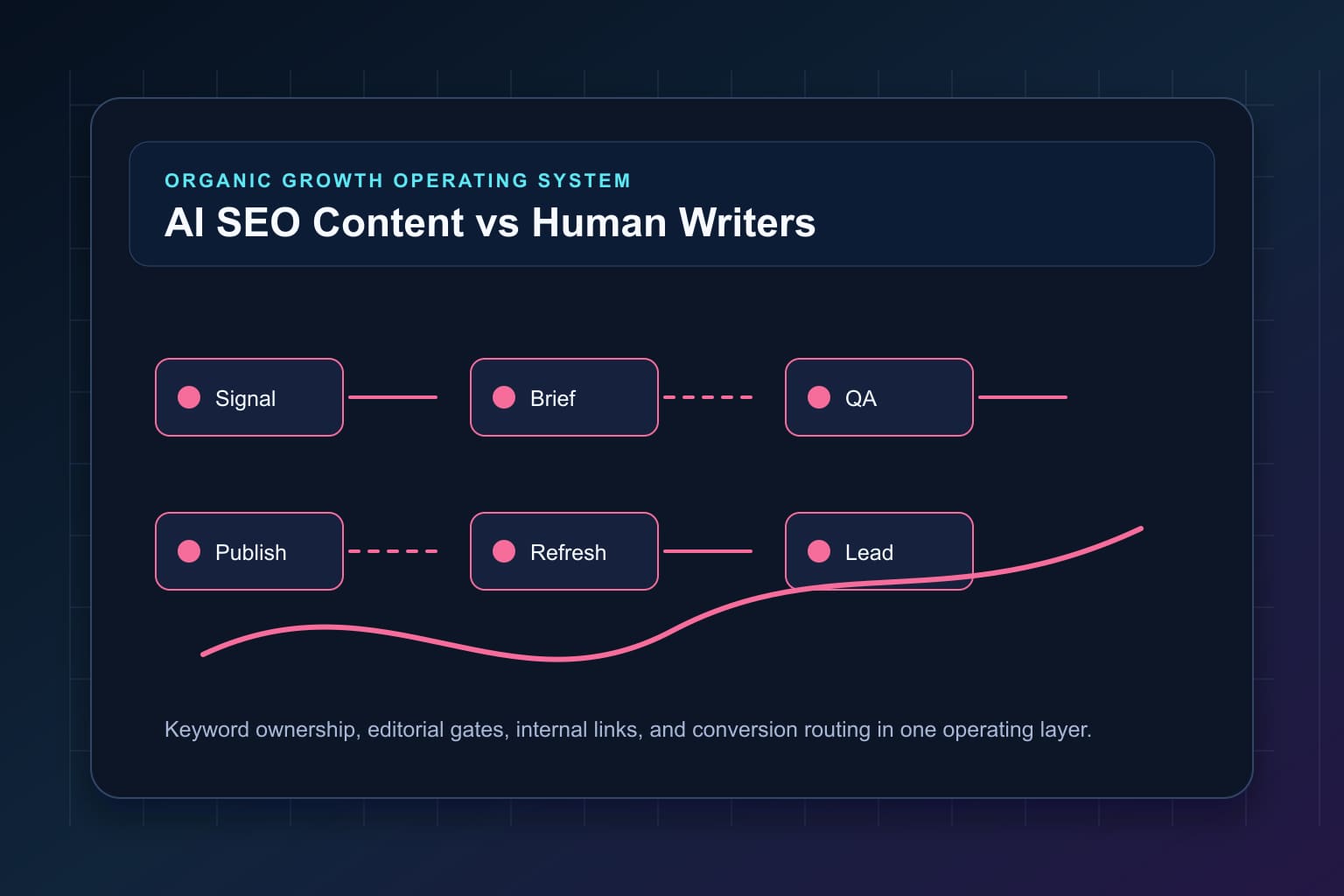
AI SEO Content vs Human Writers: Where Automation Actually Helps breaks when briefs, drafts, visuals, links, and refresh decisions live in separate queues. For operators, the painful part is the manual recovery that follows: publishing volume rises while quality and conversion paths drift, ownership is unclear, and the team has to rebuild context while the customer, lead, campaign, or report is already waiting.
Where automation gives the biggest leverage
Automation is powerful for repeatable, pattern-based work. Use it for:
- Outlines and content scaffolds: generate a standardized H2/H3 layout for a topic cluster so every page hits the same signal architecture.
- Drafting first-pass copy and variants: produce 3-5 headline and intro variants to test which tone resonates before you invest human hours.
- Data-driven snippets: pull product specs, pricing tables, or API examples from a canonical source and stitch them into pages reliably.
- Bulk refreshes: regenerate introductions, meta tags, and CTAs across hundreds of pages after a product change.
Concrete example: for a SaaS feature comparison, automation can assemble the feature matrix and 5 headline options; a human then writes the judgement line (why feature X matters for a PM who runs a tight roadmap).
What only humans should do (or at least lead)
Some tasks consistently require editorial judgment, domain experience, or a sense of positioning:

- Choosing the angle: know whether the page is a product comparison, conversion page, or thought leadership. AI offers versions; a human picks which aligns to GTM.
- Anchoring claims with examples: AI may assert “reduces churn,” but a human adds the customer vignette or the quantitative example that makes that believable.
- Synthesizing conflicting sources: when industry data disagrees, humans weigh and explain tradeoffs — that nuance is what earns links and trust.
- Naming and metaphors: good copy uses a label or metaphor that sticks with buyers. AI can suggest names; humans vet cultural fit and memorability.
Example: an AI draft of a pricing page listed features by plan. A human editor reordered them based on buyer job-to-be-done, added a one-sentence outcome per plan, and increased trial starts by 18%.
A practical hybrid workflow (step-by-step)
1) Brief the generator with constraints, not just topics. Include the target persona, top three objections, desired CTA, and one example that must appear (e.g., “Include a 2-line customer vignette about onboarding time”).
2) Generate 3 outlines and 5 intro/headline variants. Pick one outline, then ask the model to fill the draft for that outline.
3) Human pass #1: tighten positioning, add a real example, and correct any factual errors. Aim for a 20–40 minute edit per page for top-priority content.
4) Human pass #2 (light): optimize internal links, callouts, and microcopy (CTAs, meta title). Use a checklist: persona clarity, outcome statement, 1 example, 2 links to pillar pages.
5) Publish and measure: watch CTR, time on page, and conversion events tied to that content. If a page underperforms after two weeks, iterate—don’t abandon.
Checklist example you can copy: Persona | Top need | Outcome headline | 1 example | 2 internal links | CTA (trial/ebook/demo).
Measuring success and setting guardrails
Speed is valuable only if it converts. Track a small set of KPIs tied to the page’s objective:
- Discovery pages: organic clicks and CTAs to related pillar pages within 30 days.
- Decision pages: form conversions, signups, and demo requests attributed to the page.
- Engagement quality: percentage of sessions with >60 seconds or with two+ downstream pageviews.
Set limits on automation: for pages in the decision stage, require human sign-off. For discovery posts, allow larger automated batches but add a human sample check every 10 pages. Expect the first iteration to fall short on examples — prioritize those for human rewrites.
Patterns for lean teams (how to scale without hiring writers for every page)
- Template-first: lock down a handful of templates (product feature, how-to, comparison). Feed those into your generator so outputs are consistent and quicker to edit.
- Centralize examples: maintain a short library of vetted customer vignettes and metrics that editors can paste into drafts. This prevents the hollow, generic examples AI produces.
- Automate the repeatable plumbing: use your content engine to auto-fill spec tables and metadata from canonical sources so human time focuses on judgment and examples.
If you want systems rather than one-off scripts, consider how tools like the Organic Marketing Engine and our Marketing Automation Services plug into this flow to keep templates, data, and publishing consistent across a fleet of pages.
Example prompt and edit pattern you can copy
Prompt (brief): “Write an outline and a 350-word draft for a SaaS landing page targeted at product managers at mid-market startups. Key outcome: faster onboarding. Include one concrete metric and one short customer vignette (50 words). Tone: pragmatic and slightly playful.”
Edit pattern: (1) Validate the metric. (2) Swap the vignette for a real customer line from the library. (3) Replace two abstract claims with specific examples (screens, times, outcomes). (4) Add one internal link to the glossary and one to a pillar post.
For definitions and a shared vocabulary, link to the Meshline glossary. Keep topical clusters tied to your main content hub—see examples on the Meshline blog for structure ideas.
Tradeoffs and final advice
Tradeoff: speed vs. depth. If your goal is traffic spikes and experimentation, automation-first with lightweight human curation works. If the page must close deals, make human judgement mandatory. A good rule: automate the shell and the facts; invest human time in the argument.
Tradeoff: volume vs. brand voice. Large-scale automated publishing can dilute a distinctive voice. Protect your brand by defining a small set of voice rules and a mandatory human check on decision-stage pages.
Decision-stage CTA: If you want to prototype this hybrid workflow for a topic cluster or product line, book a short walkthrough and we’ll map how your templates, examples, and automation can be wired together — no noisy pitch, just the operational plan. Book a Meshline demo.
Practical operating checks
In AI SEO Content vs Human Writers: Where Automation Actually Helps, use this section to turn the workflow automation idea into a visible operating decision. The goal is to make the next handoff obvious before volume increases.
Monday morning diagnostic
For AI SEO Content vs Human Writers: Where Automation Actually Helps, start by checking the last five examples where the workflow stalled. Write down the trigger, the source system, the owner, the next action, and the moment the customer or lead received a response. If one of those fields is missing, the workflow is relying on memory.
First workflow to tighten
For AI SEO Content vs Human Writers: Where Automation Actually Helps, step 1 is to choose one handoff and make it measurable. For example, define what should happen when a qualified lead arrives, when a content brief is approved, when a CRM record changes, or when a reconciliation exception appears. The smaller the first rule, the easier it is to prove.
Checklist before you scale
- For AI SEO Content vs Human Writers: Where Automation Actually Helps, Confirm the page or workflow has one owner.
- For AI SEO Content vs Human Writers: Where Automation Actually Helps, Confirm the source system and destination system agree on the key fields.
- For AI SEO Content vs Human Writers: Where Automation Actually Helps, Add one quality check that catches bad data before it reaches a reader, lead, or customer.
- For AI SEO Content vs Human Writers: Where Automation Actually Helps, Add one relevant Meshline resource link that helps the reader take the next step.
- For AI SEO Content vs Human Writers: Where Automation Actually Helps, Review the result after seven days and improve the rule before adding more volume.
Useful references
- For AI SEO Content vs Human Writers: Where Automation Actually Helps, Google Search Central documentation
- For AI SEO Content vs Human Writers: Where Automation Actually Helps, Google Search Console Help
- For AI SEO Content vs Human Writers: Where Automation Actually Helps, Google Analytics Help