
 MeshLine
AI Blog Automation for B2B Growth Teams
Build a B2B blog workflow with AI-assisted briefs, editorial review, publishing controls, and performance checks that connect content to qualified demand.
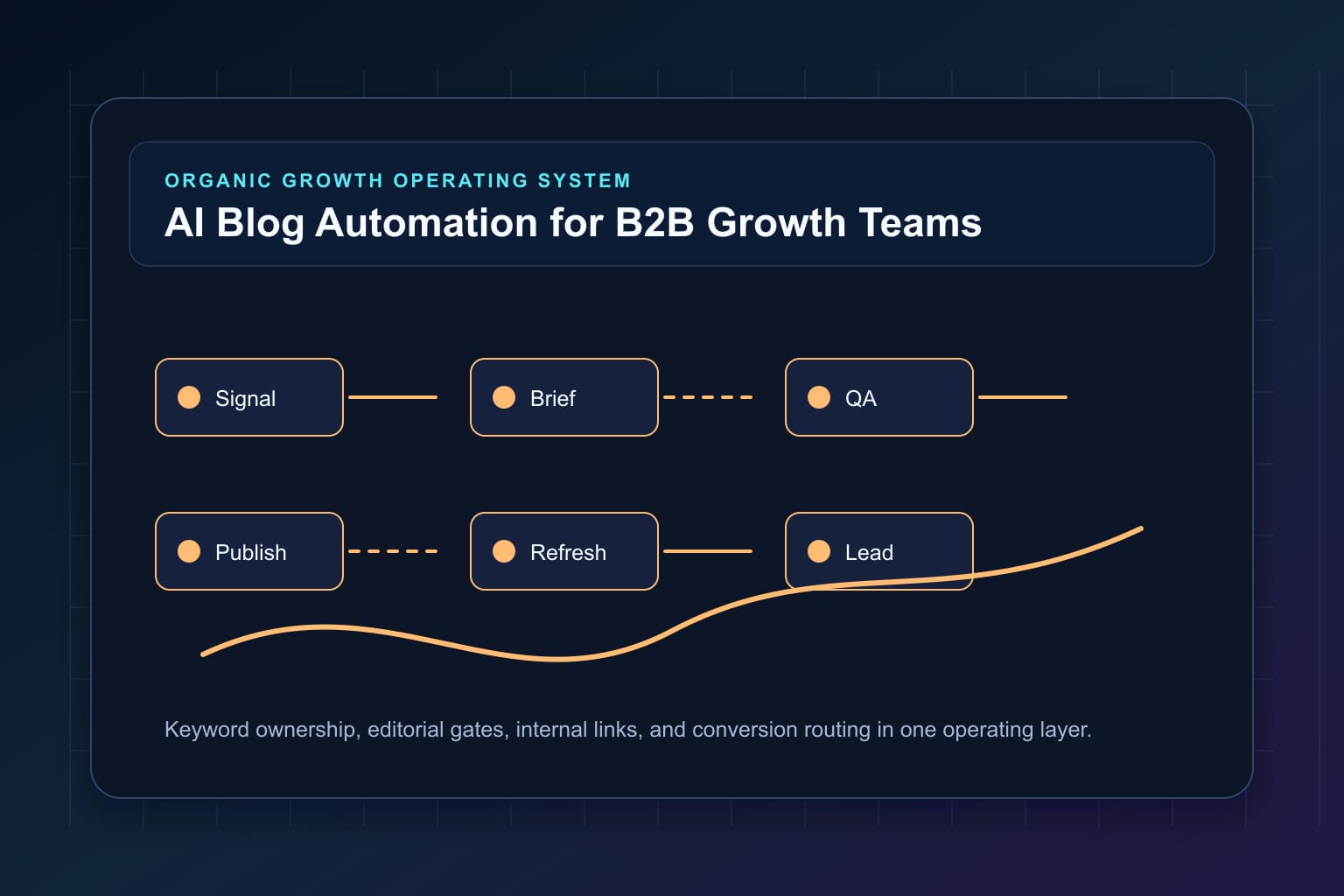
AI can generate drafts in minutes. That’s useful — until your site fills with generic pages that don’t convert or rank. The real operational win for ai blog automation for b2b growth teams is a repeatable pattern: automated draft + focused human judgment. That combo buys you speed without sacrificing positioning, examples, or conversion routing.
A Meshline point of view
Speed is a lever, not a goal. Use AI for repeatable structure, research pulls, and draft generation. Reserve humans for the parts that make B2B content work: clear positioning, concrete examples, customer language, and mapped conversion paths. In practice, one sensible rule is “automate the scaffolding, humanize the signal.”
Practical brief template you can copy
Before you ask an LLM to write, give it a brief that forces specificity. Keep it short and machine-friendly: audience, outcome, angle, examples, data sources, must-include links, CTA, and editorial constraints. Example fields:

- Audience: "Head of Revenue Ops at $5–50M ARR SaaS, cares about reducing CAC by automating lead qualification."
- Outcome: "Teach them 3 ways to use web content to pre-qualify MQLs and a one-paragraph checklist to implement."
- Angle: "Operational — how to wire forms, UTMs, and content to save two SDR hours/week."
- Examples to include: customer use case A, benchmark stat B, simple endpoint script for GA4 events."
- Required links: product page X, support doc Y (so AI includes canonical links).
- CTA: "Book a 20-minute walkthrough" (include UTM).
A tight brief avoids hollow, surface-level pages and produces drafts your editors can sharpen quickly.
Example two-touch workflow (who does what)
1) AI Draft (0.5–1 hour): outline, research pulls (stat citations with sources), first draft body, suggested headings, simple bullet list of examples and a CTA with UTM example.
2) Human Editor (20–45 minutes): critique positioning, replace two generic examples with one real customer vignette, confirm data source accuracy, tighten CTAs and add conversion wiring (form, modal, UTM).
This keeps throughput high: a single editor can process many AI drafts an afternoon while keeping pages distinct and useful.
Concrete quality checks that matter
Rejecting or fixing an AI draft should be quick. Focus on checks that drive outcomes, not blind style policing.
- Specificity: Does the post include at least one named example or a reproducible checklist? If not, add one before publishing.
- Positioning: Can you explain the one idea this page owns in one sentence? If not, rewrite the intro.
- Conversion wiring: Is there a clear CTA, tracked with UTMs and an endpoint (form, calendar link, gated demo)? If not, add it and test.
- Internal linking: Link to the relevant pillar or product pages so readers can convert or learn more (see our Organic Marketing Engine for an example of tying content to product pages).
- Citation hygiene: If a stat is used, include the source and verify it exists.
These checks are quick and directly tied to SEO and revenue outcomes.
How to wire conversions and make automation pay for itself
Automated drafting should also automate routing where possible. Practical steps:
- Append UTM parameters automatically in the AI brief for any CTA links.
- Ensure the draft includes a primary CTA above the fold and a secondary, more technical CTA lower down.
- Standardize a lightweight MQL signal: e.g., form completion + content interest tag increments lead score by X.
- Hook content events into analytics with a pre-built tracking snippet so you can measure which topics generate demos.
If you need help wiring these systems, our Marketing Automation Services are designed to implement them without adding headcount.
Measuring success and running experiments
Treat automation as an experiment platform. Track a small set of leading indicators:
- Engagement: time on page and scroll depth for pages produced by AI vs. human-only.
- Conversion rate: demo requests or MQLs per 1,000 sessions.
- SEO signals: impressions, clicks, and position changes for targeted queries.
- Quality flags: % of pages needing heavy rewrite after human review.
Run controlled tests: roll out automation on a topic cluster and compare results to baseline. Tweak prompts, examples, and human touchpoints until conversions hold or improve.
Tradeoffs and guardrails
Two common risks and how to manage them:
- Quantity-over-quality drift: If you push volume without tightening briefs and human checks, organic growth stalls. Mitigation: cap weekly outputs per editor and require a named example in each post.
- Brand voice dilution: AI can produce inconsistent tone. Mitigation: store a short voice guide in the brief and use a quick human pass focused only on voice + CTA.
Every automation program must balance throughput with maintenance. Expect to invest initially in templates and one editor-hour per X drafts; that cost is often lower than hiring full-time writers and keeps quality consistent.
Where teams get stuck and how to unblock
Common friction points: unclear ownership of CTAs, missing data sources, and lack of tracking. Fixes that work in practice:
- Create a single brief template stored with your content requests.
- Use a lightweight queuing sheet so editors can batch reviews.
- Pair automation with a productized service for initial wiring — it cuts the time to measurable outcomes. If you want a hand with implementation, you can book a Meshline demo to see how we connect content to conversions.
Final operational checklist
Before you publish an AI-assisted post, confirm: brief filled, one concrete example added, CTA with UTM present, internal link to a pillar/product, tracking event implemented, and a one-sentence positioning statement in the intro. These checks turn AI drafts into growth infrastructure.
If you're building an automation program but want a reference implementation, start by mapping one cluster, automate the draft and research pulls, and run a two-week pilot with a single editor. For product-led teams curious about tooling, explore our Organic Marketing Engine and our implementation options. When you’re ready to move from pilot to scale, our Marketing Automation Services team can help operationalize conversion wiring without expanding headcount.
You can also read more operational posts and case studies on the Meshline blog, or check definitions in the Meshline glossary.
Practical operating checks
In AI Blog Automation for B2B Growth Teams, use this section to turn the workflow automation idea into a visible operating decision. The goal is to make the next handoff obvious before volume increases.
Monday morning diagnostic
For AI Blog Automation for B2B Growth Teams, start by checking the last five examples where the workflow stalled. Write down the trigger, the source system, the owner, the next action, and the moment the customer or lead received a response. If one of those fields is missing, the workflow is relying on memory.
First workflow to tighten
For AI Blog Automation for B2B Growth Teams, step 1 is to choose one handoff and make it measurable. For example, define what should happen when a qualified lead arrives, when a content brief is approved, when a CRM record changes, or when a reconciliation exception appears. The smaller the first rule, the easier it is to prove.
Checklist before you scale
- For AI Blog Automation for B2B Growth Teams, Confirm the page or workflow has one owner.
- For AI Blog Automation for B2B Growth Teams, Confirm the source system and destination system agree on the key fields.
- For AI Blog Automation for B2B Growth Teams, Add one quality check that catches bad data before it reaches a reader, lead, or customer.
- For AI Blog Automation for B2B Growth Teams, Add one relevant Meshline resource link that helps the reader take the next step.
- For AI Blog Automation for B2B Growth Teams, Review the result after seven days and improve the rule before adding more volume.
Useful references
- For AI Blog Automation for B2B Growth Teams, Google Search Central documentation
- For AI Blog Automation for B2B Growth Teams, Google Search Console Help
- For AI Blog Automation for B2B Growth Teams, Google Analytics Help